Choosing a new mattress is one of the most consequential purchasing decisions you’ll make for your health and daily well-being. You spend roughly a third of your entire life in bed, and the surface you sleep on directly influences your sleep quality, spinal alignment, joint health, body temperature, and even your mood the next morning. Yet despite how important the decision is, most people walk into a mattress store — or scroll through an online retailer — without a clear understanding of how the two most popular mattress types actually differ in construction, feel, performance, and long-term value.
Memory foam and innerspring mattresses dominate the market, each with decades of development behind them and millions of loyal users. They operate on completely different principles, serve different types of sleepers exceptionally well, and have genuinely distinct advantages and disadvantages that go far beyond surface-level comparisons. This guide breaks down everything you need to know — in real, practical terms — so you can make an informed decision that will pay dividends in quality sleep for years to come.
Understanding How Each Mattress Type is Built
Before comparing performance characteristics, it helps to understand what’s actually inside each type of mattress. The construction drives everything else — the feel, the support, the heat retention, the motion isolation, and the lifespan.
How Memory Foam Mattresses Are Constructed
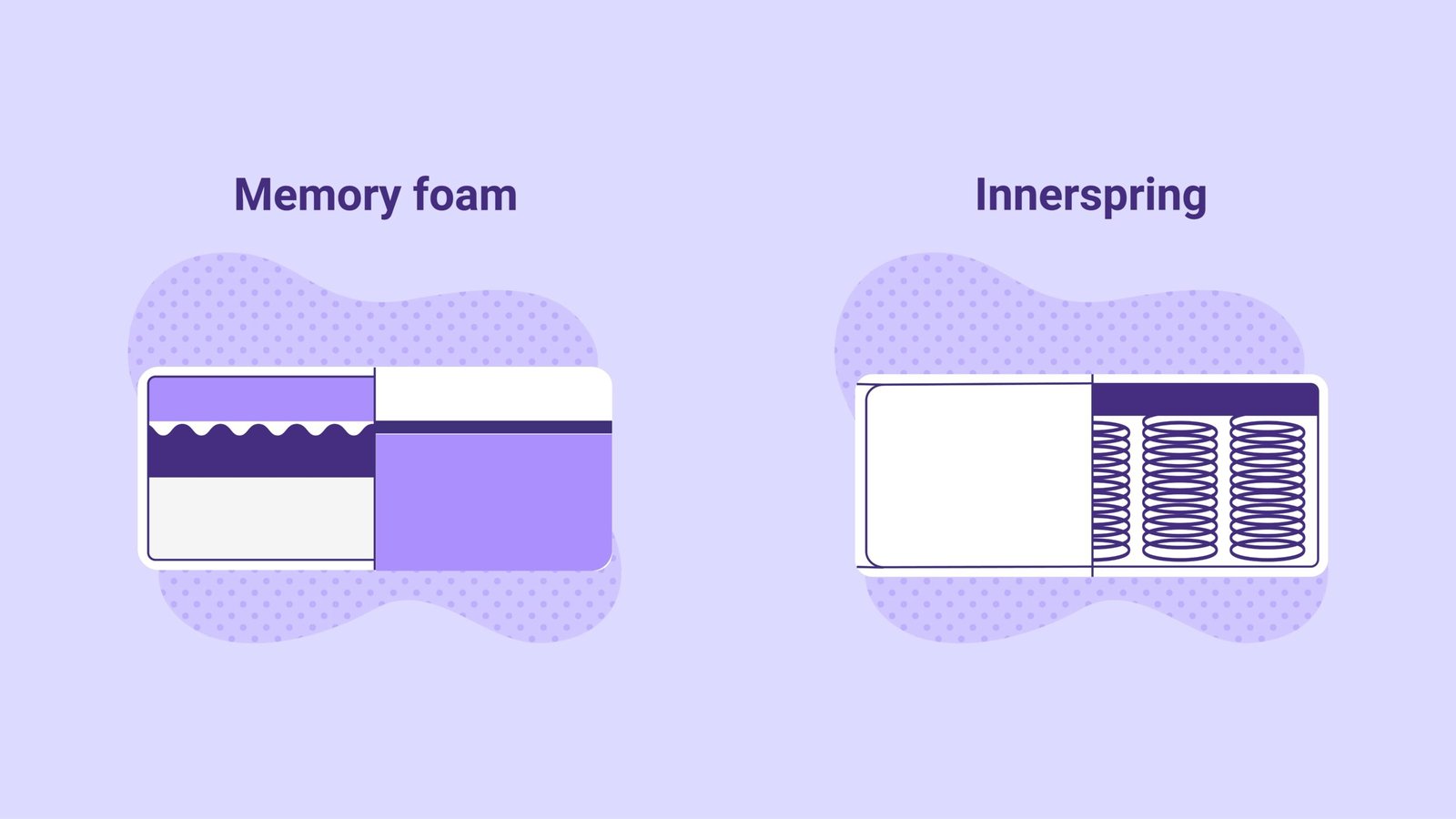
Memory foam mattresses are built entirely from layers of foam — there are no springs, coils, or metal components of any kind. A typical memory foam mattress consists of three functional layers stacked on top of each other:
The top comfort layer is made from viscoelastic polyurethane foam — the actual “memory foam” that most people think of when they hear the category name. NASA originally developed this material in the 1960s to improve crash protection in aircraft seats. It’s temperature- and pressure-sensitive, meaning it softens when it comes into contact with the warmth of your body and slowly conforms to your exact shape under pressure. When you remove the pressure (i.e., when you get up), the foam slowly returns to its original shape — hence the “memory” in the name.
Below the comfort layer sits a transition layer, typically made from slightly firmer polyurethane foam. This layer acts as a buffer between the soft, conforming comfort layer above and the firmer support layer below. It prevents the sleeper from “bottoming out” — sinking so deeply into the foam that they feel the hard support core beneath them.
The base or support layer is made from high-density polyurethane foam. This is the structural foundation of the mattress — it’s firm, durable, and provides the load-bearing support that keeps your spine properly aligned. The quality and density of this base layer are among the most important indicators of a memory foam mattress’s long-term durability.
Modern memory foam mattresses have evolved significantly from the original single-layer designs. Today’s top-tier options may include gel-infused memory foam (to address heat retention), copper-infused foam (for antimicrobial properties and thermal conductivity), plant-based foam (for reduced chemical off-gassing), perforated foam layers (for airflow), and proprietary foam blends developed by individual manufacturers.
How Innerspring Mattresses Are Constructed
Innerspring mattresses are built around a core of metal coils or springs that provide the primary support structure. This technology has been around since the late 19th century, making innerspring the original modern mattress design. The construction has evolved dramatically since then, but the fundamental principle remains: metal springs under compression provide pushback support, keeping the sleeper’s body elevated and aligned.
The coil system is the defining feature. There are several different coil designs used in modern innerspring mattresses, and the type of coil has a major impact on the mattress’s feel and performance:
Bonnell coils are the oldest and most basic design — hourglass-shaped coils interconnected in a grid. They’re durable and inexpensive, but they readily transfer motion across the mattress because all the coils are linked together.
Offset coils are an updated version of the Bonnell design with squared-off tops and bottoms that create a hinging action. They conform slightly better to body contours than Bonnell coils and transfer somewhat less motion.
Continuous coils use a single piece of wire formed into S-shapes across the entire width of the mattress. Like Bonnell coils, they’re highly interconnected and thus prone to motion transfer.
Pocketed coils (also called Marshall coils or individually wrapped coils) are the gold standard in modern innerspring mattresses. Each coil is individually wrapped in a fabric pocket, allowing it to compress independently of the others. This dramatically reduces motion transfer compared to interconnected coil systems and allows for much better contouring to body shapes.
Above the coil layer, innerspring mattresses have comfort layers — typically made from foam, fiberfill, cotton batting, wool, latex, or combinations of these materials. The thickness and quality of these comfort layers vary enormously between budget and premium innerspring mattresses. A cheap innerspring might have barely an inch of low-density foam on top of the coils, while a luxury innerspring (sometimes called a luxury firm or pillow-top mattress) might have several inches of high-quality materials, including memory foam, latex, and natural fibers in the comfort layers.
The Core Differences in Sleep Experience
With the construction context established, here’s how these structural differences translate into the experience of sleeping on each type:
Pressure Relief and Body Contouring
This is where memory foam has a clear, well-documented advantage. The viscoelastic properties of memory foam allow it to conform precisely to the contours of your body — filling in the spaces beneath your lumbar curve, cradling your shoulders, and distributing your weight across the largest possible surface area. This pressure distribution dramatically reduces pressure at any single point, which is why orthopedic specialists and physical therapists for people with joint pain, hip pain, shoulder pain, and pressure sores consistently recommend memory foam.
If you’ve ever woken up with a numb arm, a tingling hip, or shoulder soreness from lying on your side, pressure point buildup during sleep is almost certainly the cause. Memory foam addresses this directly.
READ ALSO: Best Bed Frames for Heavy People (Weight-Tested Guide)
Innerspring mattresses, even high-quality pocketed-coil designs, cannot match this level of pressure relief. Coils push back against the body from below with relatively concentrated force — the contact points where your body presses most firmly into the mattress receive proportionally more pushback. The comfort layers on top of the coils can soften this somewhat, but the fundamental mechanical difference remains. Innerspring mattresses provide support; memory foam provides conforming support.
For side sleepers especially, this difference is significant. Side sleeping concentrates a great deal of weight on relatively small contact points — the hip and shoulder — and memory foam’s ability to cushion these areas is one of the primary reasons it’s so widely preferred by side sleepers.
Motion Isolation
If you share a bed with a partner, motion transfer is one of the most practically important performance characteristics in a mattress. When one partner moves, rolls over, or gets out of bed, how much of that movement travels across the mattress and disturbs the other sleeper?
Memory foam wins this comparison decisively. Because foam doesn’t have connected mechanical components, movement in one area of the mattress stays in that area. The foam absorbs and dampens the vibration locally. Many couples who switch from an innerspring to a quality memory foam mattress report immediate, dramatic improvements in sleep quality simply because they stop waking each other up during the night.
Innerspring mattresses, particularly those with interconnected coil systems (Bonnell, continuous), are notorious for motion transfer. When one side of a Bonnell coil mattress is compressed, the energy transfers through the connected wire grid to the other side. Pocketed coil innersprings perform meaningfully better in this regard — individually wrapped coils can absorb some motion before it travels across the mattress — but even the best pocketed coil systems don’t match the motion isolation of a quality memory foam mattress.
For couples with mismatched sleep schedules, partners who move frequently during sleep, or anyone sharing a bed with a restless sleeper, this is a critical consideration that often tips the decision firmly toward memory foam.
Temperature Regulation and Sleep Heat
This is the area where innerspring mattresses have a genuine, structural advantage over traditional memory foam — and it’s an advantage that matters a great deal for many sleepers.
Traditional memory foam is a dense, closed-cell material that traps body heat. The same material properties that make it slow to respond and conforming also make it thermally insulating. Heat builds up in the foam around your body throughout the night and isn’t easily dissipated. This is the most common complaint about memory foam mattresses, and it’s particularly problematic for people who naturally sleep hot, those who live in warm climates, and anyone going through hormonal changes that affect body temperature regulation.
Innerspring mattresses, by contrast, have substantial open space within their coil systems through which air can circulate freely. When you move on an innerspring mattress, the coils compress and release, acting almost like bellows that gently push air through the mattress. The comfort layers on top are typically thinner and less thermally insulating than the foam layers in a memory foam mattress. The result is a meaningfully cooler sleep surface.
The mattress industry has worked hard to address memory foam’s heat retention problem, and modern solutions are genuinely effective, though they add to the cost. Gel-infused memory foam incorporates gel beads or swirled gel into the foam to absorb and dissipate heat. Open-cell foam formulations modify the cellular structure of the foam to allow more airflow. Phase-change materials embedded in mattress covers or comfort layers absorb excess heat. Copper-infused foams provide enhanced thermal conductivity. The best modern memory foam mattresses using these technologies sleep significantly cooler than traditional memory foam, but they still typically don’t match the passive cooling of a well-constructed innerspring.
If you frequently wake up hot, sleep with heavy blankets year-round, or have a partner whose body heat contributes to an already warm sleep environment, this is a major factor to weigh. For hot sleepers, an innerspring or a hybrid (more on this later) will often deliver more comfortable overnight temperatures than a memory foam mattress.
Edge Support
Edge support refers to how much the mattress compresses when you sit or sleep near the edge — and it matters more than many people realize. Good edge support makes it easier to get in and out of bed (significant for elderly people or those with mobility challenges), maximizes the usable sleep surface for couples who would otherwise avoid rolling to the edge, and contributes to the overall feeling of a mattress being stable and high-quality.
Innerspring mattresses generally have better natural edge support than memory foam mattresses. The coil system near the perimeter provides firm, consistent pushback, and many quality innerspring mattresses add additional perimeter reinforcement with thicker gauge coils or foam encasement around the coil edge.
Memory foam compresses readily under concentrated pressure, which means sitting on the edge of a memory foam mattress produces significant compression. Over time, the edges of memory foam mattresses can develop permanent compression in the areas where you regularly sit on the edge. Better-quality memory foam mattresses address this with high-density foam perimeter walls or steel frame edge support systems, but edge support remains a relative weakness of the category.
For someone who sits on the edge of the bed frequently — putting on shoes in the morning, sitting up to read, or helping a child get in and out of bed — this is worth considering. For pure sleepers who sleep in the center of the mattress and rarely sit on the edge, it’s less important.
Bounce and Ease of Movement
Memory foam’s conforming, slow-response character is a double-edged sword. The same properties that provide exceptional pressure relief and motion isolation make it harder to move around on. When you’re cradled in memory foam, changing positions requires more effort — you have to lift out of the impression your body has made rather than simply rolling across a responsive surface. For people who move frequently during sleep or who change positions as part of managing pain (some people with arthritis, for example, shift positions deliberately throughout the night), this resistance can be a genuine irritant.
Memory foam’s lack of bounce also has implications for couples who have sexual activity in mind — the absence of responsive pushback that many people prefer for intimacy is one of the most consistent complaints about memory foam beds.
Innerspring mattresses are highly responsive and bouncy by nature. The coils compress and release quickly under load, providing immediate pushback rather than the gradual conforming response of foam. This responsiveness makes it much easier to change positions, move to the edge of the bed, and generally navigate the sleep surface. For combination sleepers who switch between back, side, and stomach positions during the night, the easier repositioning of an innerspring can translate into better sleep.
Durability and Longevity
Over the full ownership lifetime of a mattress, durability is one of the most important economic considerations. A cheap mattress that lasts five years costs more per year of use than an expensive mattress that lasts fifteen years.
Quality memory foam mattresses, when constructed with high-density foam (4 PCF or higher for the comfort layers, 1.8 PCF or higher for the base), can last 8 to 12 years with proper care. The primary failure mode for memory foam is compression — the foam loses its ability to fully recover its original shape, leaving permanent body impressions. These impressions reduce the mattress’s ability to provide proper support and lead to the “rolling toward the center” feeling that indicates a memory foam mattress is nearing the end of its life.
The density of the foam is the single most important predictor of memory foam longevity. Low-density memory foam (under 3 PCF) breaks down significantly faster than high-density foam. Budget memory foam mattresses frequently use low-density foams to hit lower price points, which is why you see dramatic differences in durability between a $300 memory foam mattress and a $1,500 one even if they feel similar initially.
Quality innerspring mattresses, particularly those with pocketed coils, can last 8 to 12 years as well, with the better-built options lasting even longer. The coil system itself is quite durable — individual coils can deform or lose tension over time, but the metal construction is inherently robust. The limiting factor in innerspring longevity is usually the comfort layers rather than the coil system itself. The foam and fiber comfort layers on top of the coils break down and compress over time, leading to reduced cushioning and an increasingly firm sleep surface.
High-gauge, high-turn-count coil systems (more coils, heavier gauge wire) in quality pocketed coil innersprings can outlast the foam comfort layers significantly, leading some manufacturers to offer comfort layer replacement programs as part of extended warranties.
Both mattress types benefit significantly from using a mattress foundation or base appropriate for the design, rotating the mattress regularly (for double-sided innersprings), and using a quality mattress protector to prevent liquid damage and soiling.
Pricing Across the Spectrum
Both memory foam and innerspring mattresses are available across a wide price range, from budget options under $500 to luxury mattresses over $5,000. However, the price distribution differs somewhat between the categories.
Memory foam mattresses offer excellent value at the mid-range price point — roughly $800 to $1,500 for a queen. The direct-to-consumer online mattress brands (Nectar, Casper, Purple, Leesa, and many others) primarily sell memory foam and have driven prices down considerably over the past decade through competitive market pressure and efficient distribution. You can get a genuinely excellent, high-density memory foam mattress from a reputable brand in this price range.
Innerspring mattresses have a similarly wide price range, but the pricing dynamics are somewhat different. Entry-level innerspring mattresses (Bonnell or continuous coil systems with thin comfort layers) can be found for $300 to $600. However, the quality jump as you move into pocketed coil systems with substantial, high-quality comfort layers is significant and corresponds to a meaningful price increase — quality pocketed coil innersprings typically start at around $800, and the premium options can run $2,000 to $5,000 and above for luxury hotel-style pillow-top designs.
The key insight for budget shoppers is that the quality floor for memory foam at a given price point is arguably higher than for innerspring — a $700 memory foam mattress from a reputable brand can be genuinely good, while a $700 innerspring may have compromised both the coil system and the comfort layers. Conversely, at the luxury end, innerspring and hybrid designs often represent the pinnacle of mattress engineering and craftsmanship.
Who Should Buy a Memory Foam Mattress?
Memory foam is likely the better choice for you if you match several of these profiles:
Side sleepers benefit enormously from memory foam’s pressure-relieving properties. The hip and shoulder pressure points of side sleeping are cushioned and distributed by memory foam in a way that coils simply cannot replicate. If you wake up with shoulder soreness, hip discomfort, or numbness in your arm or leg after sleeping on your current mattress, memory foam is very likely to help.
Couples with different sleep schedules or restless partners will appreciate memory foam’s superior motion isolation. If your partner getting up for a 5 AM shift regularly wakes you up, switching to memory foam is one of the fastest ways to solve that problem.
People with chronic joint or back pain often find memory foam’s contouring support provides meaningful relief. The pressure distribution reduces stress on painful joints, and the full-body contouring supports natural spinal alignment. Many people with arthritis, fibromyalgia, and chronic lower back pain report significant improvement after switching to memory foam.
Light sleepers who are disturbed by the sounds of their own mattress or their partner’s movement will find memory foam’s silent surface and motion isolation benefits particularly valuable.
Budget-conscious shoppers who want reliable quality have excellent options in the mid-range memory foam market, particularly from the direct-to-consumer online brands.
Who Should Buy an Innerspring Mattress?
Innerspring is likely the better choice if you identify with these profiles:
Hot sleepers will find innerspring’s superior airflow and cooler sleep surface a meaningful quality-of-life improvement. If you regularly wake up sweating or kicking off covers, an innerspring’s passive ventilation can make a real difference.
Stomach sleepers generally need firmer support to prevent their hips from sinking too deeply into the mattress, which would put excessive stress on the lumbar spine. Firmer innerspring mattresses provide the kind of even, firm support surface that keeps stomach sleepers’ spines properly aligned.
People who value ease of movement — combination sleepers who switch positions frequently, people who move consciously to manage pain, and couples who prefer the responsive feel of their mattress — will find innerspring’s bounce and responsiveness preferable.
Those who prefer to sleep “on top of” the mattress rather than “in” it will find the responsive, less-enveloping feel of innerspring more comfortable. Mattress preference is partly psychological — some people simply feel claustrophobic or uncomfortable in the cradling embrace of memory foam, and innerspring’s more neutral, on-top-of-the-surface feel suits them better.
Heavier sleepers often find that quality innerspring or hybrid mattresses provide better sustained support than memory foam, which can compress excessively under higher body weights. High-density memory foam from brands that specifically engineer for plus-size sleepers is an exception, but for heavier people, the coil system’s mechanical support is often more reliable than foam-based support.
The Rise of Hybrid Mattresses: The Best of Both Worlds?
No discussion of memory foam versus innerspring would be complete without addressing the rapidly growing hybrid mattress category. Hybrids combine a pocketed coil support system (the structural advantage of innerspring) with substantial memory foam or latex comfort layers on top (the pressure-relief advantage of foam). The result addresses the primary weaknesses of each pure category: hybrids sleep cooler than pure memory foam because the coil layer promotes airflow, and they provide better pressure relief than pure innerspring because of the substantial foam comfort layers.
The trade-off is that price — quality hybrids are typically more expensive than pure foam or pure innerspring options at comparable quality levels, because you’re essentially paying for two sophisticated systems in one mattress. A quality queen hybrid from a reputable brand will typically cost $1,200 to $2,500.
For sleepers who share beds with partners whose needs differ from their own, or for anyone who feels they fall between the two categories in the comparisons above, a hybrid is worth serious consideration. The pocketed coil base provides the responsive, bouncy feel and airflow of an innerspring, while the memory foam comfort layers provide the pressure relief and motion dampening that foam does best.
Making the Final Decision: A Framework
If you’ve read through this guide and still feel uncertain, use this decision framework to narrow your choice:
Start with your primary sleep position. Side sleepers should lean toward memory foam or a soft hybrid. Stomach sleepers should lean toward an innerspring or a firm hybrid. Back sleepers can generally do well with either type, depending on their secondary preferences.
Next, consider your thermal profile. Do you regularly sleep hot? If yes, lean toward an innerspring or a hybrid with good airflow. Do you sleep cold or temperature-neutral? Memory foam’s heat retention won’t be a problem for you.
Then consider whether you share a bed. Solo sleepers can prioritize their own preferences without concern for a partner’s sleep patterns. Couple sleepers should weigh motion isolation heavily if there’s any significant difference in sleep schedules, body weight, or movement patterns between partners.
Finally, consider your budget and the long-term economics. At the entry-level price point, mid-range memory foam from reputable online brands offers the best quality-for-dollar ratio. At the luxury end, either category can deliver exceptional performance — your preference for feel and temperature regulation should be the deciding factor.
Frequently Asked Questions
How long do memory foam and innerspring mattresses last?
Both types, when constructed with quality materials, typically last 8 to 12 years. Cheap versions of both types — low-density memory foam and thin-comfort-layer innersprings — may need replacement in as few as 5 years.
Can I use any base with either mattress type?
Memory foam requires a solid, flat, non-spring foundation — slatted platform frames work well as long as slats are no more than 3 inches apart. Most innerspring mattresses can work with box springs, platform frames, or adjustable bases (though check your specific model’s requirements).
Is memory foam good for back pain?
Memory foam is frequently recommended for back pain because of its pressure-relieving contouring. However, the right firmness level matters — a memory foam mattress that’s too soft won’t provide adequate lumbar support. Medium-firm memory foam is generally considered optimal for most back pain sufferers, though individual needs vary.
Do innerspring mattresses need to be flipped?
Single-sided innerspring mattresses (the majority of modern designs) should not be flipped but should be rotated 180 degrees head-to-foot every 3 to 6 months. Traditional double-sided innersprings can and should be both rotated and flipped.
What’s the best mattress type for couples?
For most couples, a hybrid or a high-quality memory foam mattress offers the best combination of motion isolation, pressure relief for different body types, and temperature regulation. If one partner sleeps very hot and the other sleeps cold, a hybrid with advanced cooling features is often the ideal compromise.
Are innerspring mattresses better for sex?
The responsive, bouncy nature of innerspring and hybrid mattresses is generally preferred for sexual activity compared to the slow-response, non-bouncy feel of pure memory foam. If this is a consideration, lean toward innerspring or hybrid.
Conclusion
There is no universally “better” mattress type between memory foam and innerspring — there is only the better mattress type for your specific combination of sleep position, body type, temperature preferences, partnership dynamics, budget, and personal feel preferences. Memory foam offers unmatched pressure relief, motion isolation, and conforming support, making it ideal for side sleepers, light sleepers, and couples with mismatched schedules. Innerspring offers superior airflow, responsive feel, ease of movement, and typically better edge support, making it ideal for hot sleepers, stomach sleepers, and those who prefer sleeping “on top” of their mattress rather than “in” it.
If you’re genuinely torn between the two — or if your needs seem to pull you in both directions simultaneously — a quality hybrid mattress deserves your serious consideration. The hybrid category has matured significantly and now offers options across a wide range of price points that genuinely deliver the combined benefits of both technologies.
Whatever direction you choose, prioritize construction quality over marketing language, check return policies before you buy (most reputable brands now offer 100-night or longer sleep trials), and remember that the mattress that helps you wake up rested, pain-free, and ready for the day is the right mattress for you — regardless of what category it falls into.