What Is PMI and Why Do You Pay It?
If you bought your home with less than 20% down, there’s a good chance you’re writing an extra check every month — one that doesn’t go toward your mortgage balance, doesn’t build equity, and doesn’t benefit you in any direct way. That charge is private mortgage insurance, commonly known as PMI.
PMI is a policy that protects your lender — not you — if you default on your loan. Because you came to the table with less equity, the lender considers you a higher-risk borrower, and PMI is their financial safety net. You pay the premiums; they collect the protection.
The cost isn’t trivial. According to industry estimates, PMI typically runs between 0.5% and 1.5% of the original loan amount per year. On a $300,000 mortgage, that’s anywhere from $1,500 to $4,500 annually — or $125 to $375 every single month — funneled to an insurance company that provides you zero direct benefit.
For many homeowners, eliminating PMI represents one of the most impactful financial moves they can make. And one of the most powerful tools for doing it is refinancing.
But refinancing isn’t free, and it isn’t always the right move. This guide walks you through exactly when refinancing to remove PMI makes sense, how to calculate whether the math works in your favor, and what steps to take to make it happen.
How PMI Works: The Basics Every Homeowner Should Know
Before diving into the refinancing strategy, it’s worth understanding how PMI is structured so you know what you’re dealing with.
How PMI Is Calculated
PMI is calculated as a percentage of your original loan amount — not your remaining balance. This means even as your loan balance drops, your PMI premium doesn’t automatically shrink with it (at least not until it’s canceled entirely).
The exact rate you pay depends on several factors:
- Your loan-to-value (LTV) ratio at the time of purchase
- Your credit score — the higher your score, the lower your PMI rate
- The loan term — 15-year loans typically carry lower PMI than 30-year loans
- The type of loan — fixed-rate versus adjustable-rate mortgages can have different PMI structures
- The lender and PMI provider they use
A borrower with excellent credit who puts down 15% will pay significantly less in PMI than one who puts down 5% with a lower credit score.
When Does PMI Automatically Cancel?
Under the Homeowners Protection Act of 1998, lenders are required to automatically cancel PMI once your loan balance reaches 78% of the original purchase price — as long as your payments are current. You can also request cancellation once your balance reaches 80% of the original value.
The key phrase here is original purchase price. If your home has appreciated significantly since you bought it, you could have well over 20% equity based on current market value, yet still be paying PMI because the lender calculates the threshold based on the price you paid — not what your home is worth today.
This is exactly where refinancing becomes a powerful strategy.
Why Refinancing Is a PMI Removal Strategy
When you refinance, you’re essentially taking out a brand-new loan. That new loan is underwritten based on your home’s current appraised value, not the original purchase price. If your home has appreciated — or if you’ve paid down enough of your balance — the new loan may have an LTV ratio below 80%, which means no PMI requirement at all.
Here’s a simplified example:
- Original purchase price: $250,000
- Down payment: 5% ($12,500)
- Original loan amount: $237,500
- Current loan balance after 4 years: $220,000
- Current appraised value: $310,000
- Current LTV: $220,000 ÷ $310,000 = 70.9%
In this scenario, the homeowner still has PMI based on the original lender’s calculation — but if they refinance, the new loan is evaluated against $310,000. At 70.9% LTV, there’s no PMI on the new loan. The homeowner saves hundreds per month, potentially for decades.
When Does Refinancing to Remove PMI Actually Make Sense?
Refinancing costs money. Closing costs on a refinance typically run between 2% and 5% of the loan amount — on a $220,000 loan, that could be anywhere from $4,400 to $11,000 out of pocket. So the decision isn’t automatic just because you can remove PMI. You need to make sure the savings justify the cost.
Here are the specific conditions under which refinancing to remove PMI makes the most financial sense:
1. Your Home Has Appreciated Significantly
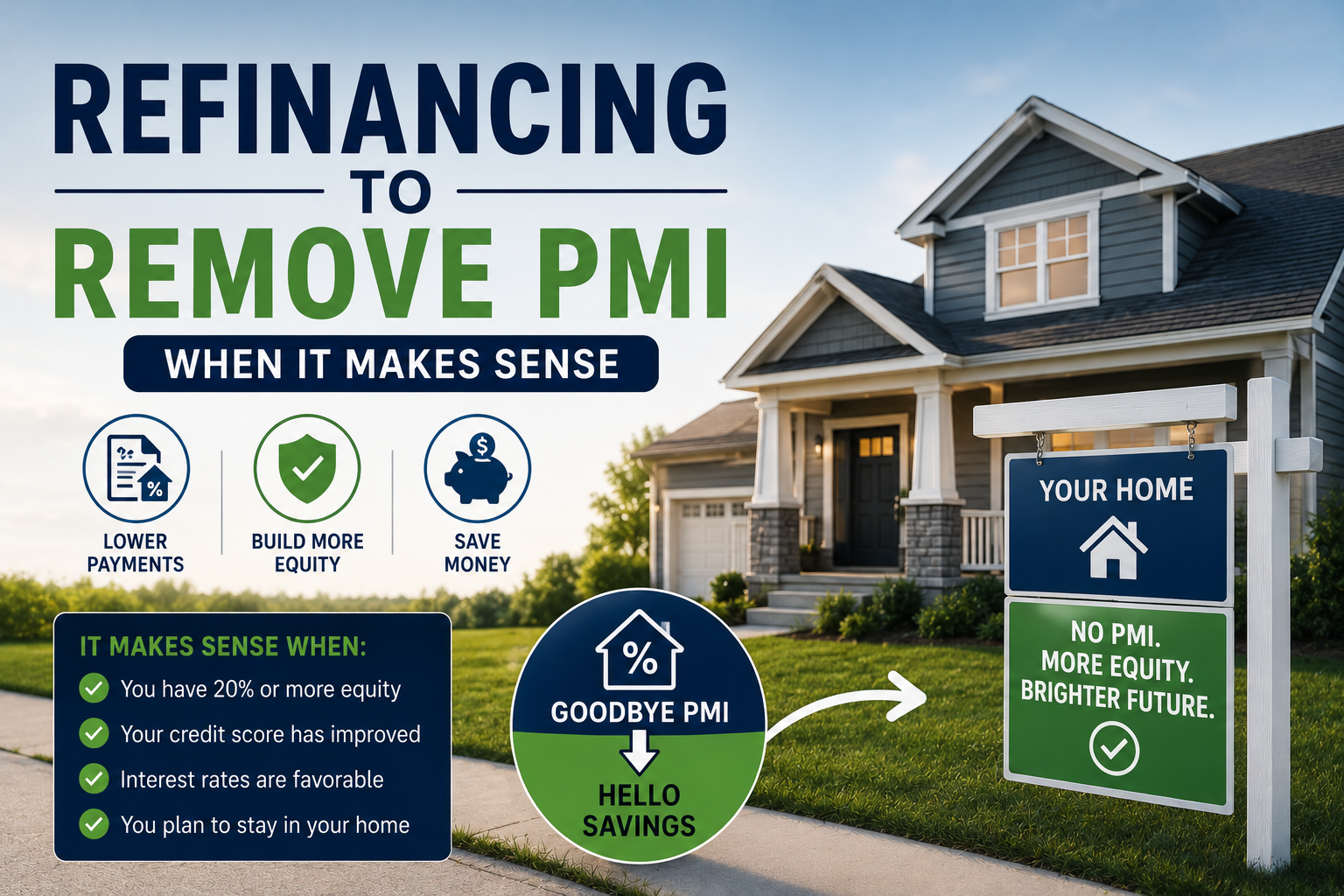
This is the most common catalyst. In a strong real estate market, homes can gain 10%, 20%, or even 30% in value within a few years of purchase. If you bought with 10% down and your home’s value has jumped 20%, you now have substantially more than 20% equity — potentially enough to refinance into a no-PMI loan even without years of payments behind you.
Use this quick equity check:
Your equity % = (Current Home Value − Current Loan Balance) ÷ Current Home Value
If that number is 20% or higher, you’re likely a candidate for a PMI-free refinance.
2. You’ve Paid Down Your Balance Considerably
Even in a flat housing market, consistent mortgage payments chip away at your balance over time. Homeowners who’ve been in their home for 7–10 years on a 30-year mortgage may have reduced their balance enough — especially combined with modest appreciation — to cross the 80% LTV threshold on a refinance.
3. Refinance Rates Are Favorable
Removing PMI is a great bonus, but if the new interest rate is higher than your current rate, the math can work against you. The ideal refinance-to-remove-PMI scenario is one where:
- You can eliminate PMI and lower your interest rate, or
- The PMI savings are large enough to offset a slightly higher rate
Run both numbers before committing. A lower rate plus PMI elimination is a double win that can dramatically reduce your monthly payment.
4. You Plan to Stay in the Home Long Enough
This is the break-even calculation — one of the most important analyses any homeowner should do before refinancing.
Break-even formula:
Break-even point (months) = Total Closing Costs ÷ Monthly Savings
If your closing costs are $6,000 and your monthly savings (PMI eliminated + rate reduction) are $300, your break-even point is 20 months. If you plan to stay in the home for at least 20 more months, refinancing makes financial sense. If you’re planning to sell in a year, it probably doesn’t.
5. Your Credit Score Has Improved Since Origination
Many homeowners who purchased with lower credit scores have since improved their financial profile. A significantly better credit score can mean:
- A lower interest rate on the refinance
- Lower PMI rates (if any PMI is still required)
- Better loan terms overall
If your score was 640 when you bought and is now 740, your refinancing picture looks very different — and much more favorable.
6. Your Debt-to-Income Ratio Is Healthy
Lenders evaluating a refinance application want to see a debt-to-income (DTI) ratio of 43% or lower, though some loan programs allow up to 50%. If your income has grown since you bought your home, your DTI has likely improved, making you a stronger refinance candidate.
When Refinancing to Remove PMI Does NOT Make Sense
Just as important as knowing when to refinance is knowing when to hold off. Here are the scenarios where refinancing for PMI removal can be a costly mistake:
You Don’t Have Enough Equity Yet
If your current LTV is still above 80% based on today’s home values, refinancing won’t eliminate PMI — it’ll just reset your loan with a new set of closing costs. Wait until appreciation or paydown gets you to the 80% threshold.
Refinance Rates Are Significantly Higher Than Your Current Rate
If you’re locked in a historically low mortgage rate (say, 3.0–3.5%) and current rates are 6.5–7%, refinancing to remove PMI is rarely worth it. The rate increase would cost you far more than the PMI savings over the life of the loan.
In this situation, explore alternative PMI removal strategies (covered in a later section).
You’re Close to Automatic PMI Cancellation
If your loan balance is projected to hit 78% of the original purchase price within the next 12–24 months, it may be smarter to wait for automatic cancellation. Paying closing costs to eliminate PMI a year early usually doesn’t pencil out.
You’ve Recently Refinanced
Most lenders require seasoning — a minimum amount of time between refinances, typically 6 to 12 months. If you recently took out or refinanced your mortgage, you may not be eligible yet.
You’re Underwater or Near Underwater
If your home has lost value since purchase, you may not qualify for a refinance at all, or the LTV will still require PMI. In this case, focus on rebuilding equity through payments or home improvements before revisiting the refinance route.
The True Cost of Keeping PMI: A Long-Term Perspective
Homeowners sometimes underestimate how much PMI costs them over time because they think of it as a small monthly line item. But the cumulative cost is staggering.
Consider this scenario:
| Loan Amount | PMI Rate | Annual PMI Cost | Monthly PMI Cost |
| $250,000 | 0.80% | $2,000 | $167 |
| $300,000 | 0.80% | $2,400 | $200 |
| $400,000 | 0.80% | $3,200 | $267 |
| $500,000 | 0.80% | $4,000 | $333 |
If a homeowner pays PMI for 5 years on a $350,000 loan at a 0.80% rate, they’ve paid roughly $14,000 in premiums — with nothing to show for it. That’s money that could have gone toward their balance, an emergency fund, retirement savings, or home improvements.
The urgency to eliminate PMI isn’t just about the monthly savings. It’s about recapturing thousands of dollars over time.
Step-by-Step: How to Refinance to Remove PMI
If the math works in your favor, here’s how to move through the refinancing process efficiently:
Step 1: Determine Your Home’s Current Market Value
Before anything else, you need a realistic estimate of your home’s current value. You have several options:
- Online estimators (Zillow, Redfin, Realtor.com) can give a rough starting point, but they’re not always accurate
- Comparative market analysis (CMA) from a local real estate agent is more reliable
- Formal appraisal — which you’ll need anyway during the refinance process — is the gold standard
Be honest with yourself. If comparable homes in your area suggest your home is worth $320,000, don’t base your calculations on a hopeful $350,000.
Step 2: Calculate Your Current LTV Ratio
With an estimated home value and your current loan balance (from your mortgage statement), calculate your LTV:
LTV = Current Loan Balance ÷ Estimated Home Value × 100
If the result is 80% or below, you’re a strong candidate for a PMI-free refinance. If it’s between 80–85%, you might still qualify, depending on the lender and loan program — though PMI may still apply at a lower rate.
Step 3: Check and Strengthen Your Credit Score
Pull your credit reports from all three bureaus (Equifax, Experian, TransUnion) at AnnualCreditReport.com. Review for errors, outdated negative items, or anything that could be dragging down your score.
If your score is below 740, take steps to improve it before applying:
- Pay down revolving balances to below 30% utilization
- Don’t open new credit accounts
- Dispute any inaccurate items on your report
Even a 20–30 point improvement in your credit score can meaningfully reduce your refinance rate.
Step 4: Shop Multiple Lenders
This step is non-negotiable if you want the best deal. Rates and fees vary significantly between lenders — sometimes by half a percentage point or more. Get quotes from:
- Your current mortgage servicer
- At least two or three other banks or credit unions
- One or two online mortgage lenders
- A mortgage broker who can shop on your behalf
When comparing quotes, look at the Annual Percentage Rate (APR) — not just the interest rate — since APR factors in fees and gives a more complete cost picture.
Step 5: Calculate Your Break-Even Point
Before accepting any refinance offer, run the break-even analysis:
- Add up all closing costs (origination fee, appraisal, title search, title insurance, recording fees, etc.)
- Calculate your total monthly savings (PMI eliminated + any rate reduction)
- Divide closing costs by monthly savings
The result is how many months it takes to recoup your costs. If you plan to stay beyond that point, the refinance is financially sound.
Step 6: Lock in Your Rate and Submit Your Application
Once you’ve chosen a lender, lock your interest rate. Rate locks typically last 30 to 60 days — enough time to complete the refinance process. Submit your full application with required documents:
- Two years of tax returns and W-2s
- Recent pay stubs (last 30 days)
- Two to three months of bank statements
- Current mortgage statement
- Homeowners insurance documentation
- Photo ID
Step 7: Complete the Appraisal
The lender will order a home appraisal — typically costing $300–$600, paid by you. The appraiser’s valuation determines the official LTV for your new loan. This is the moment of truth.
If the appraisal comes in at or above your estimate, you’re on track. If it comes in lower than expected, your LTV may not be where you need it, in which case you may need to delay or bring cash to closing to get below the 80% threshold.
Step 8: Close on Your New Loan
Once approved, you’ll go through the closing process — reviewing and signing the new loan documents, paying closing costs (or rolling them into the loan), and formally establishing your new mortgage without PMI.
Your first payment on the new loan typically starts 30–60 days after closing.
Alternatives to Refinancing for PMI Removal
Refinancing isn’t the only way to get rid of PMI. Depending on your situation, one of these alternatives may be faster, cheaper, or more practical:
Request PMI Cancellation Based on Current Appraised Value
Some lenders allow borrowers to request PMI removal if a new appraisal demonstrates that the home’s value has increased enough to bring LTV below 80%. This doesn’t require a full refinance — just a lender-approved appraisal and a formal request. Check with your lender to see if this option is available and what their specific requirements are.
Make Extra Principal Payments to Reach 20% Equity Faster
If your home hasn’t appreciated dramatically, but you have extra cash flow, making additional principal payments accelerates your timeline to 80% LTV. Once you hit that threshold, you can formally request PMI cancellation.
This strategy works best for homeowners who:
- Have favorable current rates, and they don’t want to give up
- Are within a few years of natural PMI cancellation
- Have moderate extra cash that they can direct to the principal
Wait for Scheduled Automatic Cancellation
Under federal law, your lender must cancel PMI automatically once your loan balance reaches 78% of the original purchase price — provided your payments are current. If you’re within 24 months of that point, waiting may be cheaper than paying refinance closing costs.
Lender-Paid PMI (LPMI) as a Purchase Strategy
This applies more to new buyers than existing homeowners, but it’s worth understanding: some lenders offer to absorb PMI in exchange for a slightly higher interest rate. This is known as lender-paid mortgage insurance (LPMI). It can make sense if you plan to sell or refinance before the higher rate costs you more than PMI would have.
Real-World Scenarios: Does the Math Work?
Scenario A: Strong Appreciation, Favorable Rates
Background: Sarah bought her home for $280,000 in 2021 with 5% down. Her loan balance is now $254,000, and her home has appreciated to $360,000. She pays $180/month in PMI and has a 6.8% interest rate. Current rates are around 6.4%.
Equity check: $254,000 ÷ $360,000 = 70.6% LTV ✅ PMI savings: $180/month Rate reduction savings: ~$60/month Total monthly savings: $240 Estimated closing costs: $6,500 Break-even: 6,500 ÷ 240 = 27 months
If Sarah plans to stay beyond 27 months — very likely — refinancing makes excellent sense.
Scenario B: No Appreciation, High Rates
Background: Marcus bought his home for $300,000 in 2020 with 3% down at a rate of 3.1%. His balance is $270,000, and his home is worth $305,000. He pays $200/month in PMI. Current rates are 6.75%.
Equity check: $270,000 ÷ $305,000 = 88.5% LTV ❌ (still needs PMI) Rate impact: Refinancing would increase his rate from 3.1% to 6.75% — adding $450+/month to his payment even before accounting for PMI
Verdict: Refinancing is clearly the wrong move. Marcus should focus on extra principal payments to reduce his balance and watch for home appreciation to improve his LTV position.
Scenario C: Moderate Appreciation, Borderline Decision
Background: Elena bought her home for $220,000 in 2019 with 8% down. Balance is now $192,000. Home value is $265,000. She pays $140/month in PMI at a rate of 4.5%. Current rates are 6.2%.
Equity check: $192,000 ÷ $265,000 = 72.5% LTV ✅ (no PMI on new loan) PMI savings: $140/month Rate increase cost: Refinancing at 6.2% vs. 4.5% adds roughly $180/month to payment
Verdict: The rate increase ($180) outweighs the PMI savings ($140), creating a net monthly loss of ~$40. Elena should request PMI cancellation directly from her lender based on the current appraised value — no refinance required.
Key Questions to Ask Your Lender Before Refinancing
Before signing anything, make sure you get clear answers to these questions:
- What is the exact rate I qualify for, and what fees are included?
- What is my new monthly payment, and how does it compare to my current payment, including PMI?
- What are the total closing costs, and can any be rolled into the loan?
- Will the new loan require any PMI?
- What is the break-even timeline based on my specific numbers?
- Are there any prepayment penalties on my current loan?
- How long will the rate lock last, and what happens if closing is delayed?
A trustworthy lender will walk you through all of these without pressure. If you’re getting evasive answers or being rushed, shop elsewhere.
PMI Removal and Your Long-Term Financial Picture
Eliminating PMI isn’t just about reducing a monthly expense — it’s about restructuring your financial baseline. Every dollar that was going to PMI can now be redirected toward:
- Accelerated mortgage paydown — shortening your loan term and reducing interest costs
- Emergency savings — building the 3–6 month financial cushion most experts recommend
- Retirement contributions — particularly if you’re behind on 401(k) or IRA funding
- Home improvements — investments that can further increase your property’s value
- High-interest debt — paying off credit cards or personal loans faster
Think of PMI removal as unlocking a raise — one you’ve already earned through equity building. The refinancing process is simply the mechanism to claim it.
Frequently Asked Questions
How much equity do I need to refinance and remove PMI? You generally need at least 20% equity (an LTV of 80% or less) to qualify for a conventional refinance without PMI. Some lenders offer programs with 10–15% equity, but PMI may still apply at a reduced rate.
Can I remove PMI without refinancing? Yes. You can request cancellation once your balance hits 80% of the original purchase price, or ask your lender to order a new appraisal if your home has appreciated. Federal law mandates automatic cancellation at 78% LTV.
Does refinancing to remove PMI hurt my credit score? Refinancing involves a hard credit inquiry, which may temporarily lower your score by a few points. It also closes your existing loan account and opens a new one, which can affect average account age. These effects are generally minor and short-lived.
How long does the refinance process take? Most refinances take between 30 and 60 days from application to closing, though some lenders offer streamlined processes that can close in 20–30 days.
Can I roll closing costs into the new loan? Many lenders allow this, but be aware that rolling closing costs into your loan balance means you pay interest on them over the life of the loan — increasing your total cost. It’s better to pay closing costs out of pocket if you can.
What if my appraisal comes in lower than expected? If the appraisal value leaves your LTV above 80%, you may need to bring cash to closing to buy down the balance, choose a loan that allows PMI at your current LTV, or delay the refinance and build more equity first.
Is FHA PMI different from conventional PMI? Yes. FHA loans have mortgage insurance premiums (MIP) instead of PMI, and for loans originated after June 2013 with less than 10% down, MIP is permanent for the life of the loan. This makes refinancing into a conventional loan — once you have 20% equity — an even more compelling strategy for FHA borrowers.
The Bottom Line
Refinancing to remove PMI is one of the smartest financial moves a homeowner can make — but only when the conditions are right. The decision hinges on three core factors: whether you have at least 20% equity based on your home’s current value, whether the new interest rate makes monthly and long-term sense, and whether you’ll stay in the home long enough to break even on closing costs.
When all three conditions align, refinancing can eliminate hundreds of dollars per month in unnecessary insurance premiums, lower your interest rate, and put your mortgage on a stronger long-term footing. When they don’t align — particularly when current rates are well above your existing rate — alternative strategies like requesting PMI cancellation or making extra principal payments are often smarter routes.
Run the numbers carefully. Shop multiple lenders. Understand your break-even point. And when the math works in your favor, don’t hesitate — because every month you delay is another month of PMI premiums paid to protect someone else.