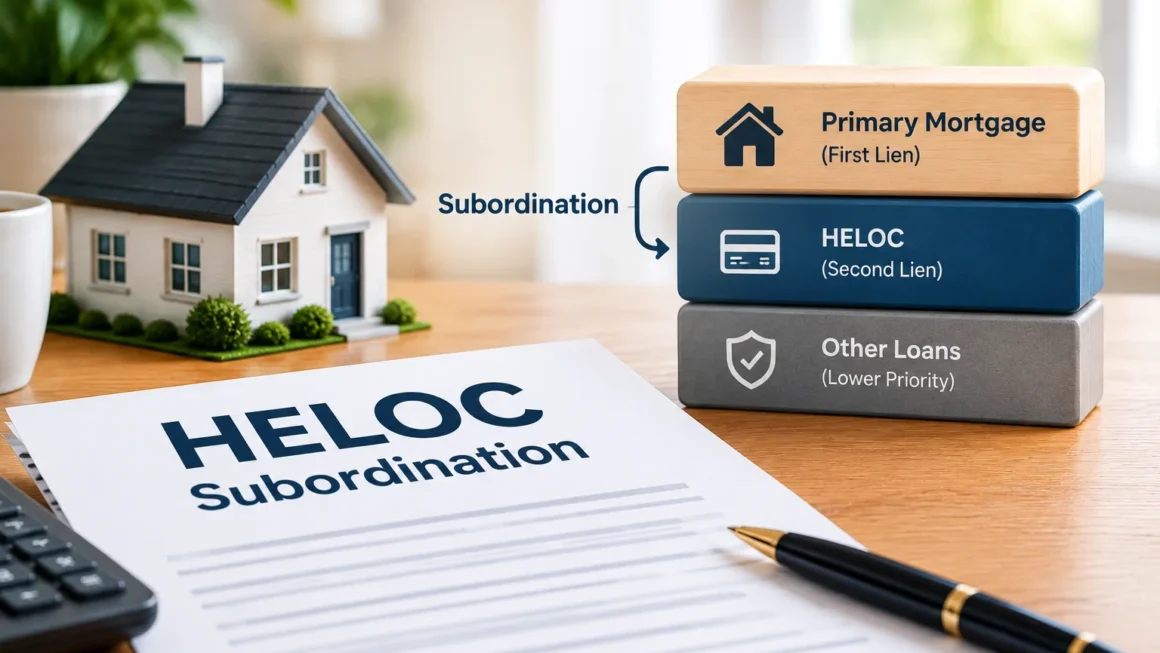

A home equity line of credit is built on a simple premise: your house is worth more than you owe on it, and a lender lets you borrow against that gap. That arrangement works fine when home values are flat or rising. But real estate markets are cyclical, and home values can and do fall — sometimes by a little, sometimes by a lot, depending on your local market, the broader economy, and factors entirely outside your control like interest rate shifts or oversupply in your area.
If you have an open HELOC, or you’re considering opening one, it’s worth understanding exactly what happens when the value of the collateral behind your credit line drops. The short answer is that your lender has more power in this situation than most borrowers realize, and the consequences can range from mildly inconvenient to genuinely disruptive to your financial plans. This article walks through the mechanics, the legal protections lenders rely on, real-dollar examples of what a value drop looks like on paper, and what you can actually do about it.
How a HELOC Is Tied to Your Home’s Value in the First Place
To understand what happens when values fall, it helps to revisit how your credit line was sized in the first place.
When you applied for your HELOC, the lender ordered an appraisal (or used an automated valuation model) to establish your home’s market value. From there, they calculated your loan-to-value ratio, often abbreviated LTV, and your combined loan-to-value ratio, or CLTV, which accounts for your primary mortgage balance plus the HELOC.
Most HELOC lenders cap CLTV somewhere between 80% and 90%, though some go as high as 95% for borrowers with strong credit. Here’s the formula in practice:
Home Value × Max CLTV% − Existing Mortgage Balance = Maximum HELOC Credit Line
So if your home appraised at $400,000, your lender allows an 85% CLTV, and you owe $250,000 on your primary mortgage, the math looks like this:
$400,000 × 0.85 = $340,000 $340,000 − $250,000 = $90,000 maximum HELOC
That $90,000 isn’t a fixed number etched into your loan documents forever. It’s a snapshot based on the home’s value at the time of underwriting. Your credit limit is, in effect, conditional on that valuation holding up — and that’s exactly the clause most homeowners skip over when they sign their HELOC agreement.
The Contract Clause That Makes Reductions Legal
Buried in nearly every HELOC agreement is language giving the lender the right to reduce or freeze your credit line if the value of your home declines significantly. This isn’t fine print designed to trap you — it’s standard industry practice, and it’s actually grounded in federal regulation.
Regulation Z, which implements the Truth in Lending Act, explicitly permits HELOC lenders to suspend credit privileges or reduce the credit limit if the value of the dwelling securing the line declines significantly below its appraised value for purposes of the plan. Lenders don’t get to do this arbitrarily or based on a hunch — they generally need objective evidence, such as a formal reappraisal, a broker price opinion, or area-wide valuation data showing a real decline, not just a temporary dip in a single comparable sale.
This is one of the most misunderstood aspects of home equity lending. Many borrowers assume their credit line is a fixed, contractual amount they can always rely on, similar to how a credit card limit usually only changes if you ask or your credit profile shifts dramatically. A HELOC is different because it is secured specifically by the equity in your home, and that equity is a moving target.
What “Significant Decline” Actually Means
Regulators don’t supply a single universal percentage threshold for what counts as “significant,” and lenders have some discretion here, but most use internal policies that trigger a review when CLTV moves outside its original tier — for example, when the line was extended at 85% CLTV and a value drop pushes the effective CLTV above 90% or higher.
In practice, here’s what tends to happen on a market-wide basis. After the 2008 housing downturn, many major banks froze or reduced HELOCs en masse in markets where home prices had fallen 10% to 30%, even for borrowers who had never missed a payment. That episode is the textbook case lenders point to when explaining why this contract clause exists, and it’s part of why so many borrowers were caught off guard. The freezes weren’t about your payment history; they were about the math behind the collateral.
Three Things a Lender Can Do When Your Home Value Drops
It helps to separate the lender’s options into three distinct categories, since the consequences for you differ quite a bit depending on which one applies.
1. Reducing Your Credit Limit
The most common response is a partial reduction. If your home value drops enough that your available equity shrinks, the lender may lower your maximum credit line to bring your CLTV back within their guidelines — even if you haven’t drawn the full amount.
Using the earlier example, suppose your $400,000 home drops to $340,000 in value, a 15% decline. Recalculating with the same 85% CLTV cap and the same $250,000 mortgage balance:
$340,000 × 0.85 = $289,000. $289,000 − $250,000 = $39,000 new maximum HELOC
Your original $90,000 limit just dropped to $39,000 — more than a 56% reduction — without you doing anything wrong. If you had already drawn $60,000 against that line, you’d now be over your new limit, which creates its own complications (more on that below).
2. Freezing (Suspending) Further Draws
In more severe cases, the lender doesn’t just lower the limit — they suspend your ability to draw any additional funds at all, even if you’re technically still under whatever the recalculated limit would be. This is common when the decline is sharp, sudden, or affects a wide swath of the lender’s portfolio simultaneously, since reappraising every account individually is expensive and slow, so lenders sometimes freeze first in a region and reassess case-by-case afterward.
A frozen HELOC still requires you to repay whatever balance you’ve already drawn, on the original schedule and terms. You just can’t pull additional funds until the freeze is lifted, which usually requires demonstrating that home values have stabilized or recovered, sometimes via a new appraisal you pay for out of pocket.
3. Closing the Line Entirely
This is the most severe outcome and is relatively rare outside of major downturns, but it can happen, particularly if the value decline coincides with other red flags like missed payments, a credit score drop, or a job loss reflected in updated income documentation. If your line is closed, you’ll typically be required to pay off the outstanding balance per the original repayment terms, though closure alone usually doesn’t accelerate the balance into an immediate lump-sum demand unless you’ve also defaulted on payments.
Comparison: Credit Limit Reduction vs. Freeze vs. Closure
| Scenario | Can you draw more funds? | Existing balance due immediately? | Typical trigger | How to reverse it |
| Credit limit reduction | Yes, up to the new (lower) limit | No | Moderate value decline, recalculated CLTV | New appraisal showing recovered value; pay down balance |
| Draw suspension (freeze) | No | No | Sharp or regional value decline | Reappraisal showing stabilization; sometimes, an automatic review period |
| Line closure | No | Not usually accelerated, but no new draws ever | Severe decline plus other risk factors (missed payments, credit drop) | Rarely reversible; may need to refinance or pay off entirely |
What If You’ve Already Drawn More Than Your New Limit?
This is the scenario that catches people off guard the hardest. Say you had a $90,000 HELOC, drew $70,000 of it for a renovation and some debt consolidation, and then your lender recalculates your limit down to $39,000 after a regional value decline. You’re now $31,000 over your new limit, even though you didn’t violate any payment terms.
Lenders handle this a few different ways, and it varies by institution and by the specific language in your agreement:
Some lenders will simply let the existing balance stay in place and continue normal repayment, while blocking any further draws until the balance organically falls back under the new limit through your regular payments.
Others may require an immediate “true-up” payment to bring the balance back under the new limit, which can mean a borrower is suddenly asked to come up with a lump sum they weren’t expecting.
In rare and more aggressive cases, particularly with lenders that see the overage as a broader risk signal, the full outstanding balance can be called due, though this is generally reserved for situations involving other defaults, not value drops alone.
If you’re ever notified of a credit limit reduction and you’re not sure which of these applies to you, the most important first step is reading the specific notice you received and calling your servicer directly to ask, in writing if possible, what repayment expectations apply to any amount over the new limit.
Underwater HELOCs: What It Means and Why It Matters
When your combined mortgage and HELOC balance exceeds your home’s current value, you’re “underwater” or have “negative equity.” This is the most serious version of a value-drop scenario, and it has consequences beyond just your credit line.
Using a concrete example: suppose your home was worth $350,000, you owe $280,000 on your primary mortgage, and you’d drawn $50,000 on your HELOC, for a combined balance of $330,000. If the local market drops 15%, your home is now worth roughly $297,500. Your combined debt of $330,000 now exceeds your home’s value by $32,500 — you’re underwater by that amount.
Being underwater on a HELOC creates a few specific problems:
You can’t refinance easily. Most refinance lenders require positive equity or, at a minimum, an LTV under a certain threshold (often 80% to 97% depending on the loan program). If you’re underwater, a standard rate-and-term refinance is usually off the table, which can be a serious problem if you were counting on refinancing to escape a rising HELOC interest rate.
You can’t sell without bringing cash to closing. If you need to sell your home while underwater, you’ll typically have to pay the difference between your sale price and your total mortgage debt out of pocket, since the lender won’t release its lien for less than what’s owed without a formal short sale agreement.
Your HELOC almost certainly stays frozen or reduced. Lenders have little incentive to extend more unsecured-feeling credit on a property that’s already underwater, so don’t expect a thaw until you’ve paid down balances or values recover.
Does a Value Drop Affect Your Interest Rate?
This is a common point of confusion. A drop in your home’s value, by itself, does not directly change the interest rate on your existing HELOC balance. Your rate is governed by the terms in your original agreement — typically a variable rate tied to the Prime Rate plus a margin, as outlined when you opened the line.
That said, there are a couple of indirect ways a value drop can affect what you pay:
If your HELOC is frozen or your limit is reduced and you later want to reopen or increase it, the lender will typically reunderwrite you at current market rates and margins, which may be higher than your original terms depending on where benchmark rates stand at that time.
If a value decline coincides with a credit score drop (which often happens together in personal financial distress, even though they’re not directly linked), some HELOC agreements include risk-based repricing clauses that allow a margin increase if your credit profile worsens. This is separate from the value issue, but it often arrives at the same time.
Does Your Repayment Obligation Change?
No — and this is an important distinction to hold onto. Whatever balance you’ve already drawn on your HELOC remains fully due according to the original repayment schedule, regardless of what happens to your home’s value. A value drop affects your access to additional credit, not your obligation to repay what you’ve already borrowed.
This means even in a worst-case scenario where your home value falls dramatically, you’re still on the hook for your draw-period interest payments (or principal-and-interest payments if you’re in the repayment period) exactly as agreed. The lender’s leverage in a value-drop scenario is almost entirely about preventing future exposure, not forgiving or restructuring existing debt.
How Lenders Typically Discover a Value Decline
You might wonder how a lender even knows your home’s value has dropped, since they’re not appraising your house every month. In practice, lenders rely on a mix of approaches:
Automated Valuation Models (AVMs) pull from public sales records, tax assessments, and market data to generate periodic value estimates across their entire HELOC portfolio, often run quarterly or during broader economic stress events.
Regional trigger events, such as a published report showing a metro area’s median home price falling by a defined percentage, can prompt a lender to proactively review HELOCs concentrated in that area.
Borrower-initiated events, like applying to increase your credit line or refinance your primary mortgage, will almost always trigger a fresh appraisal that could reveal a decline you weren’t otherwise aware of.
This means you may not get a warning before a reduction notice arrives. Federal regulations require lenders to provide written notice when they suspend or reduce a HELOC, explaining the specific reason, but that notice typically comes after the decision has already been made, not before.
What You Can Do If Your HELOC Is Reduced or Frozen
If you receive a notice that your credit line has been cut or suspended due to a value decline, you do have some options, though success isn’t guaranteed.
Request a written explanation and the data behind it. Lenders are required to tell you the specific reason for the action under Regulation Z. If the basis seems shaky — for example, an AVM estimate that seems out of step with recent comparable sales in your actual neighborhood — you have grounds to push back.
Order or request a new appraisal. If you believe your home is worth more than the lender’s estimate, you can often request a formal reappraisal, sometimes at your own expense (typically $400–$700 depending on your market), to demonstrate the home’s true current value. If the new appraisal supports a higher value, lenders are generally required to reinstate the credit line.
Pay down the balance. If you’re over the new reduced limit, voluntarily paying down the balance to bring CLTV back into compliance can sometimes accelerate a lender’s willingness to lift restrictions, even before values fully recover.
Shop for a different lender. A reduction from one lender doesn’t necessarily mean every lender will see your home the same way, especially since valuation methodologies and CLTV thresholds vary by institution. If your situation allows it, refinancing your HELOC with a different lender, assuming you still have enough equity to qualify, is worth exploring.
Wait it out, if your timeline allows. Real estate markets that decline don’t always stay down. If you don’t urgently need the credit line, sometimes the most practical move is simply to keep making payments and revisit the situation in a year or two once values have had a chance to recover.
How to Protect Yourself Before a Value Drop Happens
If you’re still in the process of deciding whether to open a HELOC, or you already have one and want to reduce your exposure to this risk, a few practical strategies can help:
Borrow conservatively relative to your approved limit rather than drawing the maximum immediately, since this gives you a cushion if your limit is later reduced.
Avoid relying on a HELOC as your sole source of emergency liquidity in a market that’s already showing signs of cooling, since that’s exactly the scenario where access could be cut off right when you need it most.
Keep an eye on local market data, including median sale price trends and inventory levels in your specific zip code, since national headlines about home values often don’t reflect what’s happening in your particular market.
Maintain a strong credit profile independent of your home equity, since lenders are less likely to take aggressive action on accounts where the borrower otherwise presents low risk.
Frequently Asked Questions
Can my lender close my HELOC even if I’ve never missed a payment? Yes. A significant decline in your home’s value can be sufficient grounds on its own under federal regulations, separate from your payment history. Lenders are required to provide a written reason, and a clean payment record doesn’t override the value-based trigger.
If my HELOC is frozen, do I still have to make payments? Yes. A freeze stops new draws but does not change your obligation to repay the balance you’ve already drawn, on the original schedule.
Will my HELOC interest rate go up if my home value drops? Not directly. Your rate is governed by your original agreement’s index and margin. However, if you need to reopen or increase the line later, you’ll likely be reunderwritten at current rates.
How much does a home value have to drop before a lender takes action? There’s no universal threshold, but most lenders act once the decline pushes your effective CLTV meaningfully above the tier you originally qualified for. This varies by lender, but historically, declines in the 10–20% range have been common triggers.
Can I get my HELOC reinstated once home values recover? Often, yes, particularly if you can provide a new appraisal showing the value has rebounded. Reinstatement isn’t automatic in most cases — you typically need to request it and provide updated documentation.
Does an underwater HELOC affect my ability to file bankruptcy or modify my mortgage? This is highly fact-specific and depends on your overall financial picture, loan structure, and state law. If you’re facing this situation, it’s worth consulting a bankruptcy attorney or HUD-approved housing counselor rather than relying on general guidance.
A Final Note on Risk
A HELOC is a useful financial tool precisely because it’s flexible and (usually) lower-cost than unsecured borrowing. But that flexibility is a function of market conditions outside your control, and the contract terms you agreed to give your lender real latitude to pull back access if your home’s value declines. None of this is unique to one lender or one type of borrower — it’s baked into how home equity lending is regulated and underwritten across the industry.
The most practical takeaway is to treat your full approved credit limit as a ceiling, not a guarantee, and to build your financial plans with some cushion in case that ceiling gets lower than expected.
In another related article, Can a Lender Freeze or Reduce Your HELOC Credit Line? When and Why