
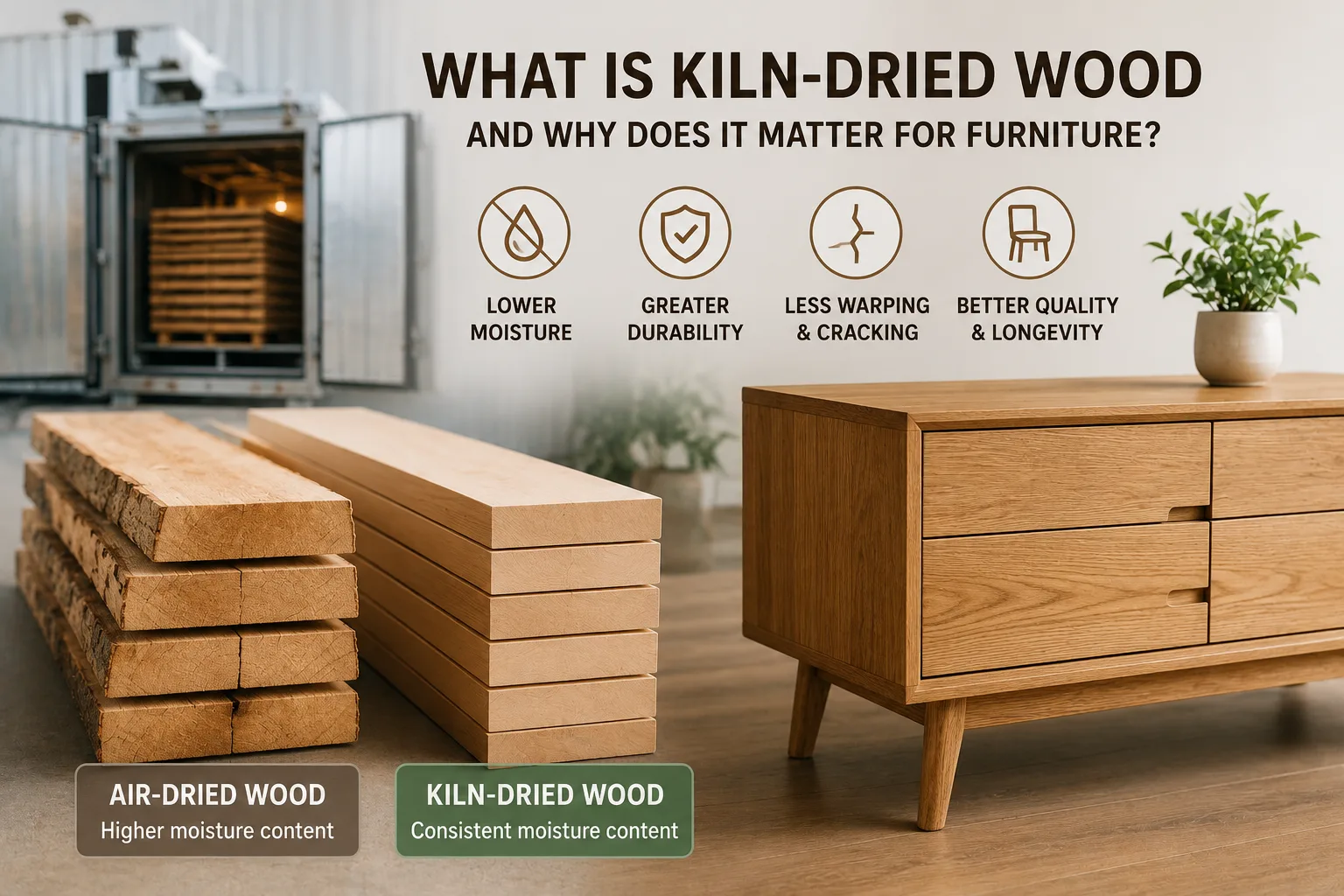
If you’ve shopped for furniture recently, you’ve probably seen the phrase “kiln-dried hardwood frame” in nearly every product description, often presented as a quality signal without much explanation of what it actually means or why it matters. It’s one of those terms that gets used so often it starts to feel like marketing filler — but it’s actually one of the single most important, concrete indicators of how long a piece of wood furniture will hold up. Understanding what kiln-drying really does, how it differs from air-drying, and how to verify a retailer’s claims can save you from buying furniture that looks solid in a showroom but starts warping, cracking, or falling apart within a year or two at home.
This guide walks through the science of wood drying, why moisture content is the hidden variable behind most furniture failures, how kiln-drying compares to the alternatives, and exactly what to look for so you can tell genuinely well-built furniture from furniture that just uses the right buzzwords.
1. Quick Answer: What Kiln-Dried Wood Actually Is
Kiln-dried wood is lumber that has had its internal moisture content reduced in a controlled, heated chamber (a kiln) rather than being left to dry naturally in open air. The process typically brings wood down to a moisture content of 6-8% for furniture-grade lumber, compared to freshly cut (“green”) wood, which can hold 30-200% moisture content depending on the species, or air-dried wood, which typically stabilizes somewhere around 12-19% depending on local humidity.
That moisture reduction matters enormously for furniture specifically, because wood is a hygroscopic material — it constantly absorbs and releases moisture based on the humidity around it, and it expands and contracts as it does so. Wood that isn’t properly dried before being cut, joined, and assembled into furniture will continue shrinking and moving after the piece is built, which is what causes the warping, cracking, loose joints, and squeaking that plague poorly constructed wood furniture within just a few years of purchase.
In short: kiln-drying isn’t a cosmetic process or a marketing term. It’s a structural prerequisite for wood furniture that’s actually going to hold its shape and its joints over time.
2. Why Wood Moisture Content Matters So Much
To understand why kiln-drying matters, it helps to understand what wood actually is at a structural level. A living tree is full of water — moving through its cells to transport nutrients — and when that tree is cut down and milled into lumber, all that water doesn’t disappear instantly. It has to leave the wood gradually, and as it does, the wood’s cell structure changes shape.
Wood shrinks as it dries — but not evenly
As moisture leaves wood, the saturated cell walls begin to compress, and the wood physically shrinks. Critically, this shrinkage isn’t uniform in every direction. Wood shrinks the most in the direction tangential to the growth rings, moderately in the direction radiating out from the center of the tree, and almost negligibly along the length of the grain. This uneven, directional shrinkage is exactly why unevenly dried wood warps, twists, cups, and cracks rather than just uniformly getting smaller — different parts of the same board are trying to shrink at different rates and in different directions simultaneously.
Wood keeps responding to humidity for its entire life
Even after wood is fully dried and built into furniture, it never stops being hygroscopic. It continues absorbing moisture from humid air and releasing it during dry periods, expanding and contracting slightly with the seasons for as long as it exists. The goal of proper drying isn’t to stop this movement entirely (that’s physically impossible with real wood) — it’s to bring the wood down to a stable equilibrium moisture content that roughly matches the environment the furniture will actually live in, so the ongoing expansion and contraction stays small and predictable rather than dramatic.
Why this matters specifically for furniture joints
Furniture joints — mortise and tenon, dowel joints, dovetails, screws into wood — are built with tight tolerances designed for wood at a specific moisture content. If a joint is assembled using wood that’s still too wet, the wood will continue shrinking after assembly, and that shrinkage pulls the joint apart from the inside, even if it looked perfectly tight on the day the piece was built. This is the single most common root cause of furniture that develops wobbly legs, loose arms, or creaking joints within the first year or two of ownership, especially in cheaper furniture where drying standards are cut to save time and cost.
3. How the Kiln-Drying Process Works
Kiln-drying uses a large, sealed chamber — essentially an industrial oven — to remove moisture from lumber in a controlled, monitored way. The process is more sophisticated than simply “baking” wood, because drying it too fast or too aggressively causes the same warping and cracking problems that under-drying does, just from the opposite direction.
Step 1: Loading and stacking
Lumber is stacked with thin spacer strips (called “stickers”) between each layer, allowing air and heated air to circulate evenly around every board. Careless stacking is actually a common cause of drying defects, since boards that don’t get even airflow dry unevenly even inside a properly functioning kiln.
Step 2: Controlled heating and humidity management
The kiln gradually raises temperature while carefully managing internal humidity, following what’s called a “drying schedule” — a specific, gradual progression of temperature and humidity changes tailored to the wood species, thickness, and starting moisture content. This schedule is critical: drying wood too quickly causes the outer layers to dry and shrink much faster than the core, creating internal stress that leads to surface checking (small cracks), case hardening (a brittle outer shell trapping wetter wood inside), or honeycombing (internal cracks that aren’t visible from the outside but severely weaken the wood).
Step 3: Monitoring moisture content throughout
Modern kilns continuously monitor moisture levels using sample boards fitted with electronic moisture sensors, allowing operators to adjust temperature and humidity in real time as the drying schedule progresses, rather than guessing based on a fixed timetable.
Step 4: Conditioning and equalizing
Toward the end of the drying cycle, a “conditioning” phase introduces controlled steam or humidity to relieve any internal stress that built up during drying and to equalize moisture content across the thickness of each board, so the surface and the core reach a similar final moisture level rather than the surface being drier than the interior.
Step 5: Final moisture verification
Before wood leaves the kiln, it’s tested to confirm it has reached the target moisture content — typically 6-8% for furniture-grade hardwood, though the exact target varies somewhat by species and intended use.
The entire cycle typically takes anywhere from a few days to several weeks depending on the wood species, thickness, and starting moisture content, which is dramatically faster than the months or years air-drying alone would require to reach a comparable moisture level.
4. Kiln-Drying vs. Air-Drying: A Direct Comparison
Air-drying — simply stacking lumber outdoors or in a ventilated shed and letting ambient air do the work — is the traditional, low-cost drying method, and it’s not without merit. But it has real limitations that matter for furniture specifically.
Time
Air-drying is slow. As a rough rule of thumb, air-drying takes about one year per inch of lumber thickness under good conditions, meaning a standard board might take a full year to reach a stable moisture level, and thicker stock can take considerably longer. Kiln-drying accomplishes the same or better moisture reduction in days to weeks.
Final moisture content achievable
Air-drying alone typically can’t get wood below the ambient humidity level of its environment, which in most climates settles somewhere around 12-19% moisture content. That’s too high for furniture that will live indoors in a heated or air-conditioned home, where indoor humidity is usually much lower than outdoor ambient humidity, especially during winter heating season. Wood that’s only air-dried to 15% and then built into furniture destined for a dry, heated living room will continue shrinking significantly after the furniture is built, since it’s still trying to reach equilibrium with an environment far drier than where it was dried.
Consistency and control
Kiln-drying allows precise control over the drying schedule, moisture monitoring throughout the process, and a conditioning phase to relieve internal stress — none of which are possible with air-drying, which is entirely at the mercy of whatever weather happens to occur during the drying period. This is why kiln-dried wood is far more consistent and predictable than air-dried wood, batch to batch and board to board.
Where air-drying still has a place
Air-drying isn’t obsolete — it’s still commonly used as a first-stage process before kiln-drying, since pre-drying lumber partially through air-drying reduces the time and energy the kiln needs to finish the job, and some specialty woodworkers prefer air-dried wood for certain traditional or rustic applications where slight, ongoing wood movement is considered part of the character of the piece. But for furniture destined for a climate-controlled indoor environment and built with tight joinery, kiln-drying is the standard that actually delivers stable, long-lasting results.
5. What Happens to Furniture Built With Improperly Dried Wood
Understanding the specific failure modes helps explain why this matters so much in practice, not just in theory.
Warping, cupping, and twisting
If a board dries unevenly — faster on one face than the other, or faster on the outer edges than the center — the resulting internal stress causes the board to physically bend out of flat. A tabletop that develops a visible curve, or a chair back that no longer sits flush, is a classic sign of wood that wasn’t properly or evenly dried before being built into the final piece.
Cracking and checking
As under-dried wood continues to lose moisture after a piece is assembled, the resulting shrinkage stress can cause visible surface cracks, particularly along the grain and at the ends of boards, where moisture escapes fastest. This is especially common in solid wood tabletops and thick structural components.
Loose or failed joints
As covered above, this is the most common furniture-specific failure. Joints assembled with wood that’s still shrinking will loosen from the inside as the wood continues to move, leading to wobbly chairs, sagging drawer fronts, and creaking frames — often within the first one to two years of ownership, well before any reasonable furniture buyer would expect structural problems.
Finish failure
Wood movement after finishing can crack, craze, or lift the finish applied to the surface, since most finishes (paint, stain, lacquer) aren’t flexible enough to accommodate significant ongoing wood expansion and contraction. A finish that looks perfect on delivery but starts cracking along seams and joints within a year often points back to wood that wasn’t stable when it was finished.
Reduced fastener holding strength
Screws and nails rely on friction against surrounding wood fibers to hold. As wood shrinks around a fastener that was installed when the wood was wetter, the fastener can loosen in its hole, which is part of why furniture built from improperly dried wood often develops the specific problem of screws backing out or hardware becoming loose over time, even without any obvious external damage.
6. Kiln-Dried Wood and Furniture Frame Construction
This is the piece of the puzzle most relevant to furniture shoppers specifically, since the frame is the part of any wood furniture piece — a sofa, a chair, a bed frame, a dining table — that determines whether the entire structure holds up over years of real use.
Why frames are especially sensitive to moisture content
A sofa or chair frame typically involves multiple pieces of wood joined at various angles under ongoing mechanical stress from sitting, standing, and shifting weight. Every one of those joints depends on a tight, stable fit between components. If the wood used in that frame wasn’t properly kiln-dried before assembly, the ongoing shrinkage after construction directly loosens the very joints that are supposed to be bearing repeated daily load — which is exactly why a poorly dried frame tends to fail specifically at the joints (loose arms, wobbly legs) rather than through some other, less predictable failure mode.
Hidden frames vs. visible wood
It’s worth noting that in upholstered furniture like sofas and armchairs, the frame is completely hidden under padding and fabric, which means moisture-related defects can develop invisibly for months or years before they manifest as a wobble, a creak, or a sag that the owner can actually feel or hear. This is part of why frame quality is so hard to evaluate by simply looking at a finished piece in a showroom, and why asking direct questions about drying and frame material matters more than it might seem.
Combination construction
Many well-built sofa and chair frames combine kiln-dried solid hardwood at load-bearing joints and corners with plywood or engineered wood panels for larger flat sections, since plywood’s layered cross-grain construction actually resists warping better than solid wood for certain shapes, while kiln-dried solid hardwood offers superior screw-holding strength exactly where joints need to be strongest. This combination approach, done well, isn’t a shortcut — it’s often a genuinely smart engineering choice, and shouldn’t be assumed to be lower quality just because it’s not 100% solid wood throughout.
7. How Kiln-Drying Affects Different Wood Species
Not all wood species dry the same way, and this matters both for how long the kiln-drying process takes and for how forgiving or unforgiving a given species is if drying isn’t done properly.
Oak
A dense, strong hardwood popular in furniture frames, but notably prone to checking and internal stress during drying due to its density and the way moisture moves through its cell structure. Oak requires a carefully managed, relatively slow kiln schedule; rushed drying is a common cause of oak-specific defects like surface checking and honeycombing.
Maple
Generally dries more predictably than oak, with a lower tendency toward checking, making it a popular and relatively forgiving choice for furniture frames and solid wood components.
Birch
Dries relatively quickly and evenly compared to denser hardwoods, and is commonly used in furniture frames as a more budget-friendly alternative to oak or maple while still offering solid structural performance when properly dried.
Ash
Known for good shock resistance and strength relative to its weight, ash dries reasonably well with standard kiln schedules and is a common choice for chair and frame components that need to flex slightly under load without cracking.
Pine and other softwoods
Softwoods generally dry faster than hardwoods and are more forgiving of minor drying schedule variations, but they’re also softer and less resistant to dents, scratches, and long-term wear, which is why they’re more commonly used for furniture backs, drawer bottoms, and other secondary structural components rather than primary load-bearing frame parts in higher-end furniture.
Walnut
A dense, prized furniture wood that requires careful, moderate drying to avoid warping given its density, but rewards that care with excellent dimensional stability once properly dried, along with its well-known rich color and grain pattern.
8. Kiln-Dried Wood vs. Engineered Wood: Where Each Fits
It’s worth directly addressing a related but separate question that often gets tangled up with the kiln-drying conversation: how does kiln-dried solid wood compare to engineered wood products like plywood, MDF, and particle board?
Plywood
Made from thin layers (plies) of wood veneer glued together with the grain direction alternating between layers, plywood is dimensionally very stable because the cross-grain construction counteracts the directional shrinkage that causes solid wood to warp. The veneers used in plywood are kiln-dried before being bonded together, so plywood inherits the stability benefits of proper drying while adding additional stability from its layered construction. Quality plywood is a genuinely excellent choice for certain furniture components, particularly large flat panels where solid wood would be more prone to warping across its width.
MDF (medium-density fiberboard)
Made from wood fibers combined with resin and pressed under heat, MDF has no grain direction at all, which makes it extremely dimensionally stable and gives it a very smooth, consistent surface ideal for painted finishes. However, MDF has significantly weaker screw-holding strength than solid wood or plywood and is notably vulnerable to swelling and crumbling if exposed to moisture, since the wood fibers and resin binder don’t handle water exposure well.
Particle board
Similar to MDF but made from larger wood particles and chips rather than fine fibers, bonded with resin under pressure. It’s the least expensive engineered wood option and the least durable, with poor screw-holding strength, vulnerability to moisture damage, and a tendency to crumble or break down at stress points over time, particularly at joints and fastener locations.
The honest comparison
Properly kiln-dried solid hardwood generally offers the best combination of strength, screw-holding ability, and longevity for load-bearing furniture components, but it’s also the most expensive raw material. Plywood, when made from quality kiln-dried veneers, is a legitimately strong and stable alternative, particularly for flat panel components. MDF and particle board are acceptable for certain non-structural or low-stress components (backs, bottoms, interior shelving) but are generally poor choices for load-bearing frame elements, joints, or anywhere significant weight or repeated stress will be applied.
9. Moisture Content Standards: What the Numbers Mean
Understanding the actual target numbers helps make sense of why “kiln-dried” claims matter and what a reasonable standard looks like.
Green (freshly cut) wood: 30% to over 100% moisture content depending on species, since this is measured as a percentage of the wood’s dry weight, and very wet species can genuinely contain more water weight than dry wood weight.
Fiber saturation point: Around 25-30% moisture content, this is the threshold below which wood actually begins shrinking as it dries (above this point, water is only in the cell cavities, not the cell walls themselves, so its loss doesn’t cause shrinkage).
Air-dried lumber (typical outdoor stack, temperate climate): Generally stabilizes around 12-19% depending on local humidity and season, and can’t reliably go lower through air-drying alone.
Kiln-dried furniture-grade lumber: Typically targeted at 6-8% moisture content, which corresponds reasonably well with the indoor equilibrium moisture content of a typical climate-controlled home in much of the United States.
Indoor equilibrium moisture content: This varies by region and by season (homes in dry climates or with winter heating tend to run drier, around 6-8%, while humid coastal regions might equilibrate closer to 9-11%), which is part of why furniture manufacturers targeting a broad national market generally aim for the lower end of the range, since it’s easier for wood to absorb a bit of additional moisture in a humid environment than for over-wet wood to lose enough moisture without warping in a dry one.
The takeaway: a moisture content around 6-8% at the time of construction isn’t an arbitrary marketing number — it’s chosen specifically because it closely matches the environment the finished furniture will actually live in, which minimizes the amount of ongoing expansion and contraction the wood needs to do after the piece is built and sold.
10. How to Verify a Retailer’s Kiln-Dried Claims
Because “kiln-dried” has become such a common phrase in furniture marketing, it’s worth knowing how to actually verify the claim rather than taking it at face value.
Ask what species and where the frame components are kiln-dried vs. engineered wood. A retailer or salesperson who can answer specifically (“the frame is kiln-dried oak at the joints, with plywood panels for the back and base”) is giving you a real, verifiable answer. Vague responses like “it’s all solid wood” without specifics are a weaker signal.
Check for a written warranty specifically on the frame. Manufacturers confident in properly dried, well-constructed frames often back that confidence with longer warranties (5, 10, even lifetime frame warranties in some cases) than they offer on fabric or cushions, since frame failure from poor construction is exactly the kind of defect a warranty is designed to cover.
Look for manufacturer transparency about sourcing and construction. Brands that are proud of their drying and construction process tend to describe it in some detail on their website or product pages, rather than using the term “kiln-dried” as a single unexplained bullet point.
Physically test the piece if you’re shopping in person. Push firmly on arms, backs, and legs to check for wobble or give, and listen for creaking. While this won’t tell you the exact moisture content the wood was dried to, a well-constructed frame built from properly dried wood should feel genuinely rigid, not just cosmetically solid.
Be skeptical of unusually low prices on “solid hardwood” claims. Kiln-drying takes time, energy, and equipment, all of which cost money, and hardwood lumber itself costs meaningfully more than engineered wood alternatives. A frame described as solid kiln-dried hardwood priced dramatically below comparable competitors is worth extra scrutiny.
11. Warning Signs of Improperly Dried Wood in Finished Furniture
If you’re evaluating either new furniture or a used piece you’re considering, these are physical signs that point toward wood that wasn’t properly dried before construction:
- Visible cracks along the grain, especially at board ends or near joints
- Cupping or bowing in flat panels like tabletops, doors, or panel backs, visible as a slight curve when you sight down the surface at an angle
- A twisted appearance where a leg or panel doesn’t sit flat or square relative to the rest of the piece
- Joints that are loose despite the piece being relatively new, particularly if the looseness developed within the first year or two of light-to-normal use
- Finish that’s cracked or crazed specifically along seams and joints, rather than general surface wear
- A “green” or slightly damp smell to raw or unfinished wood components, which can indicate the wood wasn’t fully dried before the piece was assembled
- Noticeably heavier weight than comparable pieces of similar size and wood species, which can sometimes (though not always reliably) indicate retained moisture
12. Does Kiln-Dried Wood Cost More, and Is It Worth It?
Kiln-drying does add cost to lumber compared to unprocessed or purely air-dried wood, due to the energy, equipment, time, and labor the process requires. That cost gets passed through the furniture supply chain and shows up in the final retail price.
Roughly how much more: Kiln-dried hardwood lumber typically costs somewhere in the range of 15-40% more than comparable air-dried or green lumber, depending on species, thickness, and regional lumber market conditions, though this varies considerably.
Is it worth it for furniture specifically? For any furniture piece meant to be a long-term investment — a sofa frame, a dining table, a bed frame, a dresser — yes, decisively. The cost difference in raw material is a small fraction of the piece’s total retail price (which includes design, labor, fabric or finish, shipping, and retail markup), while the durability difference between properly kiln-dried and improperly dried wood can mean the difference between furniture that lasts 15-20 years and furniture that starts developing structural problems within 2-3 years. Given how much more the finished furniture costs than the raw lumber price difference alone, kiln-drying is one of the highest-value quality investments in the entire furniture construction process relative to its actual cost impact.
Where it matters less: For furniture that’s genuinely meant to be short-term or disposable (a piece for a first apartment you expect to replace in a couple of years, for example), the durability advantage of kiln-dried construction may matter less relative to upfront cost, since you’re not planning to keep the piece long enough to benefit fully from its extended lifespan.
13. Kiln-Drying and Environmental/Pest Considerations
Beyond moisture stability, the kiln-drying process has two additional practical benefits worth knowing about.
Pest elimination
The heat used in kiln-drying (often reaching internal wood temperatures well above what insects and their eggs or larvae can survive) effectively sterilizes the wood of pests like wood-boring beetles and certain fungi, which is one reason kiln-dried wood is often required for international shipping under phytosanitary regulations (commonly marked with the “HT” — heat treated — stamp on shipping pallets and crates, a related but distinct certification from furniture-grade kiln-drying).
Fungal and mold resistance
Because kiln-drying reduces moisture content well below the level fungi and mold need to grow and spread, properly kiln-dried wood is significantly more resistant to mold and rot issues than under-dried wood, particularly important for furniture that might spend time in less climate-controlled environments during shipping and storage before it reaches a customer’s home.
14. How Climate and Home Environment Affect Wood Furniture Long-Term
Even properly kiln-dried furniture continues responding to its environment for its entire lifespan, since wood never fully stops being hygroscopic. Understanding this helps set realistic expectations and informs simple care choices that meaningfully extend furniture life.
Homes with central heating and air conditioning tend to maintain relatively stable, moderate humidity year-round, which is generally the friendliest environment for wood furniture, since it minimizes the swings in humidity that cause the most noticeable wood movement.
Homes without climate control, or in regions with extreme seasonal humidity swings (very humid summers combined with very dry, heated winters, for example) put more ongoing stress on wood furniture, since the wood is constantly expanding and contracting more dramatically with the seasons, even if it was properly kiln-dried to begin with.
Basements and unconditioned spaces tend to run more humid than the rest of a home, which can cause wood furniture placed there to absorb moisture and swell somewhat compared to furniture kept in the main living areas.
Simple environmental steps that help: maintaining relatively stable indoor humidity (many households find a range of roughly 30-50% relative humidity comfortable for both people and wood furniture), avoiding placing wood furniture directly next to heating vents or radiators where localized drying is more extreme, and using a humidifier during dry winter months in climates with forced-air heating, which tends to dry indoor air significantly.
15. Comparison Table: Drying Methods at a Glance
| Factor | Green (Undried) Wood | Air-Dried Wood | Kiln-Dried Wood |
| Typical moisture content | 30-100%+ | 12-19% | 6-8% |
| Time required | N/A (not dried) | Roughly 1 year per inch of thickness | Days to a few weeks |
| Suitable for indoor furniture | No | Marginal, continues shrinking indoors | Yes, matches typical indoor equilibrium |
| Dimensional stability after construction | Very poor | Moderate | Good to excellent |
| Consistency batch-to-batch | N/A | Variable, weather-dependent | Highly consistent, controlled process |
| Pest/mold resistance | Poor | Moderate | Strong (heat sterilization effect) |
| Relative cost | Lowest | Low to moderate | Moderate (15-40% more than air-dried) |
| Best use case | Not recommended for furniture | Rough construction, some traditional/rustic work | Furniture-grade construction, joinery |
16. Frequently Asked Questions
Is all “solid wood” furniture automatically kiln-dried? No. “Solid wood” only describes the material — it says nothing about how it was dried. Solid wood furniture can be built from green, air-dried, or kiln-dried lumber, and only kiln-dried lumber reliably reaches the low moisture content needed for long-term indoor stability. Always ask specifically about drying method rather than assuming solid wood implies kiln-dried.
How can I tell if a piece of furniture I already own was built with kiln-dried wood? It’s difficult to verify after the fact without documentation from the manufacturer. However, furniture that has remained stable — no warping, no loose joints, no cracking — for several years across normal seasonal humidity changes is a reasonably strong practical indicator that the wood was properly dried, regardless of what the original marketing claimed.
Does kiln-dried wood ever warp or crack later on? It’s less likely, but not impossible, particularly if the finished furniture is exposed to extreme or unusual conditions — direct heat sources, flooding, extended high humidity, or dramatic swings between very wet and very dry environments. Kiln-drying dramatically reduces the risk of these issues compared to improperly dried wood, but it doesn’t make wood immune to all environmental stress for its entire lifespan.
Is kiln-dried wood better than engineered wood like plywood? It depends on the application. For load-bearing joints and components subject to repeated mechanical stress, kiln-dried solid hardwood generally offers superior screw-holding strength. For large flat panels prone to warping across their width, quality plywood (itself made from kiln-dried veneers) can actually offer better dimensional stability than solid wood. Well-designed furniture often uses both strategically rather than treating one as universally superior.
What does “KD” mean on a lumber label? “KD” is a common industry abbreviation for kiln-dried, often paired with a specific moisture content target (for example, “KD-8%” indicating kiln-dried to approximately 8% moisture content).
Does painted or finished furniture need to be kiln-dried too? Yes, arguably even more so. Finishes like paint and lacquer are relatively rigid once cured, and wood that continues moving significantly after being finished is more likely to crack, craze, or lift that finish along seams and joints, making proper drying just as important — if not more visually consequential — for painted and finished pieces as it is for furniture left in a natural wood finish.
How long does kiln-dried wood stay stable once it’s built into furniture? Indefinitely, in the sense that wood never fully stops responding to humidity, but properly kiln-dried wood that’s stayed in a reasonably stable indoor environment typically shows only minor, seasonal dimensional changes for the entire useful life of the furniture, rather than the significant, one-directional shrinkage that causes structural problems in improperly dried wood.