
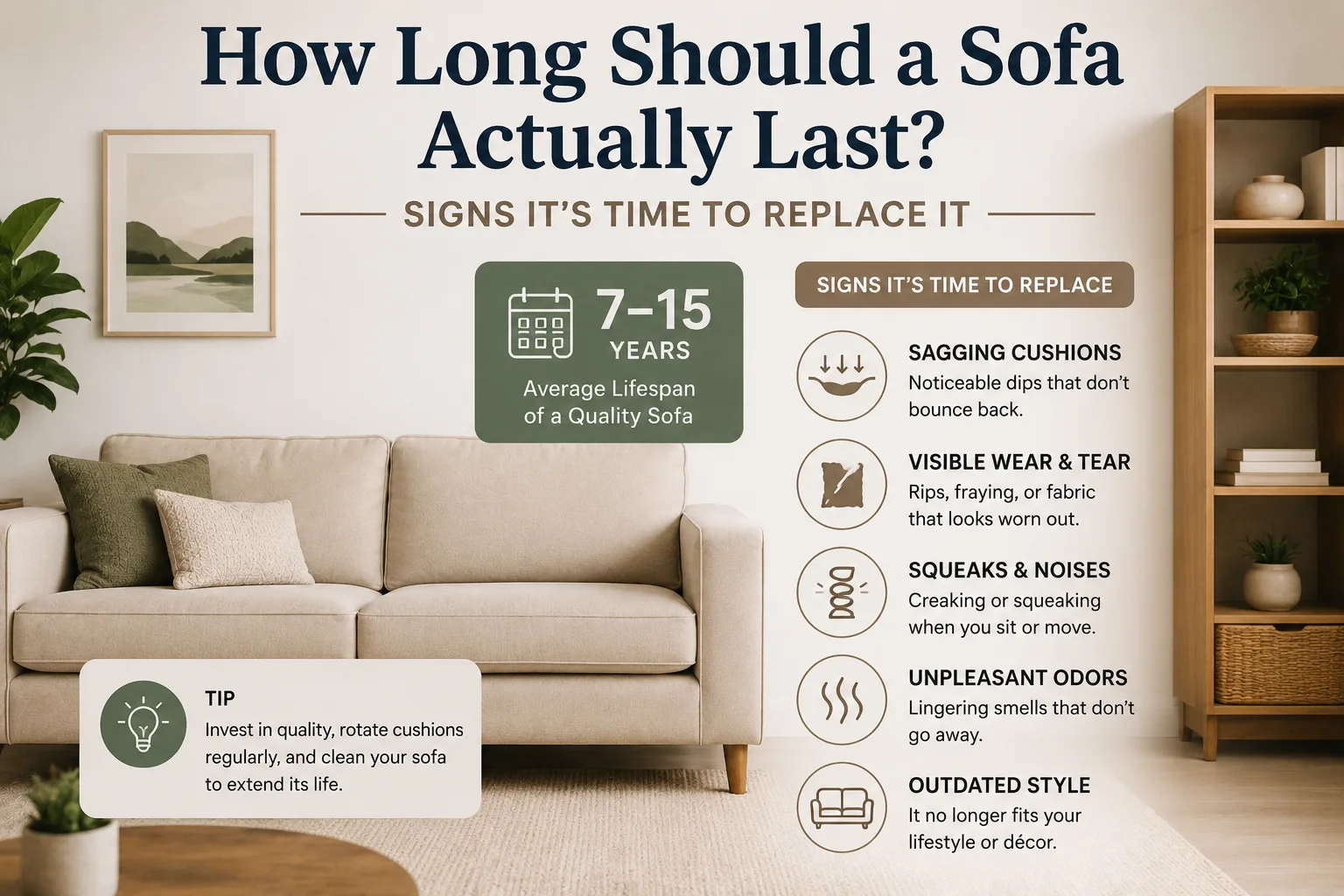
A sofa is one of the most expensive single purchases in most living rooms, and it’s also one of the most heavily used pieces of furniture in the entire house. It absorbs daily sitting, lounging, kids jumping on it, pets curling up on it, spills, sunlight, and years of gradual compression — and unlike a mattress, which most people replace on a fairly predictable schedule, sofas tend to get kept far past the point where they’re actually doing their job well. People often don’t realize their sofa has quietly become uncomfortable, unsupportive, or even unsanitary until they sit on a friend’s newer couch and feel the difference.
This guide breaks down exactly how long you should expect a sofa to last based on its construction, what actually causes sofas to wear out, and the specific, concrete signs that tell you it’s time to repair, reupholster, or replace rather than keep pushing through.
1. Quick Answer: Average Sofa Lifespan
Most sofas last somewhere between 7 and 15 years, but that range is wide for a reason — the actual number depends heavily on how the sofa was built, what it’s stuffed and covered with, and how it’s used day to day.
- Budget sofas (particle board frames, polyurethane foam cushions, synthetic fabric): typically 3-7 years before noticeable sagging, frame issues, or fabric wear
- Mid-range sofas (hardwood-plywood hybrid frames, high-density foam with some fiber wrap, polyester blend fabrics): typically 7-10 years
- High-end sofas (kiln-dried hardwood frames, down-wrapped or spring-supported cushions, performance or genuine leather upholstery): typically 15-20+ years, especially with periodic reupholstering
The honest takeaway is that “how long should a sofa last” is really two separate questions: how long the frame and internal structure will hold up (which is largely fixed once you buy it), and how long the fabric and cushions will look and feel good (which you have more control over through maintenance and use patterns).
2. What Actually Determines How Long a Sofa Lasts
Four structural components determine a sofa’s real lifespan, and they don’t wear out at the same rate. Understanding each one separately is the key to understanding why two sofas that look similar in a showroom can have wildly different lifespans.
The frame
The frame is the skeleton of the sofa, and it’s the single most important factor in overall lifespan, because a failing frame usually means the sofa is beyond repair, while worn fabric or flattened cushions are both fixable. Frames are typically made from solid hardwood, engineered wood (plywood or laminated veneer lumber), particle board, or metal.
The suspension system
This is what sits between the frame and the cushions, giving the seat its bounce and support. Common systems include sinuous (S-shaped) springs, eight-way hand-tied coil springs, webbing (interwoven fabric straps), and, in cheaper furniture, solid plywood platforms with no give at all.
The cushion fill
This determines how the sofa feels to sit on and how quickly it loses its shape. Common fills include high-resiliency (HR) foam, standard polyurethane foam, down and feather blends, fiber (polyester) wrap over a foam core, and various hybrid combinations.
The upholstery
The outer fabric or leather takes the most visible daily abuse — sun exposure, spills, pet claws, and simple friction from sitting and standing. It’s usually the first thing to show wear, even on a sofa with a great frame and cushions underneath.
A sofa is only as durable as its weakest of these four components. A beautiful leather exterior wrapped around a particle board frame will still fail within a few years, and a gorgeous hardwood frame with cheap foam cushions will still feel worn out and saggy well before the frame itself gives any trouble.
3. Frame Materials and Their Lifespans
Kiln-dried hardwood (oak, maple, birch, ash)
This is the gold standard for sofa frames. Kiln-drying removes moisture from the wood in a controlled way, which prevents warping, cracking, and shrinkage over time — issues that plague air-dried or “green” lumber. A well-built kiln-dried hardwood frame can realistically last 25-30 years or more, often outlasting several rounds of reupholstering.
Plywood and laminated veneer lumber (LVL)
These engineered woods are made from layered sheets of wood bonded under pressure, which actually makes them resistant to warping and, in some ways, stronger than solid wood for certain joint applications. A quality plywood frame typically lasts 15-20 years and is common in well-made mid-range and even some high-end furniture.
Particle board and MDF (medium-density fiberboard)
These are made from wood fibers or particles bound with resin under heat and pressure. They’re inexpensive and easy to manufacture into consistent shapes, but they don’t hold screws and joints nearly as well as solid wood or plywood, and they’re prone to crumbling or splitting under repeated stress, especially at load-bearing joints. Sofas built on particle board frames typically last 3-7 years before structural failure becomes noticeable, particularly at the arms and the points where the legs attach.
Metal frames
Less common for full sofa bodies but frequently used for sofa beds, sleeper mechanisms, and recliner frames. Steel frames can be extremely durable structurally (often 20+ years), but the moving mechanisms (springs, hinges, recliner motors) tend to wear out well before the metal frame itself does.
4. Cushion Fill Types and How They Age
High-resiliency (HR) foam
Denser and more consumer-durable than standard foam, HR foam is graded by density (measured in pounds per cubic foot) and indentation load deflection (a measure of firmness). Higher-density HR foam (2.5 lbs/cu ft or higher) resists compression significantly better than standard foam and typically holds its shape for 7-10 years of daily use before noticeable softening.
Standard polyurethane foam
The most common and least expensive cushion fill. Lower-density standard foam compresses relatively quickly under regular use, often showing visible flattening within 2-4 years, especially in the most-used seating positions (usually the middle cushion of a three-seat sofa).
Down and feather blends
Luxurious and famously comfortable, but down cushions require regular fluffing and redistribution to maintain their shape, since the feathers naturally shift and compress with sitting. Pure down cushions can look flat within days of sitting unless fluffed, though the feathers themselves don’t structurally degrade for many years if properly cared for. Most modern “down-wrapped” cushions use a foam or fiber core wrapped in a layer of down and feathers, which offers a middle ground: the plush feel of down with more shape retention from the core, typically lasting 10-15 years.
Fiber (polyester) wrap over foam
A common approach in mid-to-high-end sofas, where a foam core is wrapped in polyester fiberfill to soften the edges and add a bit of loft. This combination extends the comfortable life of the cushion by a few years compared to bare foam, typically lasting 8-12 years before the fiber wrap compresses down and the underlying foam becomes the dominant feel.
Spring-down hybrid (pocket coils topped with down or foam)
Found in premium sofas, this system uses individually wrapped pocket coils for support topped with a comfort layer of foam or down. It offers the best long-term shape retention of any cushion system, commonly lasting 15+ years, because the springs — not the topper — bear most of the structural load over time.
5. Upholstery Fabric Durability
Fabric durability is measured using the Wyzenbeek or Martindale rub test, which simulates wear by rubbing a fabric sample back and forth (Wyzenbeek) or in a figure-eight pattern (Martindale) thousands of times and recording when visible wear appears.
Double rub ratings (Wyzenbeek):
- Below 15,000 double rubs: light-duty, suitable for occasional-use furniture, not ideal for a primary living room sofa
- 15,000-30,000 double rubs: medium-duty, suitable for average household use
- 30,000+ double rubs: heavy-duty, suitable for high-traffic households, families with kids and pets, or commercial use
Common upholstery types and their general durability:
- Genuine leather (full-grain or top-grain): Extremely durable and actually improves in appearance with age when cared for properly, often lasting 20-25 years. Full-grain leather in particular develops a patina rather than simply wearing out.
- Performance fabric (engineered synthetic blends): Designed specifically for stain resistance and durability, often rated at 50,000+ double rubs, making it one of the most practical choices for households with kids or pets, with a realistic lifespan of 10-15 years before fading or pilling becomes noticeable.
- Cotton and linen blends: Comfortable and breathable but generally less durable, prone to wrinkling, staining, and fading, with a typical lifespan of 5-8 years before visible wear.
- Velvet: Beautiful but delicate, prone to crushing in high-traffic seating areas and showing wear patterns from repeated sitting, typically lasting 5-10 years depending on the pile density and backing quality.
- Polyester and synthetic blends (budget tier): The most common fabric on lower-priced sofas, offering decent initial durability but prone to pilling and fading faster than performance fabrics, typically lasting 3-6 years before visibly aging.
- Bonded or “faux” leather: Made by adhering a polyurethane layer to a fabric backing, this material tends to crack and peel as the bonding adhesive breaks down, regardless of how gently it’s used, often failing within 2-5 years.
6. Sofa Lifespan by Type and Price Tier
Different sofa styles carry different structural demands, which affects how long they typically last even when built to a similar quality standard.
Standard three-seat sofas
The most straightforward construction, with the fewest moving parts and the most even weight distribution. Well-built standard sofas commonly reach 10-15 years.
Sectionals
Because sectionals involve connecting multiple sections, the connection points (clips, brackets, or interlocking mechanisms) become an additional wear point that standard sofas don’t have. Well-made sectionals last 8-12 years, with the connectors often needing tightening or minor repair before the main structure shows any issue.
Sleeper sofas/sofa beds
The pull-out mechanism is a mechanical system with moving metal parts, springs, and hinges, and it’s almost always the first thing to fail, typically within 5-8 years of regular use, even when the sofa’s frame and upholstery are otherwise still in good shape.
Recliners and reclining sofas
Similar to sleeper sofas, the mechanical reclining mechanism (whether manual, powered, or motorized) tends to wear out before the frame does, especially powered recliners with electric motors, which typically need mechanism repair or replacement within 6-10 years.
Chesterfield and tufted sofas
The deep button-tufting on these styles involves additional stitching points that can pull loose over time, particularly with genuine leather or heavier fabrics. Well-built tufted sofas last 10-20 years, but the tufting itself sometimes needs minor re-tacking or restitching partway through that lifespan.
7. The 12 Clear Signs It’s Time to Replace Your Sofa
1. Visible sagging in the seat cushions
If you can see a permanent dip in the seat cushions even when no one is sitting on the sofa, the foam or fill has lost its ability to spring back. This is the most common and most visible sign of a sofa reaching the end of its comfortable life.
2. You can feel the frame or springs through the cushions
If sitting down means feeling a hard edge, a spring, or the wooden frame itself through the cushion, the cushion’s support layer has broken down structurally, not just cosmetically. At this point, cushions alone often can’t be replaced without addressing whatever is happening underneath.
3. Creaking, popping, or shifting sounds when you sit down
Wooden frame joints loosen over time, especially at glued or stapled connections. Occasional creaking might just need tightening, but persistent, worsening noise usually signals the joints themselves are failing.
4. The frame wobbles or shifts when you push on the arm or back
Gently push on the arm of the sofa and see if the whole structure shifts or wobbles rather than staying rigid. A stable frame shouldn’t move independently of its legs; if it does, the internal joinery has likely failed.
5. Cushions no longer sit flush or level
If cushions visibly tilt, gap at the seams, or no longer sit evenly across the frame, the internal support system (springs or webbing) underneath has likely stretched or broken in specific spots.
6. Persistent odors that cleaning doesn’t remove
Sofas absorb moisture, spills, pet dander, and body oils over years of use, and once odor has worked its way into the foam and frame (not just the surface fabric), professional cleaning typically can’t fully remove it. This is especially common in households with pets or in humid climates.
7. Visible mold, mildew, or moisture damage
If a sofa has been exposed to significant moisture — a spill that wasn’t dried properly, flooding, or long-term humidity — mold can develop inside the cushions or frame where it’s not visible from the outside. This is both a durability issue and a genuine health concern, and it typically means the affected cushions or the entire piece need replacing rather than cleaning.
8. Fabric that’s worn through to the padding
Thinning fabric is cosmetic; fabric that’s actually torn or worn through to expose the padding or foam underneath is structural, since it will only get worse and allows the cushion fill to degrade faster from direct exposure and abrasion.
9. Allergy symptoms that improve when you’re away from the sofa
Dust mites, allergens, and years of accumulated particles embed deep into upholstery and cushion fill in ways that vacuuming and surface cleaning can’t fully address. If household members notice sneezing, congestion, or skin irritation specifically when using the sofa, and it improves when they’re away from it, that’s a meaningful sign worth taking seriously, separate from the sofa’s physical condition.
10. Repeated repairs that keep coming back
If you’ve had the same cushion re-stuffed, the same joint re-glued, or the same spring re-secured more than once, it’s usually a sign that the surrounding structure has weakened enough that repairs are only holding for a limited time rather than solving the underlying issue.
11. It no longer matches how you actually use the space
This one’s not about wear at all — sometimes a sofa is structurally fine but simply doesn’t fit current needs anymore (too small for a growing family, wrong configuration for a renovated layout, or no longer matching a home’s overall style after other updates). This is a legitimate, non-durability reason to replace, and it’s worth acknowledging as separate from “the sofa broke.”
12. The cost of repair or reupholstering approaches the cost of a new sofa
At a certain point, especially with budget or mid-range sofas, the cost of professional reupholstering plus foam replacement plus any needed structural repair can approach 60-80% of what a comparable new sofa would cost. When that math starts to close in, replacement usually makes more financial sense than repair, particularly for a sofa that wasn’t premium-built to begin with.
8. Signs That Mean Repair, Not Replacement
Not every issue means the sofa is done. These are situations where repair is usually the smarter and cheaper path:
A single broken spring or loose section of webbing. This is a localized, inexpensive fix (often $75-$200 depending on the sofa and the repair professional) that doesn’t require replacing the whole piece.
Flattened cushions on an otherwise solid frame. New foam inserts cut to the exact dimensions of your existing cushions typically cost $50-$150 per cushion and can dramatically extend a sofa’s comfortable life if the frame and suspension system underneath are still sound.
Worn fabric on a structurally excellent frame. Reupholstering a high-quality hardwood-frame sofa, especially one with an eight-way hand-tied spring system, is often worth the investment (typically $800-$2,500 depending on size and fabric choice), since you’re preserving genuinely superior construction that would be expensive to replicate in a new purchase at any price point.
A loose joint that hasn’t failed yet. Tightening screws, re-gluing a loosening joint, or adding a corner brace is a preventive fix that’s far cheaper than waiting for full structural failure.
Minor surface stains or light wear. Professional upholstery cleaning, spot treatment, or simple slipcovers can meaningfully refresh a sofa that’s otherwise in good working order.
9. How Usage and Household Factors Change the Math
The lifespan ranges above assume “typical” household use, but your actual situation can shift these numbers significantly in either direction.
Factors that shorten lifespan
- Households with young children: Jumping, spills, and general rough use can cut effective lifespan by 30-50% compared to manufacturer estimates
- Pets, especially cats: Claws damage fabric and can penetrate cushion covers, and pet dander accelerates the odor and allergen issues covered above
- Direct sunlight exposure: UV exposure fades and weakens fabric fibers, sometimes cutting fabric lifespan in half for sofas placed directly in a sunny window
- High humidity climates: Moisture accelerates foam breakdown and creates mold risk in ways drier climates don’t
- Heavy daily use (the “everyone sits here every evening” sofa): A primary family sofa used for hours daily wears out faster than a formal living room sofa used occasionally
- Smoking in the home: Smoke particles embed in fabric and foam in ways that are difficult to fully clean out
Factors that extend lifespan
- Rotating and flipping cushions regularly: Evens out wear across all cushions rather than concentrating it in the most-used seat
- Using furniture covers or throws in high-wear areas: Protects the original fabric from the most direct contact
- Keeping the sofa out of direct sunlight: Preserves fabric color and fiber strength significantly longer
- Professional cleaning on a regular schedule (roughly annually): Prevents dirt and oils from working deep into fibers where they cause more permanent damage
- Addressing spills immediately: Prevents staining and moisture penetration into cushion fill
10. Cost-Per-Use: Is Replacing Actually Worth It?
A useful way to think about sofa value isn’t just the sticker price, but the cost per year of comfortable, functional use. Here’s a simplified way to run the numbers.
Example: Budget sofa
- Purchase price: $600
- Realistic comfortable lifespan: 5 years
- Cost per year: $120
Example: Mid-range sofa
- Purchase price: $1,400
- Realistic comfortable lifespan: 9 years
- Cost per year: $156
Example: High-end sofa with one reupholstering
- Purchase price: $3,500
- Reupholstering at year 12: $1,800
- Total lifespan: 22 years
- Cost per year: $241
At first glance, the budget sofa looks like the best value on a cost-per-year basis. But this simple math misses two things worth factoring in: comfort and support quality tend to be noticeably better on higher-tier sofas throughout their lifespan (not just at the very end), and the disruption cost of replacing furniture every 5 years — shopping, delivery, disposal of the old piece — is a real, if harder-to-quantify, cost that favors buying fewer, better pieces over a lifetime.
The most financially sound approach for most households is a mid-range sofa with strong bones (a plywood or hardwood frame, HR foam cushions, and a performance fabric rated at 30,000+ double rubs), which tends to offer the best balance of upfront cost, comfortable lifespan, and total cost per year of ownership.
11. How to Extend Your Sofa’s Lifespan
- Vacuum weekly using an upholstery attachment to remove dust, crumbs, and pet hair before they work into the fabric fibers.
- Rotate and flip cushions every few weeks if they’re reversible, to distribute wear evenly rather than concentrating it in one seating position.
- Address spills immediately with a clean cloth and appropriate cleaner for your fabric type, rather than letting moisture sit and penetrate the padding.
- Keep the sofa out of direct, sustained sunlight, or use curtains/blinds during peak sun hours if repositioning isn’t possible.
- Use arm covers or throws in the specific spots that get the most contact, particularly if you have pets that tend to jump up in the same location repeatedly.
- Get professional upholstery cleaning roughly once a year, more often in households with kids, pets, or allergy concerns.
- Fluff and reshape cushions at the end of each day, especially down or down-blend cushions, to help maintain their loft.
- Tighten hardware periodically, checking leg screws and any visible frame connections every six months or so.
- Avoid sitting on the arms, which puts stress on joints and connection points that weren’t designed to bear that kind of concentrated weight.
- Keep pets’ nails trimmed if they’re regularly on the furniture, to reduce fabric snagging and puncturing.
12. Repair vs. Reupholster vs. Replace: How to Decide
Use this simple framework to think through your specific situation:
Choose repair if: The issue is localized (one spring, one loose joint, one section of fabric), the sofa is otherwise structurally sound, and the repair cost is well under half the price of a comparable replacement.
Choose reupholstering if: The frame and suspension system are genuinely high quality (solid hardwood, hand-tied springs or high-density foam), the fabric or leather is worn, but the internal structure isn’t, and you’d have a hard time finding comparable construction quality in a new sofa at any reasonable price point.
Choose replacement if: Multiple structural issues have appeared (frame wobble plus sagging plus worn fabric), the sofa was built with lower-tier materials to begin with (particle board frame, standard foam), the combined repair costs approach 60%+ of a new sofa’s price, or your needs have genuinely changed in a way no repair addresses (size, configuration, style).
13. What to Look For When Buying a Longer-Lasting Sofa
If you’re shopping for a replacement and want it to actually last, prioritize checking these details before purchase, ideally in person:
- Ask specifically about frame material. “Solid wood” claims can be misleading — ask whether it’s kiln-dried hardwood, plywood, or particle board, since sales descriptions don’t always volunteer this detail clearly.
- Check the suspension system. Eight-way hand-tied springs or high-quality sinuous springs outperform basic webbing or rigid platforms for long-term support.
- Ask for the fabric’s double rub rating. A reputable retailer should be able to tell you the Wyzenbeek or Martindale rating; if they can’t, that’s often a sign the fabric wasn’t chosen with durability in mind.
- Sit on it for several minutes, not seconds. Cushion quality that feels fine for a quick sit can reveal thin, low-density foam once you’ve actually settled into it.
- Check the warranty terms carefully. A manufacturer confident in their frame and spring construction will often back it with a longer warranty (5-10+ years on the frame specifically) than the fabric or cushions, since those wear at different rates.
- Consider performance fabric if you have kids or pets, since the durability difference over 10 years is substantial compared to standard fabric blends.
14. Comparison Table: Lifespan by Construction Quality
| Component | Budget Tier | Mid-Range Tier | High-End Tier |
| Frame material | Particle board / MDF | Plywood / engineered wood | Kiln-dried hardwood |
| Frame lifespan | 3-7 years | 15-20 years | 25-30+ years |
| Suspension system | Basic webbing or rigid platform | Sinuous springs | Eight-way hand-tied springs |
| Cushion fill | Standard polyurethane foam | HR foam + fiber wrap | Spring-down hybrid |
| Cushion lifespan | 2-4 years | 8-12 years | 15+ years |
| Typical fabric | Polyester blend, low rub rating | Performance fabric, 15,000-30,000 rubs | Performance fabric or genuine leather, 30,000+ rubs |
| Fabric lifespan | 3-6 years | 7-10 years | 15-25 years |
| Realistic total lifespan | 3-7 years | 7-10 years | 15-20+ years |
| Typical price range | $400-$900 | $1,000-$2,500 | $2,500-$8,000+ |
15. Frequently Asked Questions
How often should you replace a sofa? Most households replace a sofa every 7-15 years depending on construction quality and usage, though budget sofas with lower-density foam and particle board frames often need replacing within 3-7 years.
Can a saggy sofa be fixed without replacing it? Often, yes. If the frame and suspension system are structurally sound, replacing the cushion foam inserts alone can restore support and comfort at a fraction of the cost of a new sofa.
How do you know if a sofa’s frame is broken versus just the cushions? Push firmly on the arms and back of the sofa. If the structure wobbles, shifts, or you hear cracking, the frame or joints have likely failed. If it stays rigid but the seating feels soft or uneven, the issue is more likely in the cushions or suspension system alone.
Is it worth reupholstering an old sofa? It depends on the underlying construction. Reupholstering a hardwood-frame sofa with a quality spring system is usually a smart investment, since you’re preserving construction that’s expensive to replicate. Reupholstering a sofa built on a particle board frame is rarely worth it, since the frame itself likely won’t last much longer regardless of the fabric.
Why does my new sofa already feel less supportive after just a year or two? This usually points to lower-density foam that compresses quickly under regular use. It’s one of the most common complaints with budget and some mid-range sofas, and it’s worth checking the foam density specification before your next purchase.
Do leather sofas really last longer than fabric sofas? Genuine full-grain or top-grain leather generally outlasts most fabric options, often reaching 20-25 years with proper conditioning, and tends to develop an attractive patina rather than simply wearing out. Bonded or faux leather, by contrast, often cracks and peels within just a few years and shouldn’t be assumed to share leather’s durability.
How much does it cost to fix a sagging sofa? Replacing cushion foam typically runs $50-$150 per cushion, while repairing or replacing a spring or webbing system typically costs $75-$300, depending on the sofa’s size and the extent of the damage.
Should I buy a sofa with a warranty, and how long should it last? Yes, and pay close attention to what the warranty actually covers. Frame warranties on quality sofas often run 5-10+ years, since manufacturers confident in their hardwood construction are willing to stand behind it longer, while cushion and fabric warranties are typically shorter, often 1-3 years, since these components naturally wear faster regardless of build quality.