
Introduction
If you’re buying a home with less than 20% down, you’re almost certainly staring down private mortgage insurance (PMI) — a monthly charge that protects your lender, not you, and can add hundreds of dollars to your payment with zero equity benefit in return. Most buyers accept it as an unavoidable cost of entry. But there’s a decades-old workaround that’s quietly making a comeback as home prices climb and buyers look for every possible edge: the piggyback HELOC strategy.
Instead of taking one mortgage and paying PMI on it, you take two loans at closing — a primary mortgage covering roughly 80% of the purchase price, and a second loan (typically a HELOC) covering part or all of the remaining down payment gap. Because your primary mortgage never exceeds 80% loan-to-value (LTV), PMI is never triggered. This is commonly called an 80-10-10 loan, though the exact split can vary.
This article breaks down exactly how the piggyback HELOC strategy works, when it saves you real money, when it backfires, and how to evaluate whether it’s the right move for your specific financial situation. We’ll walk through real numbers, qualification requirements, the tax implications, and the risks that lenders and loan officers often gloss over.
What Is a Piggyback HELOC Loan?
A piggyback loan is a financing structure where a buyer takes out two loans simultaneously to purchase a home, rather than one. The most common structure is:
- First mortgage: 80% of the home’s purchase price (a conventional loan)
- Second loan (the “piggyback”): 10% of the purchase price, typically structured as a HELOC or a fixed home equity loan
- Down payment: 10% from the buyer’s own funds
This is known as an 80-10-10 loan. Variations exist depending on how much cash the buyer has available:
- 80-15-5: 5% down payment, 15% second loan
- 80-5-15: 15% down payment, 5% second loan
- 80-20-0: No down payment at all, with the second loan covering the full 20%
The defining feature in every version is that the first mortgage never exceeds 80% LTV. That threshold matters because conventional mortgage lenders require PMI on any loan where the borrower puts down less than 20% of the purchase price. By splitting the financing into two pieces, the primary loan technically qualifies as a low-risk 80% LTV mortgage, and PMI never enters the picture.
Why HELOCs Specifically?
While the second loan in a piggyback structure can be a fixed-rate home equity loan, HELOCs are popular for this purpose because:
- Interest-only draw periods keep initial payments low, which helps buyers qualify for both loans under debt-to-income (DTI) limits.
- Flexible repayment allows borrowers to pay down the second loan aggressively once they have cash flow, without prepayment penalties in most cases.
- Revolving access means that once the HELOC balance is paid down, the line remains available for future use — home improvements, emergencies, or other expenses — without reapplying.
The tradeoff is that HELOCs almost always carry variable interest rates, which introduces payment uncertainty that a fixed second mortgage doesn’t have. We’ll cover that risk in detail later.
Why PMI Exists — and Why Buyers Want to Avoid It
Private mortgage insurance is a policy that reimburses the lender, not the borrower, if the borrower defaults on a conventional loan with less than 20% equity. Lenders require it because a smaller down payment statistically correlates with a higher default risk.
PMI premiums typically range from about 0.5% to 2% of the original loan amount per year, split into monthly installments and added to your mortgage payment. On a $400,000 loan, that’s roughly $2,000 to $8,000 per year — money that builds no equity, provides no benefit to the homeowner, and in most cases cannot be deducted on federal taxes under current law.
PMI isn’t permanent. Under the Homeowners Protection Act, lenders must automatically cancel PMI once the loan balance reaches 78% of the home’s original value, and borrowers can request cancellation once they hit 80%. But that can take years, especially in a market where home values are flat or declining, and in the meantime, that money is simply gone.
This is the core financial pitch behind the piggyback HELOC: instead of paying an insurance premium that protects the bank, you’re paying interest on a loan that at least reduces your own principal balance over time — and depending on how it’s structured, may be paid off faster than PMI would have been cancelled anyway.
How the 80-10-10 Structure Works: A Real Example
Let’s walk through a concrete example to see how this plays out financially.
Scenario: Purchasing a $450,000 home with $45,000 available for a down payment (10%)
Option A: Traditional Loan with PMI
- Down payment: $45,000 (10%)
- Primary mortgage: $405,000 at 90% LTV
- PMI required: approximately 0.75% annually on the loan amount = ~$3,038/year, or about $253/month
- PMI cancels once the loan reaches 78% LTV (around $351,000 balance), which — assuming standard amortization and no extra payments — takes roughly 5 to 6 years on a 30-year loan
- Total PMI paid over that period: roughly $15,000–$18,000
Option B: 80-10-10 Piggyback Structure
- Down payment: $45,000 (10%)
- First mortgage: $360,000 at 80% LTV — no PMI required
- Second loan (HELOC): $45,000 (10%)
- No PMI at any point
In this scenario, the buyer avoids PMI entirely. Instead, they carry a HELOC balance of $45,000, typically at a variable rate that, as of 2026, tends to run higher than the rate on the first mortgage — often by 1 to 3 percentage points, depending on credit profile and lender.
Cost comparison, assuming a HELOC rate of 9% vs. a first-mortgage rate of 6.5%:
| Option A: PMI | Option B: Piggyback HELOC | |
| First mortgage rate | 6.5% | 6.5% |
| First mortgage balance | $405,000 | $360,000 |
| Second loan | None | $45,000 HELOC at 9% |
| Monthly PMI cost | ~$253 | $0 |
| Monthly HELOC interest (interest-only, initial) | N/A | ~$338 |
| Combined monthly housing cost (excl. principal on 1st) | Higher initial principal, plus PMI | Lower initial principal, plus HELOC interest |
At first glance, the HELOC’s interest-only payment of roughly $338/month looks worse than PMI’s $253/month. But the difference is that the HELOC balance is a debt you’re actively choosing to pay down and can eliminate faster than PMI’s built-in 5–6 year timeline — and once it’s paid off, that $338 disappears completely. PMI, by contrast, often keeps getting paid on the original schedule even if you could technically afford to pay it off faster, because it’s baked into the mortgage servicing structure and homeowners don’t always proactively request cancellation.
If the buyer in Option B pays off the $45,000 HELOC aggressively over 3 years instead of letting PMI run 5–6 years, they can come out ahead — but only if the math on the HELOC rate doesn’t erode those savings. This is where the strategy gets genuinely case-specific, and where a lot of buyers get talked into piggyback loans without running the real numbers.
When the Piggyback HELOC Strategy Makes Sense
This strategy isn’t universally better than paying PMI. It tends to make sense in specific situations:
1. You Have Strong, Reliable Income to Pay Down the HELOC Fast
The entire value proposition depends on eliminating the second loan faster than PMI would have cancelled on its own. If you have bonus income, a side business, or simply strong monthly cash flow, aggressively paying down a $30,000–$50,000 HELOC in 2–3 years is realistic and can save thousands compared to PMI.
2. You’re in a High-Appreciation or Fast-Rising Market
If home values are climbing, your equity position improves faster than your amortization schedule alone would suggest, which can make PMI cancellation come sooner too — but it can also mean the piggyback strategy pays off faster since you’re not “wasting” money on insurance premiums while waiting for appreciation to do the work.
3. You Want to Avoid a Rigid PMI Cancellation Process
Some borrowers find that even after reaching 80% LTV, getting PMI removed involves paperwork, a new appraisal (often paid for by the borrower), and lender pushback. A piggyback structure sidesteps that entirely — there’s no insurance product to cancel, just a loan balance you pay down on your own terms.
4. You Have Excellent Credit and Can Secure a Competitive HELOC Rate
The math only works if the spread between your HELOC rate and what PMI would have cost isn’t too extreme. Borrowers with strong credit (typically 740+) tend to get meaningfully better HELOC pricing, which narrows or eliminates the gap.
When the Piggyback HELOC Strategy Backfires
1. Variable Rates Can Rise Unexpectedly
HELOCs are almost always variable-rate products tied to the prime rate. If rates climb during your draw period — as they did sharply in 2022–2023 — your “cheaper” second loan can quickly become more expensive than PMI ever would have been. A buyer who takes a piggyback HELOC assuming today’s rate environment holds steady is taking on real risk that PMI simply doesn’t carry.
2. You Don’t Actually Pay It Down Faster
If the HELOC just becomes another long-term revolving balance — paid at the minimum, or worse, drawn on again for other expenses — you lose the entire advantage. At that point you’re paying more in interest than PMI would have cost, with none of the built-in cancellation protections PMI offers under federal law.
3. Qualifying for Two Loans Simultaneously Is Harder
Lenders evaluate your debt-to-income ratio using the combined payments from both the first mortgage and the second loan. Some buyers who could easily qualify for a single mortgage with PMI find that the combined DTI from two simultaneous loans pushes them over lender limits, especially if the HELOC’s fully-indexed payment (not just the initial interest-only figure) is used in underwriting.
4. Two Sets of Closing Costs
You may be responsible for separate closing costs, underwriting fees, and potentially separate appraisals for each loan. This upfront cost needs to be weighed against the long-term PMI savings, and it can meaningfully change the breakeven timeline.
5. Refinancing Complications
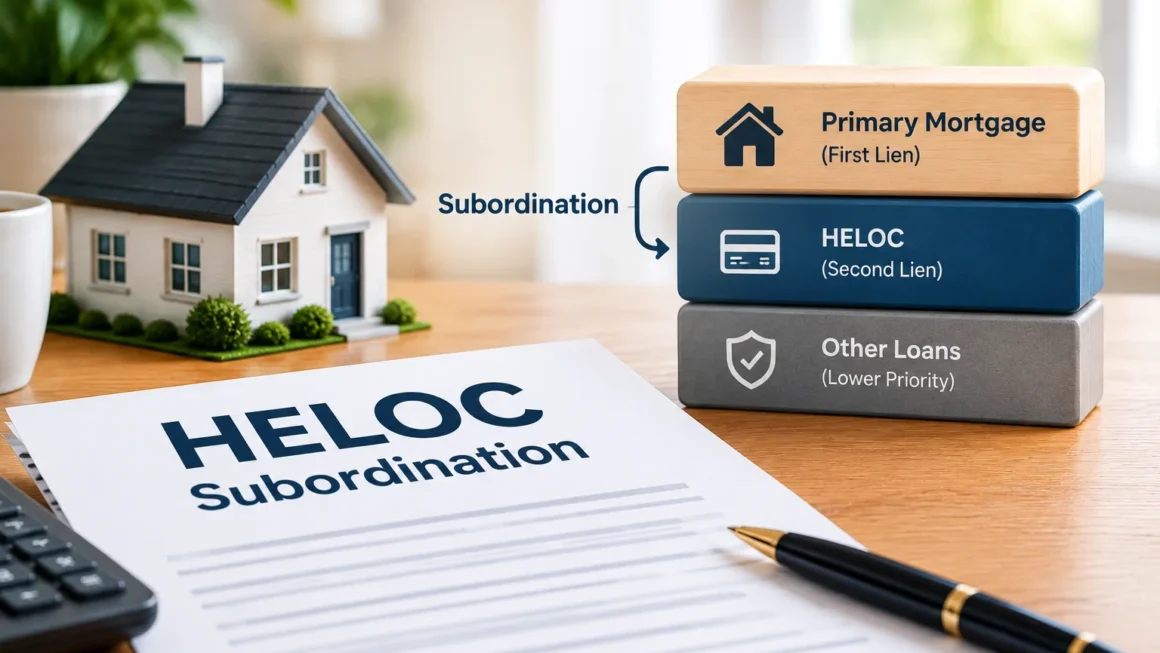
If you want to refinance your first mortgage down the road, having an active HELOC in second position complicates things. The HELOC lender must agree to “resubordinate” — essentially agreeing to remain in second position behind the new refinanced first mortgage. Some HELOC lenders charge fees for this; others may decline, which can limit your refinancing options or force you to pay off the HELOC first.
Piggyback HELOC vs. Traditional PMI: Side-by-Side Comparison
| Factor | Piggyback HELOC (80-10-10) | Traditional Mortgage with PMI |
| Number of loans | Two (first mortgage + HELOC) | One |
| PMI required | No | Yes, until 78–80% LTV reached |
| Interest rate structure | First loan fixed/variable; HELOC typically variable | Single rate, fixed or variable |
| Tax deductibility of interest | HELOC interest deductible only if funds used to buy/build/improve the home (IRS rules) | PMI itself is not deductible under current law |
| Payment predictability | Lower — HELOC rate can fluctuate | Higher — PMI premium is generally fixed for the year, recalculated annually based on declining balance |
| Ability to eliminate the cost early | Yes, by paying down HELOC principal on your own schedule | Somewhat — must reach 80% LTV and request cancellation, or wait for automatic cancellation at 78% |
| Closing costs | Potentially two sets of fees | One set of fees |
| Underwriting complexity | Higher — two loans, two approvals, combined DTI | Lower — single loan approval |
| Refinance flexibility | Requires HELOC lender’s subordination agreement | No second lien to manage |
| Risk profile | Higher — variable rate exposure on second loan | Lower — cost structure is regulated and predictable |
Qualifying for a Piggyback HELOC: What Lenders Look For
Because you’re applying for two loans that will close simultaneously, lenders scrutinize piggyback structures more closely than a standard single mortgage. Typical requirements include:
Credit Score
Most lenders want to see a minimum credit score of 680–700 for the first mortgage, but the HELOC piece often requires 700+ for competitive pricing. Borrowers with scores below 680 will find piggyback structures difficult to secure altogether, and the ones available tend to carry higher rates that erode the PMI-avoidance benefit.
Debt-to-Income Ratio (DTI)
Lenders combine the payments from both loans when calculating your DTI. Most conventional guidelines cap DTI around 43–45%, though some lenders allow higher with strong compensating factors (large cash reserves, high credit score). Because the HELOC’s payment is calculated on the fully-indexed rate (not the promotional or interest-only rate) in many underwriting models, your DTI can look worse on paper than the “real” initial payment suggests.
Cash Reserves
Because you’re taking on two loans, lenders often want to see 2–6 months of mortgage payments in reserve after closing, sometimes more depending on property type and loan amount.
Employment and Income Verification
Standard W-2 or self-employment documentation is required for both loans, and inconsistencies between the two applications (which may go to different lenders) can slow down or derail the closing process.
Property Type Restrictions
Piggyback structures are generally easier to secure on primary residences. Investment properties and second homes often face stricter LTV limits and higher rate premiums on both pieces of the loan.
Same-Lender vs. Different-Lender Piggyback Loans
You can structure a piggyback loan either through a single lender offering both products, or through two separate lenders — one for the first mortgage, one for the HELOC.
Same lender (or lender-affiliated HELOC provider):
- Streamlined underwriting and closing process
- Easier subordination agreements down the road since it’s the same institution
- Potentially bundled discounts or rate incentives
- Less rate-shopping leverage since you’re negotiating both pieces with one entity
Different lenders:
- More room to shop for the best HELOC rate independently
- More coordination required — two closing timelines, two sets of documentation, two underwriters who need to communicate
- Subordination on future refinances may be more complicated since you’re dealing with an outside HELOC lender who has no relationship with your future refinance lender
Most mortgage brokers who regularly structure piggyback loans have relationships with specific HELOC lenders who are used to this exact transaction type, which can significantly smooth the process. If you’re pursuing this strategy, working with a broker experienced in 80-10-10 structures — rather than a loan officer who’s never done one — is worth the extra vetting.
Tax Implications of the Piggyback HELOC Strategy
Under current federal tax law, mortgage interest deductibility rules changed significantly with the Tax Cuts and Jobs Act, and HELOC interest is treated differently than it was before 2018.
Key rule: HELOC interest is only tax-deductible if the loan proceeds are used to “buy, build, or substantially improve” the home that secures the loan. In a piggyback purchase-money structure, the HELOC proceeds are used directly to purchase the home — which generally satisfies this requirement, making the interest potentially deductible, subject to the combined mortgage debt limit (currently $750,000 for loans originated after December 15, 2017, for married couples filing jointly; $375,000 if filing separately).
This is a meaningful point of differentiation from PMI, which is not currently deductible under federal tax law (the itemized PMI deduction that existed in prior years has lapsed and has not been consistently renewed). This means the piggyback HELOC strategy may offer a tax advantage that traditional PMI does not, assuming you itemize deductions and stay under the combined debt cap.
That said, tax law changes, and deduction eligibility depends on your individual filing situation, whether you itemize versus take the standard deduction, and how the loan proceeds are documented and used. This is not something to assume applies to your situation without professional guidance — consult a CPA or tax advisor before factoring tax savings into your decision-making, since a miscategorized use of funds can jeopardize the deduction entirely.
Step-by-Step: How to Set Up a Piggyback HELOC When Buying a Home
Step 1: Get Pre-Approved for the Combined Structure
Work with a lender or broker who explicitly offers 80-10-10 (or similar) structures. Not all lenders do this routinely, so ask directly during your initial consultation rather than assuming it’s available.
Step 2: Compare the True Cost, Not Just the Headline Rate
Request a loan estimate for both the first mortgage and the HELOC, and calculate the combined monthly payment against a single mortgage with PMI. Don’t just compare interest rates — compare total monthly cash outflow and total interest paid over your expected payoff timeline for the second loan.
Step 3: Confirm HELOC Draw Terms
Understand exactly how much of the HELOC will be drawn at closing (usually the full second-loan amount, since it’s funding part of the purchase), what the interest-only period looks like, and when the loan converts to a repayment schedule.
Step 4: Underwrite Both Loans Simultaneously
Expect to submit documentation to two underwriting processes at once. Confirm your loan officer or broker is coordinating timelines so both loans close together — a mismatch in closing dates can derail the entire purchase.
Step 5: Build an Aggressive Payoff Plan Before Closing
Before you close, map out how quickly you realistically intend to pay down the HELOC. If you don’t have a credible plan to eliminate it faster than PMI would have cancelled, the strategy likely isn’t worth the added complexity and rate risk.
Step 6: Monitor the HELOC Rate Post-Closing
Since HELOC rates are variable, check your rate and payment regularly. If your HELOC lender offers a fixed-rate conversion option on all or part of the balance, evaluate whether locking in a portion makes sense if rates are rising.
Common Piggyback Loan Structures Beyond 80-10-10
While 80-10-10 is the most talked-about version, several variations exist depending on down payment size and buyer goals:
- 80-15-5: Buyer puts down only 5%, second loan covers 15%. This increases reliance on the HELOC and typically results in a larger, longer-term second loan balance — meaning more interest rate risk and a longer payoff runway.
- 80-20-0: No down payment at all. Increasingly rare in today’s underwriting environment, and when available, usually reserved for extremely strong borrower profiles (high income, excellent credit, substantial reserves).
- 75-15-10 or other splits: Some lenders structure the first mortgage below 80% to secure better first-mortgage pricing or to meet specific loan program requirements, with the second loan sized accordingly.
Each variation shifts the balance of risk and cost differently. Smaller down payments mean a larger second-loan balance, which magnifies the impact of HELOC rate movements — a 15% piggyback loan is far more sensitive to rate increases than a 5% one.
Piggyback HELOC vs. Lender-Paid PMI vs. Higher Interest Rate in place of PMI
Buyers exploring ways to avoid traditional monthly PMI have a few options besides the piggyback structure, and it’s worth understanding how they stack up:
Lender-Paid Mortgage Insurance (LPMI): The lender pays the PMI premium upfront, but recoups the cost by charging a higher interest rate on the entire loan for its full term. Unlike borrower-paid PMI, LPMI never cancels — you’re stuck with the higher rate for the life of the loan (or until you refinance).
Single-Premium PMI: PMI is paid in one lump sum at closing rather than monthly. This can be cheaper over time if you plan to stay in the home long-term and don’t want a monthly PMI line item, but it requires more cash at closing and isn’t refundable in most cases if you sell or refinance early.
Piggyback HELOC: As detailed above — avoids PMI entirely by structuring around the 80% LTV threshold.
| Option | Monthly Cost Impact | Duration | Refinance Impact | Cancels? |
| Borrower-paid PMI | Added monthly line item | Until 78–80% LTV | None | Yes, automatically or on request |
| Lender-Paid PMI (LPMI) | Built into a higher rate | Life of loan | Higher rate carries through | No — must refinance to remove |
| Single-Premium PMI | One-time upfront cost | Life of loan (no monthly charge) | Complicates refund calculations | Generally no refund after early payoff |
| Piggyback HELOC | Second loan payment (variable) | Until HELOC is paid off (borrower-controlled) | Requires subordination | Yes — borrower eliminates it directly |
The piggyback strategy stands out because it’s the only option where the borrower retains direct control over how quickly the added cost disappears.
Real-World Breakeven Analysis
Let’s run a more detailed breakeven scenario using our earlier example: a $450,000 home, $45,000 down (10%), first mortgage of $360,000 at 6.5%, and a second loan (HELOC) of $45,000.
Assumptions:
- PMI rate: 0.75%/year on the higher loan balance ($405,000), declining as principal is paid
- HELOC rate: 9%, interest-only for the first 5 years, then converts to a 15-year repayment schedule if not paid off sooner
- Buyer’s goal: eliminate the “extra cost” (PMI or HELOC) as fast as possible
Scenario 1 — Buyer pays only the minimum on both:
- PMI path: Cancels automatically around year 5–6 once the loan amortizes to 78% LTV. Total PMI paid: approximately $16,500.
- HELOC path (interest-only, no extra principal payments): Buyer pays roughly $4,050/year in interest ($337.50/month) for 5 years = $20,250 in interest, and the full $45,000 principal is still owed at the end of year 5, now entering a repayment phase.
In this scenario, PMI actually comes out ahead, because the buyer never accelerates payoff of the HELOC — they’re just making minimum interest-only payments, which means they’ve paid more in interest than PMI cost, and they still owe the full principal balance PMI never would have required.
Scenario 2 — Buyer aggressively pays down the HELOC ($1,000/month toward principal in addition to interest):
- HELOC balance is eliminated in roughly 3.5–4 years
- Total interest paid on the HELOC over that period: approximately $7,500–$8,500
- Total cost is meaningfully lower than the ~$16,500 in PMI paid over 5–6 years, and the buyer has zero second-loan balance once paid off, versus PMI simply disappearing on its own with no acceleration possible
This comparison illustrates the central truth of the piggyback HELOC strategy: it is not automatically cheaper than PMI — it’s cheaper only if you actively and aggressively pay down the second loan faster than PMI’s amortization-driven cancellation timeline. Buyers who go this route and then treat the HELOC like a normal, low-priority debt often end up paying more than they would have with straightforward PMI.
Risks Specific to HELOCs as the Piggyback Vehicle
Rate Resets and Payment Shock
Most HELOCs have a draw period (often 5–10 years) followed by a repayment period where the loan fully amortizes, sometimes over 10–20 years. If a buyer hasn’t paid down the balance significantly by the time the repayment period begins, the payment can jump substantially — both because principal is now included and because the rate may have moved.
Prime Rate Exposure
HELOC rates are typically indexed to the prime rate plus a margin. When the Federal Reserve raises rates, HELOC rates follow closely and quickly — unlike fixed-rate PMI costs, which don’t move with broader rate cycles at all.
Home Equity Line Freezes
Lenders retain the right, in some circumstances, to freeze or reduce a HELOC’s available credit line if home values drop significantly or if the borrower’s financial situation changes — though this is more relevant to HELOCs used post-purchase for ongoing access than to the piggyback structure, where the full second-loan amount is drawn at closing.
Cross-Collateralization Risk
Both loans are secured by the same property. If you fall behind on either loan, you risk foreclosure — same as with PMI, but now you have two separate loan servicers, two sets of communications, and potentially two different loss-mitigation processes to navigate if you hit financial trouble.
Alternatives Worth Considering Before Committing to a Piggyback Structure
- Saving for a full 20% down payment, if your timeline allows, eliminates PMI and piggyback complexity — though this isn’t realistic for many buyers in high-cost markets.
- Physician loans or other specialty programs for qualifying professionals sometimes waive PMI without requiring a second loan at all.
- VA loans, for eligible veterans and service members, require no PMI and no down payment, making the piggyback strategy unnecessary.
- USDA loans, for eligible rural properties, also avoid traditional PMI in favor of a different guarantee fee structure.
- Negotiating seller credits toward closing costs can free up more of your own cash for a larger down payment, potentially avoiding PMI without a second loan.
None of these apply to every buyer, but they’re worth ruling out before assuming a piggyback HELOC is your only path to avoiding PMI.
Questions to Ask Your Lender Before Choosing a Piggyback HELOC
- What is the fully-indexed HELOC rate used for underwriting, not just the promotional or interest-only rate?
- What happens to the HELOC rate and payment structure at the end of the draw period?
- Are there fees for extra principal payments or early payoff on the second loan?
- Will this specific HELOC lender agree to subordinate the loan if I refinance my first mortgage later?
- What are the total closing costs across both loans combined, compared to a single mortgage with PMI?
- Is there a fixed-rate conversion option available on all or part of the HELOC balance?
- How is my combined DTI being calculated, and does it include the fully-indexed HELOC payment?
Frequently Asked Questions
Is a piggyback HELOC the same as a second mortgage? It functions as a second mortgage in that it’s secured by the same property and sits in a second lien position behind the primary mortgage. The specific structure — HELOC versus a fixed-rate home equity loan — determines whether the rate is variable or fixed, but both are technically second mortgages used in tandem with a first mortgage.
Can I use a piggyback HELOC strategy on a refinance, not just a purchase? Yes, though it’s less common. A homeowner refinancing with less than 20% equity could theoretically use a similar structure to avoid PMI on the refinance, splitting the new financing into a primary refinance loan and a second HELOC. The mechanics are similar, but lender availability for this specific use case varies more than it does for purchase transactions.
What credit score do I need for a piggyback HELOC? Most lenders want a minimum of 680–700 for the first mortgage, and the HELOC portion often requires similar or slightly higher scores for competitive pricing. Below that range, piggyback structures become harder to find and less cost-effective when they are available.
Does a piggyback HELOC affect my ability to get a future mortgage or refinance? It can. Any refinance of the first mortgage requires the HELOC lender’s agreement to subordinate their lien, which isn’t guaranteed and may come with fees. It’s worth confirming subordination policies with your HELOC lender before closing.
Is HELOC interest tax-deductible in a piggyback purchase structure? Potentially, since the funds are used to purchase the home — but this depends on your overall itemized deduction eligibility, the combined mortgage debt limit, and current IRS rules. This isn’t something to assume without checking with a tax professional, since deduction eligibility depends heavily on individual circumstances.
What happens if home values drop after I close on a piggyback loan? Your first mortgage remains at whatever LTV it was structured at closing, so PMI still isn’t triggered on that loan. However, a value drop can affect your overall equity position and could make a future HELOC line reduction more likely if you were to draw on the line further, and it may complicate refinancing since your combined loan balance could exceed the home’s new market value.
Is a piggyback HELOC riskier than just paying PMI? It carries different risks, not necessarily worse ones. PMI has a fixed, regulated cost and a legally mandated cancellation timeline. A piggyback HELOC has variable-rate exposure and requires borrower discipline to pay down aggressively, but it also gives the borrower direct control over eliminating the cost, rather than waiting on amortization schedules.
Can I get a piggyback HELOC with less than 5% down? It’s uncommon. Most piggyback structures assume the borrower is contributing at least 5–10% of their own cash, with the HELOC filling the remaining gap up to 20%. Lenders offering 80-20-0 structures with zero down exist but are far less common and typically reserved for exceptionally strong borrower profiles.