Introduction
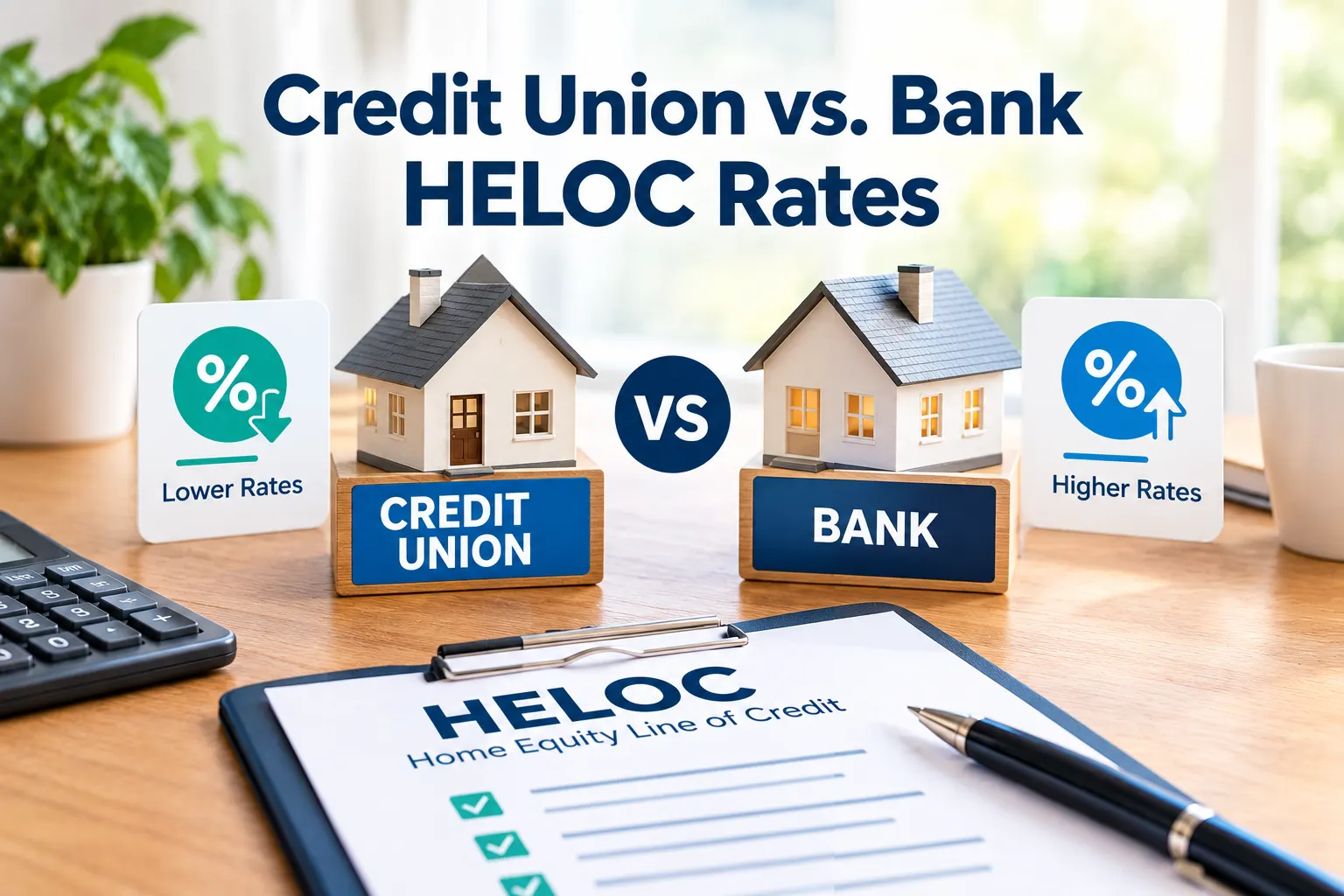
When homeowners start shopping for a home equity line of credit, most begin the same way: they check the rate their existing bank offers, maybe glance at one or two national online lenders, and call it research. What a lot of borrowers skip entirely is checking with a local credit union—and that’s often a mistake, because credit unions frequently offer better HELOC terms than large national or regional banks.
This isn’t true in every case, and it isn’t true for every borrower. But the pattern shows up often enough, and for structural reasons specific to how credit unions are built, that it’s worth understanding before you commit to a HELOC lender. This guide breaks down exactly why credit unions sometimes beat banks on HELOC pricing, where banks still have the edge, and how to actually compare offers so you land on the best deal for your situation rather than the most convenient one.
The Fundamental Structural Difference: Member-Owned vs. Shareholder-Owned
To understand why credit union HELOC rates sometimes undercut bank rates, you have to start with the basic business model difference between the two types of institutions.
Banks are for-profit companies, typically owned by shareholders. Whether it’s a small community bank or a national giant, the institution exists to generate profit, and a portion of the interest and fees collected from loans flows back to shareholders as returns. This isn’t a criticism—it’s simply how banks are structured, and it’s a legitimate business model that funds a lot of useful infrastructure and services.
Credit unions are structurally different. They’re not-for-profit financial cooperatives, owned by their members rather than outside shareholders. When you open an account or take out a loan with a credit union, you typically become a member with a small ownership stake, not just a customer. Because there are no outside shareholders demanding dividends, credit unions can operate with narrower margins between what they pay out on deposits and what they charge on loans, passing more of that difference back to members in the form of better rates—whether that’s higher interest on savings accounts or lower interest on loans, including HELOCs.
This isn’t marketing spin; it’s baked into the tax and regulatory structure. Credit unions are exempt from federal income tax due to their not-for-profit, member-owned status, which further reduces their cost structure compared to for-profit banks that do pay corporate income tax on their earnings. Lower operating costs and tax obligations translate, at least in part, into more competitive lending rates.
Why This Matters Specifically for HELOCs
HELOC pricing is particularly sensitive to a lender’s cost structure because, unlike a fixed-rate mortgage where pricing is heavily influenced by what the loan can be sold for on the secondary market, HELOCs are typically held on the originating institution’s own books. Banks and credit unions aren’t bundling and selling HELOCs to investors the way they often do with 30-year fixed mortgages. That means the lender offering the HELOC bears the ongoing cost and risk directly, and their internal cost of funds and margin requirements translate more directly into the rate they offer you.
Because credit unions generally have a lower cost of funds (no shareholder profit requirement, tax-exempt status, and often lower overhead than large national banks with expansive branch networks and marketing budgets), they frequently have more room to offer a lower margin over the prime rate—which is how most HELOC rates are structured.
How HELOC Rates Are Actually Set
Before comparing institutions, it helps to understand the mechanics of HELOC pricing itself, since this is where the credit union advantage becomes concrete rather than abstract.
Most HELOCs carry a variable interest rate tied to the prime rate, which itself moves based on the Federal Reserve’s federal funds rate. Your actual HELOC rate is calculated as the prime rate plus a margin (sometimes described as prime plus a certain number of percentage points), and that margin is where lenders actually compete with each other. The prime rate itself is the same across virtually all lenders at any given time—it’s a benchmark, not something a bank or credit union sets independently—so the margin added on top is the real battleground for competitive pricing.
Your specific margin is determined by underwriting factors like your credit score, combined loan-to-value ratio, debt-to-income ratio, and sometimes your existing relationship with the institution. But even accounting for identical borrower qualifications, credit unions frequently advertise lower starting margins than comparable bank offers, specifically because of the cost-of-funds advantage discussed above.
Some lenders, both banks and credit unions, also offer introductory or promotional rates for an initial period (commonly six months to a year), after which the rate reverts to the standard prime-plus-margin formula. These promotional rates can make bank offers look temporarily competitive, so it’s important to compare the ongoing, post-promotional rate structure, not just the number advertised in bold on a landing page.
Where Credit Unions Tend to Win
Lower Margins Over Prime
As discussed, this is the core advantage. Because of lower cost of funds and no shareholder profit obligation, credit unions frequently offer a smaller margin added to the prime rate compared to national banks, resulting in a genuinely lower ongoing interest rate over the life of the HELOC, not just during an introductory period.
Lower or Waived Fees
Credit unions often have lower origination fees, annual fees, and closing costs on HELOCs compared to large banks, and some waive these fees entirely for members, particularly members with an existing relationship (checking account, savings account, or other loans) at the institution. Large banks, while sometimes offering fee waivers of their own as a promotional incentive, often build meaningful fee structures into their standard HELOC pricing.
More Flexible Underwriting
Because credit unions are smaller, member-focused institutions, they sometimes have more flexibility to manually underwrite borderline files rather than relying entirely on rigid automated underwriting criteria. A borrower with a slightly lower credit score but a strong overall relationship with a local credit union—consistent deposits, other loans in good standing, long membership tenure—may find more willingness to work with them than they would at a large national bank evaluating the file purely on standardized criteria.
Better Rates for Existing Members
Many credit unions offer relationship-based rate discounts, shaving a small amount off the margin for members who maintain a checking account, direct deposit, or other qualifying relationship with the institution. Because credit union membership itself often requires some form of existing relationship (employer affiliation, geographic residency, or family membership through an existing member), a meaningful share of HELOC applicants at a credit union already qualify for these relationship discounts by default.
More Personalized Service During the Process
This is less about the rate itself and more about the overall experience, but it matters for HELOCs specifically because the underwriting and subordination-related paperwork (if you have another mortgage) can be more hands-on than a simple deposit account transaction. Smaller institutions frequently offer more direct access to underwriters or loan officers, rather than routing borrowers through call centers, which can smooth out issues that arise mid-process.
Where Banks Still Have the Edge
It wouldn’t be accurate to present credit unions as universally better—there are real scenarios where a bank, particularly a large national one, makes more sense.
Broader Technology and Digital Tools
Large banks generally invest more heavily in digital account management, mobile apps, and online HELOC draw/repayment tools. If seamless digital access matters a lot to you, some credit unions—particularly smaller, local ones—may lag in this area, though many credit unions have significantly closed this gap in recent years.
Higher Maximum Credit Limits
National banks, with larger balance sheets, sometimes offer higher maximum HELOC credit limits than smaller credit unions, which may cap their lending exposure per borrower at a lower threshold. If you’re seeking a particularly large HELOC relative to your home’s equity, a large bank may have more room to accommodate that request.
Broader Branch and ATM Networks
If in-person access matters, or if you travel frequently and want banking access nationwide, large banks typically offer far more extensive branch and ATM networks compared to credit unions, which are often geographically concentrated or membership-restricted.
More Loan Officer Bandwidth During High-Volume Periods
During periods of high refinance or HELOC application volume (such as when rates drop significantly), large banks may have more staffing capacity to handle volume without significant processing delays, whereas a smaller credit union with a lean staff could experience longer turnaround times.
Established Relationships With Larger or More Complex Financial Pictures
If your financial situation involves multiple properties, business banking needs, or complex income documentation, a large bank with broader institutional resources and more varied loan products may be better equipped to handle the full picture in one place.
Membership Eligibility: The Catch With Credit Unions
Here’s the practical hurdle that keeps a lot of borrowers from even considering a credit union: you typically have to be eligible for membership, and membership requirements vary by institution.
Common credit union membership eligibility paths include:
- Employer-based eligibility: Many credit unions were originally founded to serve employees of a specific company, industry, or government agency.
- Geographic eligibility: Some credit unions serve anyone living, working, worshipping, or attending school within a specific county or region.
- Family-based eligibility: Many credit unions allow membership if an immediate family member is already a member.
- Association-based eligibility: Some credit unions extend membership through affiliation with certain organizations, alumni associations, or advocacy groups, sometimes requiring a small one-time donation to the affiliated organization to qualify.
The good news is that credit union membership eligibility has broadened significantly in recent years, and many credit unions now have fairly accessible paths to membership, particularly community-chartered credit unions that serve entire metro areas or regions rather than a single narrow employer group. It’s worth checking eligibility for a few local credit unions even if you don’t have an obvious existing connection—many have broader qualifying criteria than people assume.
How to Actually Compare Credit Union and Bank HELOC Offers
Rate comparison shopping for a HELOC is more nuanced than simply looking at the advertised rate, because several other variables affect the true cost and usability of the line.
Compare the margin over prime, not just the current headline rate. Since the prime rate is the same across lenders, the differentiator is the margin. Ask each lender directly what their margin is, separate from any promotional rate.
Ask about introductory/promotional rate duration. If one lender’s attractive rate is only good for six months, and another’s slightly higher rate is the real ongoing rate, you need the full picture to compare accurately.
Get the full fee schedule, not just the origination fee. Ask about annual fees, early closure fees (some HELOCs charge a fee if you close the account within a certain number of years), inactivity fees, and any fees for converting a portion of the balance to a fixed rate, if that feature is offered.
Understand the draw period and repayment period structure for each offer. These can vary meaningfully between lenders and significantly affect your monthly payment obligations, particularly once the interest-only draw period ends and full repayment begins.
Ask about rate caps. Since HELOCs are variable-rate products, ask each lender what the maximum rate cap is over the life of the line, so you understand your worst-case exposure if the prime rate rises significantly.
Check whether a relationship discount applies, and what’s required to get it. If a credit union offers a lower rate specifically for members with a checking account or direct deposit, factor in whether you’re willing to establish that relationship to access the discount.
Ask about the maximum combined loan-to-value allowed. This affects how large a line you can actually qualify for, which matters as much as the rate itself if you need access to a specific amount of equity.
A Practical Example
Imagine two otherwise identical borrowers—same credit score, same home value, same combined loan-to-value ratio—shopping for a $75,000 HELOC.
A large national bank offers prime plus 1.5%, with a $75 annual fee and a $500 origination fee, alongside a six-month promotional rate of prime plus 0.5% before it reverts to the standard margin.
A local community credit union, where the borrower qualifies for membership through their employer, offers prime plus 0.75%, no annual fee for members with a checking account, and no origination fee.
On paper, the bank’s promotional rate might look more attractive in month one. But once the promotional period ends, the credit union’s ongoing rate is meaningfully lower, and the fee structure is lighter across the board. Over a multi-year draw period, the credit union offer would likely save this borrower a noticeable amount in both interest and fees—which is exactly the kind of gap that gets missed when borrowers compare only the initial advertised number.
Doesn’t Bigger Always Mean Better Technology and Reliability?
Not necessarily, though this is a common assumption. While it’s true that some smaller credit unions have historically lagged in digital banking tools, many have invested heavily in modernizing their online and mobile platforms, and plenty of regional and larger credit unions now offer digital experiences comparable to major banks. It’s worth actually checking a specific credit union’s online banking reviews and app ratings rather than assuming smaller automatically means outdated—this varies a lot by institution, and generalized assumptions in either direction (that credit unions are always better, or always behind on technology) can lead you to skip a genuinely competitive offer.
What About Credit Union HELOCs and Subordination or Refinancing Down the Line?
One consideration worth flagging for borrowers weighing a credit union HELOC: if you later refinance your first mortgage, your HELOC will need to be subordinated to the new first mortgage, regardless of whether it’s held by a bank or a credit union. Credit unions are just as capable of handling subordination requests as banks, though processing speed and internal procedures vary by institution, just as they do among banks. If smooth future refinancing is a priority, it’s reasonable to ask a credit union directly about their typical subordination turnaround time and process, the same way you would with a bank.
Common Misconceptions About Credit Unions and HELOCs
“Credit unions are only for people with modest incomes or limited banking needs.” This isn’t accurate. Credit unions serve members across the full range of income and financial complexity, and many offer competitive products for larger loans, including substantial HELOCs, not just basic checking and savings accounts.
“Credit unions don’t report to credit bureaus the same way banks do.” Credit unions report to credit bureaus just like banks do; there’s no meaningful difference in how a credit union HELOC affects your credit profile compared to a bank HELOC.
“You have to give up your existing bank entirely to use a credit union.” Not at all—there’s no requirement to close your existing bank accounts to take out a HELOC with a credit union. Many borrowers maintain accounts at both a bank and a credit union simultaneously, using each for different purposes.
“Credit unions are riskier or less regulated than banks.” Credit unions are federally regulated, and most are insured by the National Credit Union Administration (NCUA), which provides deposit insurance comparable to FDIC insurance at banks, generally up to the same standard coverage limits. They operate under meaningful regulatory oversight, not an informal or unregulated structure.
“It’s too complicated to become a member just for a HELOC.” For many community-chartered credit unions, membership eligibility is broader and easier to meet than people assume—often just requiring residency in a certain region, sometimes combined with a small minimum deposit to open a savings account as part of establishing membership.
When a Bank Might Genuinely Be the Better Choice for You
To be fair to banks, there are legitimate scenarios where choosing a bank over a credit union for your HELOC makes more sense, even if the raw rate comparison slightly favors the credit union:
- You need a very large credit line that exceeds what a smaller, local credit union is willing or able to extend.
- You travel frequently or live a highly mobile lifestyle and value a large branch/ATM network.
- You already have a strong, established relationship with a specific bank that offers meaningful relationship-based discounts or bundled account benefits.
- You don’t meet the membership eligibility criteria for any local credit union with competitive HELOC offerings.
- You prioritize the most advanced digital banking tools and a specific bank clearly outperforms local credit union options in that area.
- You need extensive additional financial products (business banking, wealth management, specialized lending) that a large bank offers in one integrated relationship.
How to Start Comparing: A Practical Approach
Start local. Search for credit unions in your city or region, and check membership eligibility criteria for each one—many are broader than expected.
Get real rate quotes, not just advertised ranges. Advertised HELOC rates on websites are often “as low as” figures reserved for the most qualified borrowers. Request an actual quote based on your credit profile and home value from both credit unions and banks before comparing.
Compare at least three offers, ideally a mix of credit unions and banks. This gives you a realistic sense of where the market actually sits for your specific profile, rather than assuming any single quote is representative.
Ask each lender the same standardized set of questions (margin over prime, fee schedule, draw and repayment period structure, rate cap, relationship discount eligibility) so you’re comparing apples to apples rather than working from inconsistent marketing materials.
Factor in your own priorities, not just the lowest rate. If digital convenience or a large branch network genuinely matters to your day-to-day banking life, weigh that against a marginally better rate from a smaller local institution.
Frequently Asked Questions
Are credit union HELOC rates always lower than bank rates?
No. While credit unions frequently offer more competitive margins due to their cost structure, this isn’t universal—some banks offer strong promotional rates, and individual credit union pricing varies significantly by institution. Direct comparison shopping is still necessary.
Do I need excellent credit to get a good rate at a credit union?
Credit union underwriting can sometimes be more flexible than large bank automated underwriting, but strong credit still generally results in better pricing at any institution, credit union or bank.
Can I join a credit union just to get a HELOC, without an existing relationship?
In many cases, yes—if you meet the credit union’s membership eligibility criteria (geographic, employer-based, or otherwise), you can typically join specifically to access their loan products, often by opening a modest savings account as part of the membership process.
Is my money less safe at a credit union than a bank?
No. Federally insured credit unions carry NCUA insurance that provides comparable protection to FDIC insurance at banks, generally up to the same standard limits per depositor, per institution.
Do credit unions offer fixed-rate HELOC options, or only variable rates?
Many credit unions, like many banks, offer the option to convert some or all of a variable-rate HELOC balance to a fixed rate for a portion of the draw, though this varies by institution and isn’t universal. It’s worth asking specifically if this feature matters to you.
Will a credit union HELOC show up differently on my credit report than a bank HELOC?
No, both report the same way to credit bureaus, and there’s no meaningful difference in how either type of HELOC affects your credit profile or score calculation.
Final Thoughts
The comparison between credit union and bank HELOC rates isn’t a case of one type of institution being definitively better than the other in every scenario—it’s a case of structurally different business models that often, though not always, tilt pricing in the credit union’s favor. Lower cost of funds, no shareholder profit requirement, and tax-exempt status give credit unions genuine room to offer more competitive margins and lighter fee structures, and that advantage shows up often enough in real-world offers that skipping a credit union comparison altogether means potentially leaving real savings on the table.
That said, the right choice still depends on your specific priorities: your comfort with a smaller institution, your need for a particularly large credit line, your appetite for the newest digital tools, and whether you meet membership eligibility somewhere competitive. The only way to know for certain which side wins for your specific situation is to actually get quotes from both types of lenders and compare them side by side, on the full terms—not just the number in bold on the homepage.