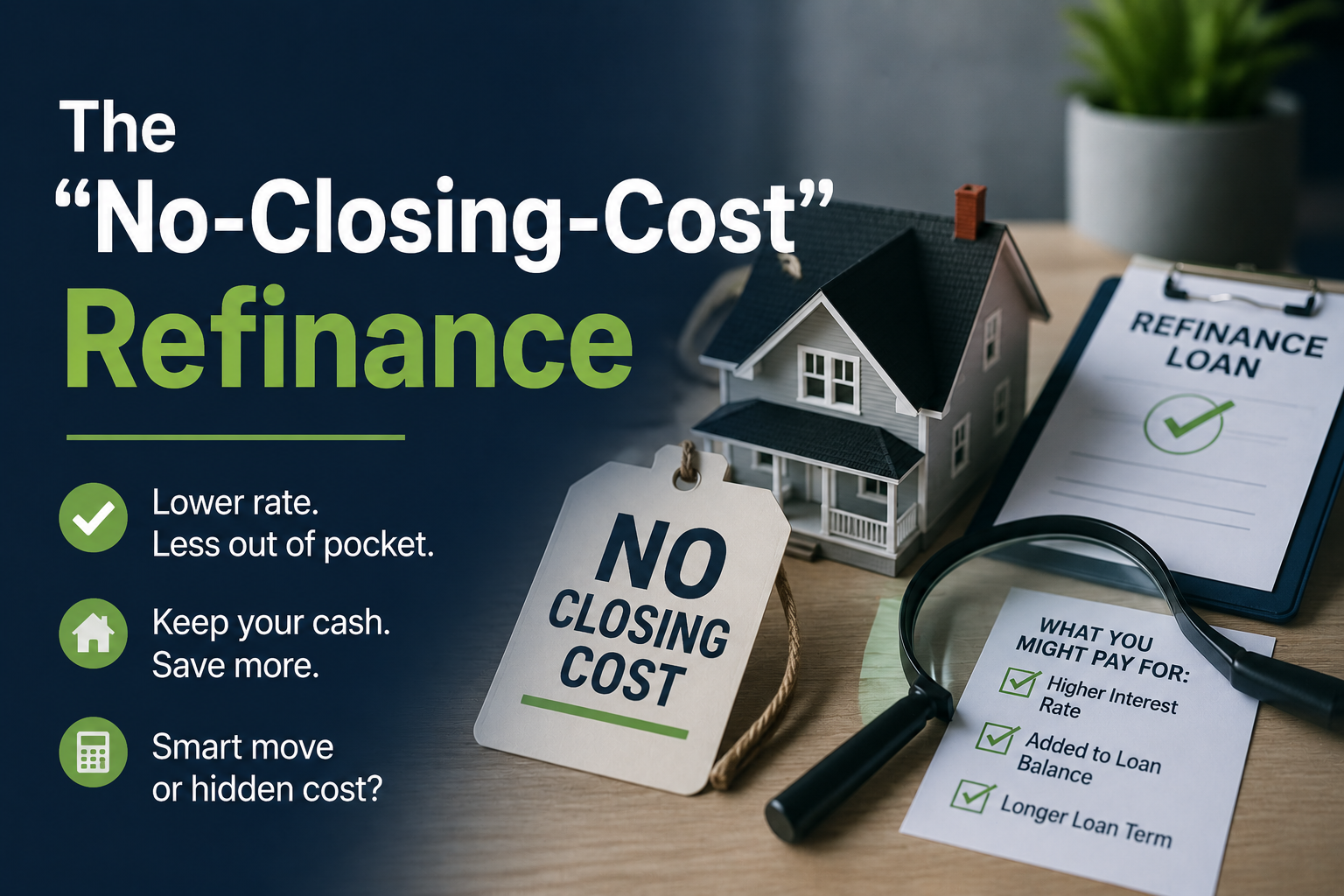
Introduction: The Offer That Sounds Almost Too Perfect
Picture this: You are scrolling through your email or browsing the web when an advertisement catches your eye. A lender is promising a mortgage refinance with absolutely no closing costs. No fees. No out-of-pocket expenses. Just a lower interest rate and a smaller monthly payment — starting immediately.
It sounds almost too good to be true.
And the truth is, sometimes it is — and sometimes it is not. The answer depends almost entirely on how well you understand what a no-closing-cost refinance actually is, how it works behind the scenes, and whether its specific trade-offs align with your financial goals and timeline.
No-closing-cost refinancing is one of the most misunderstood mortgage products in the market. Millions of homeowners have used it to their genuine advantage. Millions of others have accepted one without understanding what they agreed to — and ended up paying significantly more than they would have with a traditional refinance.
This article is your complete, no-nonsense guide to no-closing-cost refinancing. We will break down exactly how these loans work, who offers them, what the real costs are, how to calculate whether one makes sense for you, and the situations where this type of refinancing is a brilliant strategic move versus a costly mistake.
By the end of this guide, you will have everything you need to make a confident, informed decision — and to ask exactly the right questions when a lender makes you this offer.
What Is a No-Closing-Cost Refinance?
A no-closing-cost refinance is exactly what it sounds like on the surface: a mortgage refinancing arrangement in which the borrower does not pay closing costs upfront at the time of the loan closing.
But here is the critical truth that most advertisements leave out: the closing costs do not disappear. They are simply paid differently.
When you refinance a mortgage under a traditional arrangement, you are required to pay a set of fees at closing — typically ranging from 2% to 6% of the loan balance. On a $300,000 mortgage, that could mean anywhere from $6,000 to $18,000 due at or before closing.
A no-closing-cost refinance eliminates that upfront payment. Instead, lenders recover those costs in one of two primary ways:
Method 1: Rolling the Costs Into the Loan Balance
The lender adds the total closing costs to your outstanding loan balance. For example, if your remaining mortgage balance is $280,000 and your closing costs total $8,000, your new loan balance becomes $288,000. You now owe more than you did before refinancing.
You do not pay the fees up front, but you will pay interest on that larger balance for the entire life of the loan. Depending on your interest rate and how long you hold the loan, this can cost you significantly more than simply paying the closing costs out of pocket.
Method 2: Accepting a Higher Interest Rate (Lender Credits)
The more common no-closing-cost refinance mechanism involves what lenders call a “lender credit.” The lender offers you a slightly higher interest rate than you would otherwise qualify for. In exchange for that higher rate, the lender gives you a credit that covers your closing costs.
For example:
- Your best available refinance rate might be 6.25% with full closing costs paid upfront
- With a no-closing-cost option, the lender offers you 6.75% — and uses the extra revenue generated by that higher rate to absorb your closing costs
You pay nothing at closing. But every single month for the life of the loan, you pay a slightly higher mortgage payment than you would have at the lower rate.
Both methods have the same essential structure: you trade a lower long-term cost for the elimination of a short-term financial burden. Whether that trade is favorable depends on several factors — primarily how long you plan to stay in the home.
What Are Closing Costs, and Why Do They Exist?
To fully understand no-closing-cost refinancing, it helps to understand exactly what closing costs are and why lenders charge them.
Closing costs are a collection of fees associated with processing, underwriting, and completing a mortgage loan. They typically include:
- Loan origination fee — charged by the lender for processing the application (typically 0.5%–1% of the loan amount)
- Appraisal fee — the cost of a professional assessment of your home’s current market value ($300–$700 on average)
- Title search and title insurance — verifying legal ownership and protecting against title disputes ($500–$1,500)
- Credit report fee — the cost of pulling your credit history ($25–$50)
- Underwriting fee — charged for evaluating and approving your loan ($400–$900)
- Attorney or settlement fees — required in some states ($500–$1,000)
- Recording fees — government fees for recording the new mortgage ($50–$250)
- Prepaid items — including homeowners insurance premiums, property tax escrow, and prepaid interest for the remainder of the month of closing ($1,000–$3,000+)
- Discount points — optional upfront payments to lower your interest rate (each point equals 1% of the loan amount)
Added together, these costs are substantial. For most homeowners, coming up with $6,000 to $18,000 in cash at the time of refinancing is a genuine challenge — particularly for those who are refinancing specifically because their finances are under pressure.
This is exactly why no-closing-cost refinancing exists, and why it can be genuinely valuable in the right circumstances.
The Real Math: What No-Closing-Cost Refinancing Actually Costs You
Understanding the true cost of a no-closing-cost refinance requires some arithmetic. Let us work through a concrete example.
Scenario: Traditional Refinance vs. No-Closing-Cost Refinance
Loan Details:
- Current loan balance: $300,000
- Remaining loan term: 25 years
- Current interest rate: 7.5%
- Current monthly payment (principal + interest): $2,224
Option A: Traditional Refinance
- New interest rate: 6.25%
- Closing costs: $9,000 (paid upfront)
- New monthly payment: $2,001
- Monthly savings: $223
- Break-even point: $9,000 ÷ $223 = approximately 40 months (3 years, 4 months)
- Total interest paid over 25 years: approximately $300,400
Option B: No-Closing-Cost Refinance (Higher Rate)
- New interest rate: 6.75% (lender credit covers $9,000 in closing costs)
- Closing costs: $0 upfront
- New monthly payment: $2,082
- Monthly savings vs. current payment: $142
- Total interest paid over 25 years: approximately $324,600
The Difference: By choosing the no-closing-cost option, you save $9,000 upfront but pay an additional $24,200 in interest over the life of the loan. If you stay in the home for the full 25 years, the traditional refinance is dramatically cheaper — by more than $15,000 net.
However, if you only plan to stay in the home or keep this loan for 3 years or less, the no-closing-cost refinance saves you money — because you leave before the higher monthly payments accumulate past the point of the $9,000 savings.
This is the central calculation every homeowner must make before choosing a no-closing-cost refinance. The break-even timeline is everything.
The Break-Even Point: The Most Important Number in Refinancing
Whether you choose a traditional refinance or a no-closing-cost refinance, the concept of the break-even point should drive your decision.
The break-even point is the moment in time at which the total savings from your lower interest rate have equaled the total cost of obtaining that rate, whether that cost was paid upfront or embedded in your loan.
For a traditional refinance: Break-Even Point = Total Closing Costs ÷ Monthly Savings
If you paid $9,000 in closing costs and save $223 per month, your break-even point is roughly 40 months. Stay longer than 40 months, and you come out ahead. Leave before 40 months, and you lose money on the refinance.
For a no-closing-cost refinance, the break-even calculation is different but equally important. The question becomes: At what point does the cumulative cost of the higher monthly payment exceed what you would have paid in upfront closing costs?
Monthly cost of the higher rate: $2,082 − $2,001 = $81 per month more than the traditional refinance. Months until the extra payment cost exceeds the $9,000 saved: $9,000 ÷ $81 = approximately 111 months (just over 9 years)
If you stay in the home for fewer than 9 years, the no-closing-cost refinance costs you less overall. If you stay longer than 9 years, you would have been better off paying the closing costs up front.
This is why no-closing-cost refinancing is not inherently good or bad — it is situationally good or bad, depending entirely on your timeline.
Who Benefits Most from a No-Closing-Cost Refinance?
No-closing-cost refinancing is genuinely advantageous in specific circumstances. Here are the homeowners for whom this option tends to work best:
1. Homeowners Who Plan to Move Within 3 to 5 Years
If you know — or strongly believe — that you will sell your home within a few years, paying thousands in upfront closing costs for a traditional refinance makes little financial sense. You would likely leave before reaching the break-even point, meaning the closing costs were a net loss.
A no-closing-cost refinance lets you capture a lower rate immediately without the upfront investment that you would not have time to recover.
2. Homeowners Who Cannot Afford Upfront Closing Costs
For homeowners who are cash-constrained — perhaps they recently lost income, are recovering from a financial setback, or simply do not have liquid savings available — a no-closing-cost refinance provides access to lower rates without requiring thousands of dollars upfront.
This can be a genuine lifeline. Even a slightly lower payment can create meaningful breathing room in a tight monthly budget, and avoiding the upfront cost makes the refinance accessible when it otherwise would not be.
3. Homeowners in Falling Rate Environments
If interest rates are declining and you expect them to continue falling, a no-closing-cost refinance allows you to capture today’s improved rate without a significant upfront investment — and then refinance again when rates fall further, again without major upfront cost.
This “serial refinancing” strategy — repeatedly taking no-closing-cost refinances in a falling rate environment — can be highly effective, allowing homeowners to chase rates down a declining curve without accumulating high sunk costs each time.
4. Homeowners With High-Value Loans Near Payoff
If your remaining loan balance is relatively small and your loan is close to payoff, the absolute dollar value of the interest savings from a lower rate may not justify large upfront closing costs. A no-closing-cost refinance in this situation avoids a potentially bad cost-benefit trade-off.
5. Homeowners Refinancing Primarily to Change Loan Terms
If your primary goal is to switch from an adjustable-rate mortgage to a fixed-rate mortgage — for stability rather than rate savings — and the rate difference is modest, a no-closing-cost refinance avoids significant expense for a change that delivers peace of mind rather than dramatic financial savings.
Who Should Be Cautious About No-Closing-Cost Refinancing?
Just as this option suits some homeowners perfectly, it is a poor choice for others:
1. Long-Term Homeowners
If you have lived in your home for many years and plan to stay for many more, the compounding cost of a higher interest rate over an extended period will almost certainly exceed what you would have paid in upfront closing costs. For long-term owners, paying closing costs upfront and securing the lowest possible rate is almost always the better financial outcome.
2. Homeowners Refinancing Large Loan Balances
The larger your loan balance, the more significant the impact of a higher interest rate. A rate difference of 0.5% on a $500,000 loan generates substantially more extra interest than the same rate difference on a $150,000 loan. For large loans, even small rate increases translate into large dollar amounts over time.
3. Homeowners Seeking Maximum Cash-Out
If you are doing a cash-out refinance and rolling your closing costs into the loan, you are increasing an already larger balance. The compounding cost of interest on a larger principal over time can erode a significant portion of the cash equity you pulled out.
4. Homeowners Who Have Already Refinanced Recently
If you refinanced within the last few years, your loan amortization has already been reset once. Refinancing again, especially at a higher rate through a no-closing-cost product, means resetting amortization again and paying a disproportionately high ratio of interest to principal in the early years of the new loan. The math can be particularly unfavorable in this scenario.
No-Closing-Cost Refinance: Common Myths and Misconceptions
The marketing around no-closing-cost refinancing has generated several persistent myths. Here are the most important ones to understand:
Myth 1: “It’s Completely Free”
This is the most dangerous misconception. Nothing about a mortgage transaction is free. The costs are real — they are simply structured differently. Any lender who presents a no-closing-cost refinance as genuinely free is either misleading you or using language so imprecise as to be effectively misleading.
Always ask: “How are my closing costs being covered? Is it through a higher rate, a larger loan balance, or both?”
Myth 2: “The Interest Rate Is the Same as a Traditional Refinance”
It rarely is. Lenders offering true no-closing-cost refinances — particularly those using lender credits — will offer a rate that is typically 0.25% to 0.75% higher than their best available rate with full upfront closing costs. That difference, applied over years or decades, is substantial.
Myth 3: “There Are No Fees at All”
Some fees may still apply even in a no-closing-cost refinance. Certain prepaid items — like the first month’s interest, homeowners’ insurance premium deposits, or property tax escrow — may still be required at closing. Always get a full Loan Estimate document and read every line carefully.
Myth 4: “It’s Only for People With Bad Credit”
No-closing-cost refinancing is available across the credit spectrum and is used by financially sophisticated borrowers as a deliberate strategic choice. It is not a product of last resort — it is a cash flow management tool that has genuine strategic applications.
Myth 5: “Lender Credits Are the Same as Discount Points — Just in Reverse”
This is partially true but importantly incomplete. Discount points are upfront payments that permanently buy down your interest rate for the life of the loan. Lender credits are credits that increase your rate temporarily in exchange for covering closing costs. The symmetry is conceptually similar, but the financial implications are different and must be calculated individually.
How to Evaluate a No-Closing-Cost Refinance Offer
When a lender presents you with a no-closing-cost refinance offer, here are the exact steps to evaluate it properly:
Step 1: Request the Full Loan Estimate
Federal law requires lenders to provide a standardized Loan Estimate document within three business days of your application. This document shows every fee associated with the loan in a standardized format, making it possible to compare offers across lenders on equal terms. Do not make any decisions without this document.
Step 2: Identify How Closing Costs Are Being Covered
Ask your lender specifically: Are the closing costs being rolled into the loan balance, or are they being covered through a higher interest rate via lender credits? Understand exactly which mechanism is being used — and in some cases, both mechanisms may be at play simultaneously.
Step 3: Calculate Your Break-Even Timeline
Using the monthly payment difference between the no-closing-cost offer and the best traditional refinance offer, calculate how many months it would take for the additional monthly cost to equal the amount saved in upfront fees.
Then ask yourself honestly: How long do I plan to stay in this home with this loan?
Step 4: Compare Total Interest Paid Over Your Expected Timeline
Run the numbers for both options over your realistic holding period — not the full loan term, but how long you actually expect to keep the loan. Compare total payments, not just monthly payments.
Step 5: Get Competing Quotes
Never accept the first no-closing-cost offer you receive. Get quotes from at least three to five lenders — including banks, credit unions, online lenders, and mortgage brokers. The difference in offered rates and lender credit structures can be substantial, and shopping around can save thousands of dollars even within the no-closing-cost category.
Step 6: Consider Your Cash Flow Needs Holistically
Beyond the pure math, consider your broader financial situation. If paying $9,000 in closing costs would drain your emergency fund and leave you financially vulnerable, a no-closing-cost refinance might be the right choice even if it is slightly more expensive over time — because financial resilience has its own value.
How Lenders Profit from No-Closing-Cost Refinances
Understanding how lenders benefit from no-closing-cost refinancing helps you negotiate and evaluate these offers more effectively.
When a lender offers you a higher interest rate in exchange for a lender credit, they are not absorbing a loss. They are making a calculated bet that the higher rate will generate more revenue over time than the closing costs they are crediting. And in most cases — particularly for homeowners who stay in their homes long-term — they are correct.
The lender also profits by selling your loan on the secondary mortgage market. Loans with higher interest rates command higher prices from mortgage investors — so lenders are often paid a premium at the point of sale for loans with rates above market average.
This does not mean no-closing-cost refinancing is bad for you. It means it is a product designed for lenders to profit while offering a genuine benefit — the elimination of upfront costs — to borrowers. Understanding this dynamic helps you negotiate from a position of knowledge rather than naivety.
How to Get the Best No-Closing-Cost Refinance Deal
If you have evaluated your situation and determined that a no-closing-cost refinance is the right choice, here is how to optimize the deal:
1. Strengthen Your Credit Profile First
The higher your credit score, the lower the base rate a lender will offer — and the lower the rate from which your lender credit will be calculated. Even a modest improvement in your credit score (such as paying down a credit card balance) before applying can result in meaningfully better terms.
2. Work With a Mortgage Broker
Mortgage brokers have access to dozens of lenders and can shop your loan across multiple institutions simultaneously. They can often find better no-closing-cost structures than you would find by approaching individual lenders directly. Their fee is typically paid by the lender, not by you.
3. Negotiate the Rate, Not Just the Closing Costs
Once a lender has confirmed they can offer a no-closing-cost product, negotiate the interest rate within that structure. Even a 0.125% improvement in the offered rate can save thousands of dollars over the life of the loan.
4. Ask About Partial Closing Cost Coverage
Some lenders will allow you to pay a portion of the closing costs upfront in exchange for a slightly lower rate than the full no-closing-cost option provides. This hybrid approach — covering, say, $3,000 of $9,000 in closing costs — can sometimes deliver better overall value than either extreme.
5. Lock Your Rate Promptly
Once you find a favorable no-closing-cost offer, lock your interest rate in writing as quickly as possible. Rate lock agreements typically last 30 to 60 days. In a volatile interest rate environment, delays can mean your locked-in offer expires before closing — forcing you to accept a less favorable rate.
No-Closing-Cost Refinance and Tax Implications
There are several tax considerations relevant to no-closing-cost refinancing that every homeowner should understand:
Mortgage Interest Deduction
If you itemize deductions on your federal tax return, the mortgage interest you pay — including the additional interest generated by a higher no-closing-cost rate — is generally deductible up to IRS limits. However, the Tax Cuts and Jobs Act of 2017 significantly expanded the standard deduction, meaning fewer homeowners now benefit from itemizing. Consult a tax professional to determine whether this deduction applies to your situation.
Closing Cost Deductibility
In a traditional refinance, some closing costs — particularly discount points — can be deducted over the life of the loan. In a no-closing-cost refinance, since these costs are effectively embedded in your rate rather than paid explicitly, the deductibility treatment may differ. Again, professional tax guidance is important here.
Cash-Out Refinance Tax Rules
If your no-closing-cost refinance includes a cash-out component, different tax rules apply depending on how you use the proceeds. Funds used for substantial home improvements may qualify for mortgage interest deduction treatment, while funds used for personal expenses generally do not.
Special Situations: When No-Closing-Cost Refinancing Gets Complicated
FHA and VA Streamline Refinances
The FHA Streamline Refinance and VA Interest Rate Reduction Refinance Loan (IRRRL) programs are specifically designed to make refinancing fast and affordable for eligible borrowers. Both programs allow for no-appraisal, reduced-documentation refinancing, and both can be structured with no upfront closing costs through lender credits.
For eligible borrowers, these programs represent some of the most straightforward and genuinely beneficial no-closing-cost refinancing options available.
Investment Properties
No-closing-cost refinancing on investment properties follows the same structural logic as primary residence refinancing, but with important differences. Investment property loans carry higher interest rates to begin with, meaning the lender credit rate premium is applied to an already elevated baseline. The math must be recalculated carefully, and the tax implications differ from primary residence refinancing.
Condominiums and HOA Properties
Some lenders apply additional fees or restrictions to condominium refinances. Make sure any no-closing-cost offer you receive accounts for all condo-specific costs and that those costs are genuinely covered by the lender credit structure.
Red Flags: When a No-Closing-Cost Offer Should Worry You
Not every no-closing-cost refinance offer is legitimate or well-structured. Here are warning signs to watch for:
- The lender cannot clearly explain how the closing costs are being covered. Any reputable lender should be able to articulate exactly whether costs are being rolled into the balance, covered by lender credits, or both.
- The offered rate is dramatically higher than market rates. A premium of 0.25%–0.75% is typical for lender credit structures. A premium of 1.5% or more should raise serious concerns.
- There is no Loan Estimate provided. Federal law requires this document. A lender who resists providing it is not operating transparently.
- Pressure to close quickly without time to review documents. Legitimate lenders give you time to read and understand your loan documents.
- The offer sounds dramatically better than competing quotes. In mortgage lending, if one offer is significantly better than all others, it is almost always because something is different about the structure — and not always in your favor.
- Prepayment penalties are buried in the terms. Some no-closing-cost refinances include prepayment penalties that kick in if you sell or refinance again within a specified period — exactly the scenario where no-closing-cost products are most commonly used. Read every clause.
The Verdict: Is a No-Closing-Cost Refinance Too Good to Be True?
After everything we have covered, here is the honest answer: No, a no-closing-cost refinance is not too good to be true. But it is also not as good as it initially appears.
It is a genuine financial product with genuine strategic value — and it is also a product that costs more over the long term than it appears upfront. Both of these things are true simultaneously.
The homeowners for whom a no-closing-cost refinance is an excellent choice are those who:
- Plan to move or refinance again within three to seven years
- Cannot afford upfront closing costs without depleting emergency savings
- Are operating in a declining rate environment and plan to refinance again
- Have smaller loan balances where the rate premium has a limited dollar impact
The homeowners for whom a traditional refinance is almost certainly better are those who:
- Plan to stay in their home for ten or more years
- Have large loan balances where even small rate premiums generate large interest costs
- Can comfortably afford upfront closing costs without financial strain
- Have already refinanced recently and want maximum long-term savings
The key is not to accept the framing of the advertisement — that no upfront cost means no cost at all. The key is to do the math, know your timeline, compare your options honestly, and make the choice that serves your actual financial life rather than the one that looks most appealing in the moment.
A no-closing-cost refinance is a tool. Like all tools, it is only valuable when you use it for the right job.
Frequently Asked Questions (FAQs)
Q: Are no-closing-cost refinances legitimate? A: Yes. They are a standard mortgage product offered by reputable lenders. The key is understanding how the costs are structured — not avoiding them entirely.
Q: Can I negotiate a no-closing-cost refinance? A: Yes. You can negotiate the interest rate, the specific fees covered, and whether a hybrid approach (partial upfront payment, partial lender credit) might provide better value.
Q: How much higher is the interest rate on a no-closing-cost refinance? A: Typically 0.25% to 0.75% higher than the best available rate with full closing costs paid upfront. This varies by lender, loan size, and market conditions.
Q: Can I do a no-closing-cost refinance with bad credit? A: Possibly, but your options will be more limited, and the rate premium may be higher. Credit unions and FHA Streamline programs may offer the most accessible options for borrowers with lower credit scores.
Q: Do no-closing-cost refinances affect my home equity? A: If the costs are rolled into the loan balance, yes — your loan balance increases, which temporarily reduces your equity. If costs are covered by lender credits (higher rate), your balance is not increased.
Q: How often can I do a no-closing-cost refinance? A: There is no legal limit on how often you refinance, but lenders may have seasoning requirements (typically 6 to 12 months from your last refinance). Serial refinancing in a falling-rate environment using no-closing-cost products is a legitimate strategy, but it must be evaluated carefully each time.
Q: What is the difference between lender credits and discount points? A: They are essentially opposite mechanisms. Discount points are upfront fees that permanently lower your interest rate. Lender credits are rate increases that eliminate upfront fees. Both involve a trade-off between short-term and long-term costs.
In another related article, Documents You Need to Refinance Your Home: The Complete Checklist