
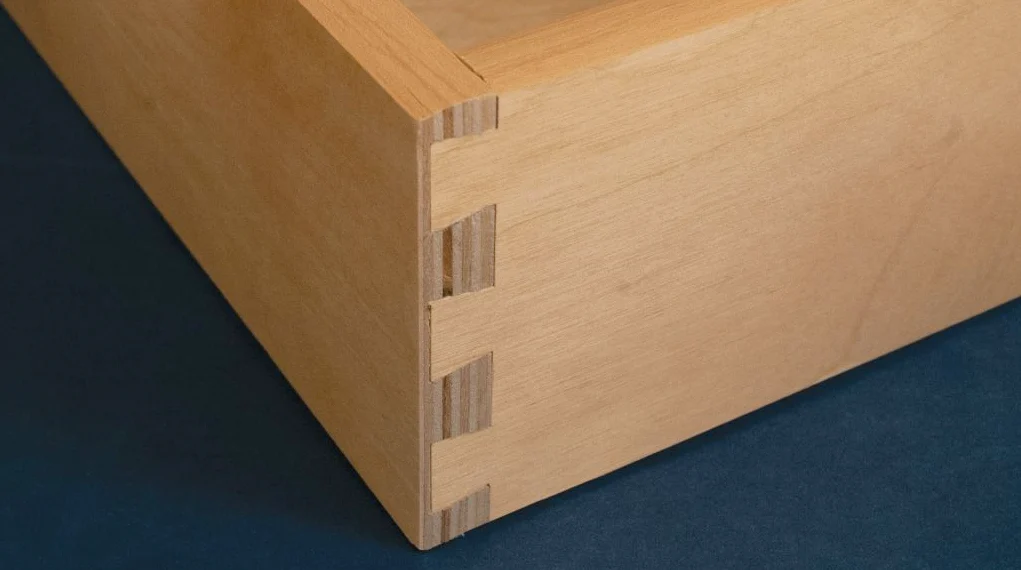
Furniture shopping is full of language designed to sound impressive without meaning much. “Solid wood accents.” “Premium finish.” “Heirloom quality.” Most of it is marketing shorthand that tells you almost nothing about how the piece will hold up in five years, let alone twenty. But there’s one detail that cuts through the noise almost every time: how the drawers are joined together.
Pull open a drawer. Look at the corners. What you see there — interlocking wood, or a few thin metal staples — tells you more about a piece of furniture’s real quality than the fabric, the finish, or the price tag ever will.
This guide walks through exactly what dovetail and stapled joints are, why the difference matters so much more than most shoppers realize, and how to inspect any drawer in under thirty seconds to know what you’re actually buying.
Why Drawer Joints Matter More Than You Think
Drawers are one of the hardest-working components in any piece of furniture. Every time a drawer opens and closes, the corners absorb the full force of that motion — the weight of the contents, the friction of sliding, and the small shocks of being pushed shut a little too hard. Over years of daily use, that stress adds up.
A drawer isn’t just a box. It’s a mechanical assembly that gets pulled, pushed, loaded, and jostled thousands of times over its life. The joints at the corners are the structural core of that assembly. If they fail, the whole drawer fails — the sides splay apart, the bottom drops, or the front detaches from the box entirely.
Here’s a rough sense of the stress involved: a mid-size dresser drawer loaded with folded clothing might weigh 15 to 25 pounds. A kitchen or file drawer packed with papers or cookware can weigh 30 to 40 pounds or more. Every one of those pounds pulls against the corner joints each time the drawer is opened, especially if it’s opened quickly or the piece isn’t perfectly level.
Multiply that by daily use over a decade, and you start to see why the corner joint — not the wood species, not the finish — is often the single best predictor of how long a piece of furniture will actually last.
What Is a Dovetail Joint?
A dovetail joint is a woodworking joint made of interlocking wedge-shaped “pins” and “tails” that fit together like puzzle pieces. When cut correctly, the pieces lock mechanically — the wedge shape means the joint physically resists being pulled apart in the direction the drawer is used (front to back).
How Dovetail Joints Are Made
Traditionally, dovetails were cut entirely by hand using a saw and chisel, a slow and skill-intensive process. Today, most dovetail joints in furniture — even well-made furniture — are cut by machine using a router jig, which can produce consistent, precisely fitted joints far faster than hand-cutting while preserving the same mechanical strength.
There are two common styles worth knowing:
Through dovetails — the joint is visible from both the front and side of the drawer. You’ll see the interlocking pattern on the drawer’s face as well as its sides. This is more common on furniture where the drawer front IS the box side (seen on the inside of vintage or rustic pieces).
Half-blind dovetails — the joint is visible only from the side of the drawer, not the front. This is by far the most common style in quality modern furniture, because it hides the joinery from view when the drawer is closed while still delivering full mechanical strength.
Why Dovetails Are Strong
The strength of a dovetail joint comes from geometry, not glue. The wedge-shaped pins physically cannot be pulled straight apart — they have to be pulled at an angle that doesn’t exist once the drawer is assembled. Glue is still used to fill the joint and prevent any wood movement, but even a dovetail joint with weakened or old glue retains significant mechanical strength because of the interlocking shape itself.
This is the key distinction that separates dovetails from every other joint type: a dovetail joint doesn’t rely on an adhesive or fastener to hold it together. It relies on shape.
What Is a Stapled Joint?
A stapled joint (sometimes combined with glue, sometimes not) is exactly what it sounds like — the drawer sides are butted or overlapped at the corner and held together with metal staples driven through the wood, usually reinforced with a thin bead of glue.
Some manufacturers use a variation with small nails or narrow-crown staples fired from a pneumatic gun, sometimes marketed as “corner-locked” or “staple and glue” construction. A few use plastic corner brackets instead of staples entirely, which perform similarly.
Why Stapled Joints Are Weaker
Unlike a dovetail, a stapled joint has no interlocking geometry. The strength of the joint depends almost entirely on:
- The holding power of the staple in the wood grain
- The strength of the glue bond
- The quality and thickness of the wood being joined
None of these hold up as well as mechanical interlocking over time. Wood naturally expands and contracts with humidity changes throughout the year. Every expansion and contraction cycle works against the staple’s grip and the glue’s bond, gradually loosening the joint. Add the repeated stress of everyday drawer use, and stapled joints are the most common point of failure in low-to-mid-range furniture.
This doesn’t mean every stapled drawer will fall apart in a year. Quality varies — a well-glued staple joint on thick plywood sides can last a reasonably long time with light use. But it will virtually always fail before a comparable dovetail joint under the same conditions.
Side-by-Side Comparison
| Feature | Dovetail Joint | Stapled Joint |
| Structural mechanism | Mechanical interlock (wedge shape) | Fastener + adhesive only |
| Typical lifespan (regular use) | 20–50+ years | 3–10 years |
| Weight capacity before stress damage | High — designed for repeated heavy loading | Moderate to low, depends on wood thickness |
| Repairability | Easily re-glued if it loosens | Often requires full corner rebuild |
| Visual appearance | Visible interlocking pattern (unless hidden by drawer front) | Smooth butted corner, staples sometimes visible inside |
| Manufacturing cost | Higher — requires routing or hand-cutting | Lower — fast, low-skill assembly |
| Common in | Mid-range to premium furniture, custom furniture | Budget and fast-furniture / big-box pieces |
| Failure mode | Rare; occurs after decades or with severe abuse | Common; staples pull loose, sides splay, bottom sags |
| Sound when working the drawer | Solid, minimal play | Often slightly loose, wobble in the corners |
How to Spot the Joint Type in Under 30 Seconds
You don’t need any tools or expertise to check this. Here’s the exact process to use in a showroom or when inspecting a piece that’s arrived at your home.
Step 1: Fully Open the Drawer
Pull the drawer all the way out, or as far as it will go without removing it. If it’s on a track that stops before full extension, most stores will let you lift the drawer off the track briefly — ask before doing this if you’re in a showroom.
Step 2: Look at the Side Corners
Look at where the drawer’s side panel meets the front panel and the back panel. This is where the joint lives. You’re looking specifically at the top edge of the side panel, right where it meets the front.
Step 3: Identify the Pattern
- Dovetail: You’ll see a zigzag, interlocking pattern — alternating trapezoidal shapes cut into the wood, fitted together like a puzzle. It will look intentional and precise, almost decorative.
- Stapled/butted: You’ll see a flat, straight seam where two flat pieces of wood meet at a 90-degree angle, usually with small metal staple heads visible in the wood, sometimes a thin bead of dried glue squeeze-out along the seam.
Step 4: Check the Drawer Bottom
While you’re in there, flip the drawer over or look underneath if possible. A quality drawer has a bottom panel set into a routed groove (called a dado) on all four sides, not just stapled or glued flat against the bottom edges. A dado-set bottom distributes weight across the whole panel instead of relying on staples to hold the weight of the contents.
Step 5: Test for Play
With the drawer out or partially out, gently try to rock the front of the drawer side to side relative to the sides. A dovetailed drawer should feel rigid, with almost no give at the corners. A stapled drawer, especially on furniture that’s already seen some use, will often have a small but noticeable wobble at the joint.
Step 6: Check All Four Corners, Not Just One
Manufacturers sometimes cut corners (literally) — using dovetails on the front corners, which are visible and marketed, while using cheaper stapled or butted joints on the back corners, which are hidden and rarely inspected. Check the back of the drawer too, not just the front-facing joints.
Real-World Example: What the Difference Looks Like Over Time
To make this concrete, here’s a comparison based on typical wear patterns reported for two similarly priced six-drawer dressers — one built with half-blind dovetail joints on solid wood sides, one built with stapled joints on thinner plywood sides.
Dresser A (dovetail, solid wood sides, ~$650):
- Year 1–5: No noticeable change in drawer function
- Year 5–10: Minor stiffness in one drawer track, resolved with a drop of wax on the runners
- Year 10–15: Drawers still open and close smoothly; no looseness at corners
- Year 20: Joints remain tight; finish shows wear, but structure is fully intact
Dresser B (stapled, plywood sides, ~$580):
- Year 1–2: Function is fine, comparable to Dresser A
- Year 2–4: Front corners begin to develop slight looseness, especially on the heaviest-use drawers (typically the top two)
- Year 4–6: One or more staples begin to pull loose from repeated racking stress; drawer front may separate slightly at one corner
- Year 6–8: Drawer bottom begins to sag or drop at a back corner if it wasn’t dado-set; drawer may need to be pulled at an angle to fully close
- Year 8–10: Full corner failure on at least one drawer is common; repair requires disassembly, redrilling, and reinforcement (or replacement)
The price difference between these two hypothetical pieces was modest — about 12% — but the difference in usable lifespan was roughly 2 to 3 times longer for the dovetailed piece. This is the core economic argument for prioritizing joint quality: a modest price premium up front often prevents a much larger cost (replacement or repair) down the line.
Does This Mean You Should Never Buy Stapled Furniture?
Not necessarily. Context matters.
Stapled joints can be a reasonable choice when:
- The piece is genuinely temporary — a rental home, a dorm room, a nursery dresser you know you’ll replace
- The drawers will see very light use (a decorative console drawer that’s opened a few times a month)
- Budget constraints are real, and the alternative is no furniture at all
- The piece is from a brand known for reinforcing staple joints with corner blocks or additional glue
Dovetail joints are worth prioritizing when:
- The furniture will be used daily for years (dressers, kitchen cabinetry, nightstands, filing cabinets)
- The drawers will carry meaningful weight (clothing, kitchen tools, files, tools)
- You’re buying for longevity — a “buy it once” mentality
- You’re furnishing a space you plan to stay in long-term
- The piece is expensive enough that you’d expect better construction (this is where checking really pays off — plenty of pricey furniture cuts corners on joinery while charging premium prices for finish and styling)
Other Joint Types You Might Encounter
Dovetail and staple aren’t the only two options. Here’s a quick rundown of what else is out there, in rough order from strongest to weakest.
Mortise and Tenon
Common in higher-end furniture frames (not usually drawers), this joint uses a protruding “tenon” that fits into a matching cavity (“mortise”). It’s extremely strong and is often used for chair and table joints rather than drawer boxes.
Box Joint (Finger Joint)
Similar to a dovetail in that it’s interlocking, but the “fingers” are straight-sided rather than wedge-shaped. It’s strong and mechanically interlocking, though slightly less resistant to being pulled apart than a true dovetail because it lacks the wedge angle. Still significantly better than a stapled or butted joint.
Doweled Joint
Wood dowels (small cylindrical pegs) are inserted into pre-drilled holes on both pieces and glued. This is a step up from stapling — it distributes stress better — but it’s still adhesive-dependent rather than mechanically interlocking, and dowels can work loose over time, especially in humid or dry extremes.
Rabbet Joint (with or without glue/staples/screws)
One piece has a groove cut into it that the other piece sits into, usually secured with glue, staples, or screws. Better than a flat butt joint because there’s more surface area for the adhesive, but still weaker than any interlocking joint.
Butt Joint (Stapled or Glued)
The weakest common option — two flat pieces simply pushed together at a 90-degree angle and fastened. This is what most stapled drawers use. All the joint’s strength comes from the fastener and glue; there’s no mechanical resistance built into the wood itself.
Beyond the Joint: Other Drawer Quality Signals
Joint type is the single best indicator, but it’s worth checking a few other things while you have the drawer out, since a great joint on a poorly built drawer only gets you so far.
Drawer Slide Type
- Ball-bearing full-extension slides are the gold standard — smooth, quiet, and allow the drawer to open completely
- Roller/wood slides (the drawer rides on wooden rails, sometimes with a center guide) are common on furniture with dovetail joints and traditional construction — they work well but can require occasional waxing
- Cheap plastic or metal glides with no bearings tend to feel gritty and wear out faster, and are more often paired with stapled construction
Drawer Box Material Thickness
Solid wood or thick plywood (½ inch or more) sides hold fasteners and joints far better than thin plywood or MDF (¼ to ⅜ inch), which can crack around staples or dowels over time.
Drawer Bottom Construction
As mentioned above, look for a bottom panel set into a groove on all four sides (dado construction) rather than simply stapled to the underside of the drawer box. A dado-set bottom is a strong signal of overall build quality, and it’s very often paired with dovetail sides.
Corner Blocks
Some furniture — especially case pieces with additional structural demands — includes triangular wood blocks glued into the interior corners of the drawer box for extra reinforcement. This is a good sign regardless of the primary joint type.
What About “Solid Wood” Claims and Joint Type?
It’s worth noting these are two separate questions. A drawer can be made of solid wood and still use cheap stapled joints, and a drawer can use engineered wood (quality plywood, not particleboard) with excellent dovetail joinery. Don’t let “solid wood” in a product description substitute for actually checking the joints — it’s a common substitution shoppers make, and manufacturers know it.
If you want to verify wood claims separately, tap the drawer side and listen — solid wood tends to have a different resonance than particleboard, and you can often see the wood grain continue naturally around an edge or corner on solid wood, whereas veneer will show a thin layer with a different material visible at any exposed edge or chip.
Frequently Asked Questions
Are dovetail joints always better than stapled joints? For any drawer that will see regular use over years, yes — dovetail joints are structurally superior because they rely on interlocking geometry rather than fasteners and glue alone. The only scenarios where a stapled joint is a reasonable trade-off are short-term or very low-use situations, or when budget is the deciding factor.
Can a stapled drawer be repaired to last longer? Yes, to a point. Reinforcing a stapled joint with wood glue and clamping, or adding a small corner block, can extend its life somewhat. But once the wood around the original staple holes has worn or split, repairs become harder to make durable, and the corner may need to be rebuilt from scratch.
Do all expensive furniture brands use dovetail joints? No. Price is not a reliable stand-in for construction quality. Some higher-priced furniture invests heavily in finish, styling, and brand rather than joinery. This is exactly why checking the joint yourself matters — it’s one of the few quality signals that isn’t easy to fake or disguise in a showroom.
How can I check joint quality when buying furniture online? Look closely at product photos of the open drawer, if provided — reputable retailers with quality construction often show this detail because it’s a selling point. If it’s not shown, check the product description for terms like “dovetail,” “English dovetail,” or “box joint” construction. If none of that information is available, read customer reviews for mentions of drawer wear, or contact the retailer directly and ask.
Is a machine-cut dovetail as strong as a hand-cut one? Yes. Once a dovetail joint is cut to spec, its strength comes from the geometry, not the method used to cut it. Modern routed dovetails, when done with proper fit and glue, perform just as well structurally as hand-cut versions. The main differences between hand-cut and machine-cut are cosmetic (hand-cut joints have slightly less uniform spacing) and cost (hand-cutting is far more labor-intensive and expensive).
Does dovetail joinery matter for cabinet drawers in kitchens and bathrooms, not just dressers? Yes, arguably even more so. Kitchen and bathroom drawers tend to carry heavier, denser contents (cookware, tools, toiletries in bulk) and get opened and closed more frequently than bedroom furniture. Joint quality matters just as much, if not more, in these applications.
What’s the difference between “dovetail joints” and “dovetail drawer construction” in a product description? These usually mean the same thing, but it’s worth checking whether the listing specifies which corners use dovetails (front only, or front and back) and whether it’s half-blind or through dovetails. Vague language like “dovetail-style” or “faux dovetail” can sometimes indicate a decorative pattern stamped or routed into the wood for appearance without the actual interlocking joint underneath — worth asking about directly if the wording seems evasive.
The Bottom Line
Furniture marketing gives you a lot to look at and very little to verify. Fabric swatches, finish names, and styling photos tell you what a piece will look like on day one. They don’t tell you what it will feel like to open that top drawer for the thousandth time, five years from now.
The joint does. It’s one of the few details in furniture shopping that’s both highly predictive of long-term durability and genuinely easy to check yourself, in under a minute, with no special knowledge required. Pull the drawer open, look at the corner, and you’ll know more about that piece’s real quality than most of what’s printed on the price tag.
In another related article, Best Home Warranty Plans for New Homeowners