Introduction
Refinancing your primary mortgage when you have a home equity line of credit (HELOC) attached to your property involves more than just contacting a lender and completing paperwork. A pivotal, frequently neglected element of this procedure is HELOC subordination. Disregarding or delaying this requirement can cause a refinance to fall through right before closing—even after locking in an interest rate, funding an appraisal, and anticipating reduced monthly payments.
Although subordination is a technical term in the mortgage sector, the underlying principle is relatively straightforward, despite involving an intricate administrative process. This overview details the concept of subordination, its purpose, its impact on borrowers refinancing with an active HELOC, potential complications, and key strategies for managing the workflow smoothly.
If you hold a HELOC or second mortgage, understanding this process is essential before beginning a refinance—whether your goal is securing a lower interest rate, transitioning from an adjustable to a fixed rate, or restructuring existing debt.
What Is Loan “Position” and Why Does It Matter?
To understand subordination, you first need to understand lien position.
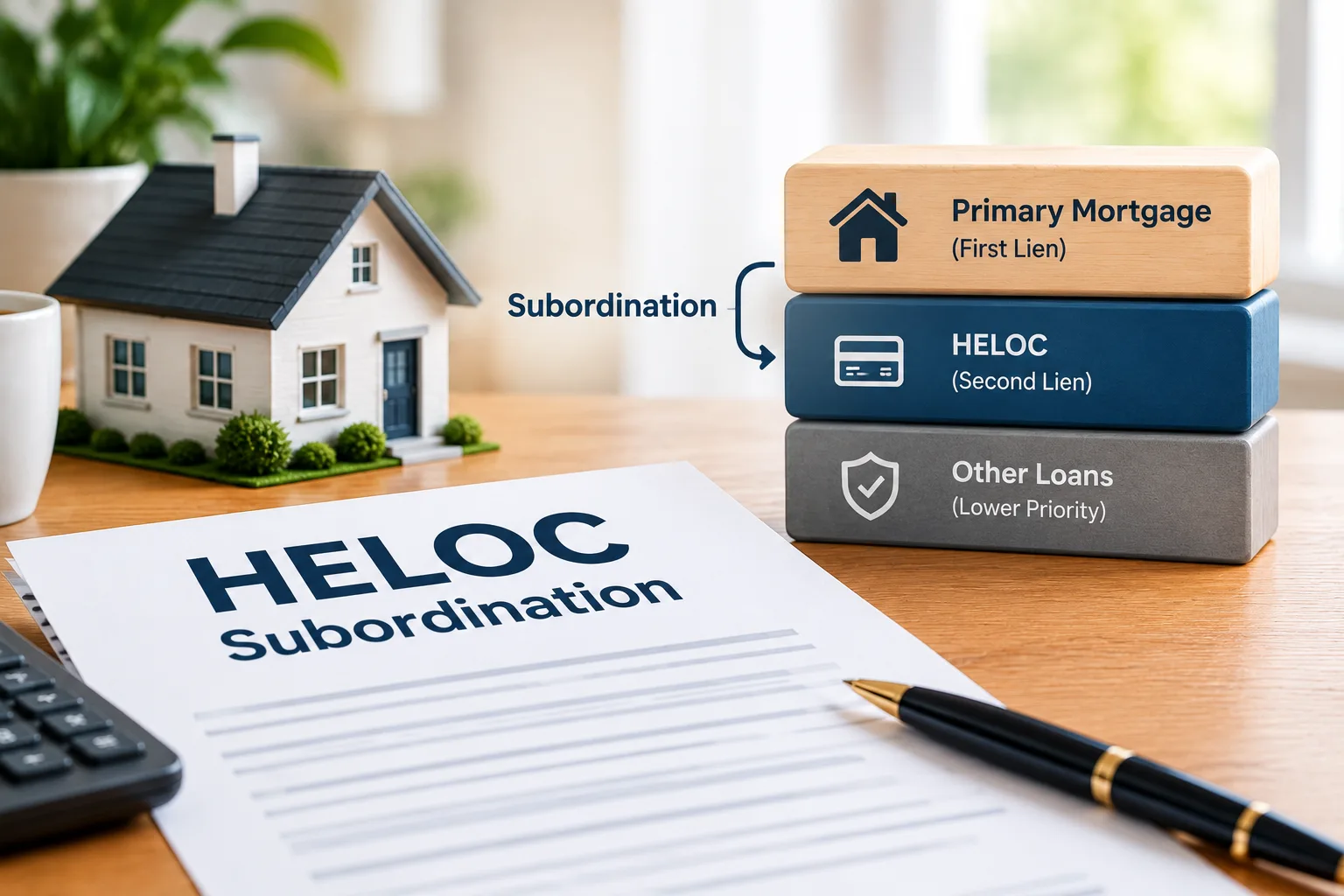
When you take out a mortgage to buy or refinance a home, the lender records a lien against the property. That lien gives the lender the legal right to foreclose and recover its money if you stop paying. The order in which liens are recorded determines their “position”—first, second, third, and so on.
Your primary mortgage is almost always in first position, or “first lien.” This is the loan you used to buy the home, or the loan you refinanced into. Because it was recorded first (and typically represents the largest debt), it has priority.
A HELOC or home equity loan taken out after your first mortgage is typically in second position, or a “junior lien.” If your home were ever foreclosed on and sold, the first-position lender gets paid back in full before the second-position lender sees a dime. Whatever is left over after the first lender is satisfied goes toward the second lien. If there’s nothing left, the second-position lender absorbs the loss.
This hierarchy is why second-position loans—HELOCs, home equity loans, and other junior liens—typically carry higher interest rates than first mortgages. The lender is taking on more risk, and the rate compensates for that.
Lien position isn’t determined by loan type or lender relationship. It’s determined by recording date. The mortgage recorded first with the county gets first position, regardless of loan size or purpose.
Why Refinancing Disrupts Lien Position
Here’s where things get complicated. When you refinance your first mortgage, you’re not modifying your existing loan—you’re paying it off entirely and originating a brand-new loan. That old first mortgage is satisfied and released. A new mortgage is recorded in its place.
Under standard lien priority rules, the new loan would actually be recorded after your existing HELOC, since the HELOC has been sitting on title since before the refinance. That would technically bump your refinanced mortgage into second position and push your HELOC into first position.
This might sound like a technicality that shouldn’t matter much. It matters enormously, and here’s why: virtually no lender will refinance your first mortgage while agreeing to accept second lien position. Lenders originating new first mortgages expect—and require—that priority. A refinance lender is not going to hand you a new $350,000 mortgage and settle for being paid back only after a $50,000 HELOC in a foreclosure scenario. It defeats the entire risk pricing model of a first mortgage.
So without intervention, refinancing your first mortgage while a HELOC is open would either be rejected outright by your new lender, or it would create a lien priority conflict that title insurance companies refuse to insure around.
This is where subordination enters the picture.
What Is HELOC Subordination?
Subordination is the legal and administrative process by which your HELOC lender agrees to voluntarily “step back” and remain in second position, even after your first mortgage has been refinanced with a brand-new loan.
In plain terms: your HELOC lender signs a subordination agreement that says, “We acknowledge you’re refinancing your first mortgage. We agree that our HELOC will remain junior (second) to the new first mortgage, exactly as it was junior to the old one.”
This agreement is recorded with the county alongside your new mortgage, preserving the lien order that existed before the refinance: new first mortgage in first position, HELOC in second position, just like before.
Without this agreement, the new first mortgage lender has no assurance of first-lien status, and as discussed, that’s typically a non-starter for underwriting.
It’s worth emphasizing: subordination doesn’t change your HELOC terms, balance, interest rate, or credit limit. It only affects lien priority. Your HELOC continues operating exactly as it did before—same lender, same account, same draw or repayment terms. The subordination agreement is purely about where it sits in the repayment hierarchy relative to your new first mortgage.
The Subordination Process: Step by Step
Understanding the mechanics helps you anticipate timing and avoid surprises. Here’s how the process typically unfolds.
Step 1: Your Refinance Lender Identifies the HELOC
During underwriting, your new lender pulls a title report that reveals any existing liens on the property, including your HELOC. If a HELOC (or home equity loan) is found in second position, the lender will require a signed subordination agreement from that HELOC lender before closing can proceed.
Step 2: Subordination Request Is Submitted
Either your refinance lender, your title company, or you directly (depending on the process) submits a subordination request to your HELOC lender. This request typically includes:
- Payoff or loan details for the new first mortgage (loan amount, term, lender)
- The current HELOC balance and credit limit
- Property address and borrower information
- Sometimes, an updated appraisal or valuation of the home
Step 3: The HELOC Lender Reviews the Request
This is the step that surprises many homeowners: your HELOC lender is not obligated to approve the subordination. They will conduct their own mini-underwriting review of the request, evaluating factors like:
- Combined loan-to-value (CLTV) ratio: How much total debt (new first mortgage plus HELOC limit) will sit against the home’s current value after the refinance
- Your credit profile: Has your credit score dropped since the HELOC was opened?
- Your payment history: Have you missed payments on the HELOC or other debts?
- The new loan terms: Is the new first mortgage larger than the one it’s replacing? (This matters enormously—more on this below)
Step 4: Approval, Conditional Approval, or Denial
If everything checks out, the HELOC lender issues a subordination agreement, sometimes for a processing fee. If there are concerns, they may approve subject to conditions, such as reducing the HELOC credit limit or requiring a paydown before agreeing to subordinate. In some cases, they deny the request outright.
Step 5: Recording
Once signed, the subordination agreement gets recorded with the county alongside the new mortgage, formally re-establishing the lien order: new first mortgage first, HELOC second.
How Long Does Subordination Take?
This is one of the most consequential practical questions for homeowners, because subordination timelines can make or break a refinance closing date.
Subordination processing times vary widely by lender, from as fast as a few business days to as long as four to six weeks. Several factors influence this:
- Lender responsiveness: Some HELOC servicers have dedicated subordination departments that move quickly. Others treat these requests as low priority, especially if the HELOC is serviced by a different company than the one that originated it.
- Complexity of your file: Straightforward files with strong credit and low CLTV tend to move faster. Files that require additional documentation or manual underwriting take longer.
- Whether an appraisal is required: Some HELOC lenders require a new valuation before agreeing to subordinate, which adds significant time.
- Volume and staffing: During periods of high refinance activity (like rate-drop cycles), subordination departments can become backlogged.
Because of this variability, mortgage professionals generally recommend starting the subordination request as early as possible in the refinance process—ideally the same week you begin your refinance application, not after your new loan has already been approved and you’re racing toward a closing date.
Why HELOC Lenders Sometimes Deny Subordination
Denial is not common, but it happens, and it can be devastating to a refinance timeline if you’re not prepared for the possibility. Here are the primary reasons a HELOC lender might refuse to subordinate.
1. Combined Loan-to-Value Exceeds Their Threshold
This is, by far, the most common reason for denial. HELOC lenders have maximum CLTV limits they’re willing to tolerate—commonly somewhere in the 80% to 90% range, though this varies by lender and by the borrower’s credit profile.
If your home’s value has dropped since you opened the HELOC, or if your new first mortgage is larger than the one it’s replacing (as happens in a cash-out refinance), the combined balance of the new first mortgage plus your HELOC limit might now exceed what the HELOC lender is comfortable subordinating behind.
For example, imagine your home was worth $500,000 when you opened a $60,000 HELOC behind a $350,000 first mortgage—a combined 82% CLTV. If your home’s value has since dropped to $460,000, and you’re refinancing into a new $340,000 first mortgage, your combined CLTV is now roughly 87%. If the HELOC lender’s subordination policy caps CLTV at 85%, they may deny the request or require you to pay down the HELOC balance to bring the ratio back into range.
2. Cash-Out Refinances Increase the New First Mortgage Balance
If you’re doing a cash-out refinance—pulling additional equity out through the new first mortgage—your new loan balance is larger than your old one. This directly increases combined CLTV and is one of the single biggest triggers for subordination denial. HELOC lenders are generally far more willing to subordinate behind a rate-and-term refinance (where the new first mortgage balance is roughly equal to or smaller than the old one) than behind a cash-out refinance that pulls the CLTV higher.
3. Deteriorated Credit Profile
If your credit score has dropped meaningfully since the HELOC was originated, or if you’ve had recent late payments, collections, or other derogatory marks, the HELOC lender may view you as a higher risk than when they first approved you—even though the HELOC terms themselves aren’t changing. A subordination request is, in effect, a fresh risk review.
4. Property Value Decline
Beyond its effect on CLTV, a documented drop in home value independently raises red flags for HELOC lenders, since it reduces their cushion in a foreclosure scenario.
5. Inactive or Underused HELOC Accounts Being Reevaluated
In some cases, HELOC lenders use a subordination request as an opportunity to review dormant accounts and may decide to freeze or reduce the credit line entirely, separate from the subordination decision itself—especially if the line has sat unused for years and market conditions have shifted.
6. Lender-Specific Overlays
Some HELOC lenders simply have stricter internal policies than others, including outright refusal to subordinate behind any cash-out refinance, regardless of CLTV, or minimum credit score requirements that exceed what was required at origination.
What Happens If Subordination Is Denied?
If your HELOC lender denies the subordination request, you have a few paths forward, none of them particularly fun, but all worth understanding.
Option 1: Pay Down the HELOC Balance
If the denial is driven by CLTV, paying down enough of the HELOC balance to bring the combined ratio within the lender’s threshold may resolve the issue. This requires having accessible cash, which not everyone does at exactly the moment they’re trying to refinance.
Option 2: Reduce the HELOC Credit Limit
Even if you don’t owe much on the HELOC, subordination decisions are often based on the credit limit, not just the current balance, because the lender has to account for the possibility you draw the full amount later. Requesting a reduction in your credit limit—even without a balance paydown—can sometimes satisfy CLTV requirements.
Option 3: Pay Off and Close the HELOC Entirely
If your refinance includes enough cash-out capacity, or if you have funds available, paying off the HELOC balance in full and closing the account eliminates the second lien, removing the subordination requirement entirely. This is common when homeowners are consolidating debt through a cash-out refinance anyway.
Option 4: Reduce Your New First Mortgage Amount
If you’re doing a cash-out refinance and the cash-out portion is what’s pushing CLTV too high, scaling back the amount of cash you’re pulling may bring the numbers back into an acceptable range for the HELOC lender.
Option 5: Try a Different HELOC Lender’s Policies (Refinance the HELOC Too)
In some cases, homeowners choose to pay off the existing HELOC using proceeds from a new HELOC or home equity loan taken out after the first mortgage refinance closes—essentially replacing the old second lien with a new one under fresh terms, rather than subordinating the old one.
Option 6: Delay the Refinance
If none of the above are feasible right now, waiting until your home’s value increases, your credit improves, or your HELOC balance decreases naturally through payments may eventually clear the path for subordination.
How Subordination Affects Your Refinance Timeline and Closing
Subordination is frequently the single biggest wildcard in a refinance that involves an existing HELOC. Homeowners often assume that because they’re only refinancing the first mortgage, the HELOC is a non-issue—until their loan officer informs them, sometimes late in the process, that subordination approval is a closing condition.
A few practical realities to know:
Your refinance likely cannot close without it. Title companies generally won’t insure a new first mortgage in first position if there’s an existing second lien that hasn’t been formally subordinated, because doing so would leave open the possibility of a lien priority dispute.
Rate locks can expire while you wait. If your subordination approval takes four to six weeks and your rate lock is only set for 30 days, you may be forced to extend the lock (sometimes for a fee) or re-lock at a potentially less favorable rate.
Appraisal timing matters. If your HELOC lender requires their own valuation as part of the subordination review, this can add real time to an already time-sensitive process.
Multiple parties are coordinating on your behalf, but you should still track it. Your refinance lender, your title/escrow company, and your HELOC servicer are all technically working the request, but coordination between three separate institutions doesn’t always move as smoothly as homeowners expect. Being proactive—confirming status directly with your HELOC lender’s subordination department—can prevent last-minute surprises.
Subordination Fees: What to Expect
Most HELOC lenders charge a processing fee for handling a subordination request, though the amount varies significantly. Fees commonly range from under $100 to several hundred dollars, and in some cases lenders waive the fee entirely for existing customers in good standing. This fee is typically separate from—and in addition to—any closing costs associated with your first mortgage refinance itself, so it’s worth budgeting for as a line item, even though it’s often small relative to overall refinance costs.
Some lenders also require payment of the subordination fee upfront, before they’ll even begin processing the request, so this is worth clarifying early to avoid delays caused by an unpaid invoice sitting in a queue.
Does Subordination Affect Your HELOC Terms?
This is a common point of confusion, so it’s worth stating clearly: subordination, on its own, does not change your HELOC’s interest rate, credit limit, draw period, repayment schedule, or any other loan term. It is purely a lien-priority formality.
However, as discussed above, the subordination review process sometimes results in the HELOC lender requiring changes as a condition of approving subordination—most commonly, a reduced credit limit or a required balance paydown. These changes, if they happen, are a consequence of the review, not an automatic feature of subordination itself.
If your subordination request is approved without conditions, your HELOC continues operating exactly as before, just now sitting behind a new first mortgage instead of the old one.
Subordination vs. Refinancing the HELOC vs. Paying It Off: Comparing Your Options
When homeowners discover they need to deal with subordination, they sometimes wonder whether it’s simpler to just refinance the HELOC along with the first mortgage, or pay it off entirely. Here’s how these options compare.
Subordination keeps your existing HELOC exactly as-is, just repositioned behind the new first mortgage. This is typically the fastest and cheapest option when approval isn’t in question, since it doesn’t require originating a new loan.
Paying off and closing the HELOC eliminates the second lien issue and can be efficient if you have a cash-out refinance generating enough proceeds to cover the payoff, or if you have separate funds available. The tradeoff is losing access to that credit line going forward, which may or may not matter depending on whether you still want revolving access to your equity.
Combining your first mortgage and HELOC into one new first mortgage (sometimes called a “cash-out refinance to consolidate”) rolls both debts into a single new loan, eliminating the second lien and the subordination question, at the cost of potentially refinancing HELOC debt (often used for renovations, debt consolidation, or other purposes) into a long-term, fully amortizing mortgage—which can mean paying interest on that balance over 15 or 30 years instead of the shorter HELOC repayment period.
Opening a new HELOC after refinancing means paying off the old HELOC (if required) and applying for a new one once the first mortgage refinance has closed. This resets the process and terms entirely and means going through full underwriting again, but may make sense if your existing HELOC lender’s subordination terms are unfavorable and another lender offers better ongoing terms.
Special Considerations for Different Types of Refinances
Rate-and-Term Refinance
This is generally the most straightforward scenario for subordination. Since you’re not increasing your first mortgage balance significantly, the combined CLTV with your HELOC typically doesn’t shift much from what it was originally, making approval more likely and paperwork usually lighter.
Cash-Out Refinance
As discussed, this is where subordination denials are most common, since pulling additional cash out through the new first mortgage directly increases the combined loan balance against the home’s value. If you’re pursuing a cash-out refinance with an existing HELOC in place, it’s worth having a contingency plan (like being prepared to reduce the cash-out amount) in case the HELOC lender pushes back.
Streamline Refinance Programs (FHA, VA)
Streamline refinance programs are designed for speed and reduced documentation, but they don’t eliminate the subordination requirement if a HELOC is in second position. Homeowners using these programs sometimes assume the “streamlined” nature of the process extends to the HELOC subordination step—it doesn’t. The HELOC lender still conducts its normal review.
Refinancing With the Same Bank That Holds Your HELOC
If your first mortgage and HELOC happen to be with the same financial institution, the subordination process can sometimes move faster, since there’s internal coordination rather than communication between two separate lenders. It’s not guaranteed to be faster, but it’s worth asking about, since some banks offer expedited internal handling for existing customers refinancing in-house.
Common Mistakes Homeowners Make With HELOC Subordination
Not disclosing the HELOC early in the refinance application. Some homeowners don’t realize their HELOC needs to be flagged upfront, assuming the lender will simply discover it during title search. While that’s true, discovering it late in the process—rather than accounting for subordination timing from day one—can add weeks to your closing timeline unnecessarily.
Assuming subordination approval is automatic. Many homeowners treat subordination as a rubber-stamp formality. It isn’t. Treating it as a real underwriting step, with its own potential for denial, helps you plan realistically.
Not confirming subordination status independently. Relying entirely on your refinance lender or title company to track subordination progress can leave you in the dark. Calling your HELOC servicer’s subordination department directly for status updates is a reasonable and often necessary step.
Locking a rate without buffer time for subordination delays. If you know your HELOC lender has a reputation for slow processing, locking a rate with minimal buffer can leave you exposed to a lock expiration if subordination drags on.
Not asking about subordination fees upfront. Small, but avoidable surprise costs can add friction to an already stressful process.
Ignoring how a cash-out refinance might affect subordination approval odds. Homeowners planning a large cash-out refinance sometimes don’t realize until deep into the process that their HELOC lender may balk at the resulting CLTV.
Frequently Asked Questions
Does subordination affect my credit score?
The subordination process itself doesn’t directly affect your credit score, though the HELOC lender’s review may include a credit inquiry, which could have a minor, typically temporary impact.
Can I request subordination before I’ve chosen a refinance lender?
Generally, no. Subordination requests require specific details about the new first mortgage (loan amount, lender, terms), so this step happens after you’ve applied with and been approved by a refinance lender, not before.
What if I have a home equity loan instead of a HELOC?
The subordination process is essentially identical for home equity loans (which have a fixed balance and fixed payments) as it is for HELOCs (which are revolving lines of credit). Both are junior liens requiring subordination when the first mortgage is refinanced.
Is subordination required if I’m refinancing with the same lender that holds my first mortgage?
Yes. Subordination is required any time the first mortgage is being paid off and replaced with a new loan, regardless of whether the new lender is the same as the old one, because a new lien is being recorded.
Can my HELOC lender charge whatever fee they want for subordination?
Fees vary by lender and aren’t heavily regulated the way some other mortgage fees are, so it’s worth asking upfront what the fee will be and whether it’s negotiable or waivable.
What happens to my HELOC’s draw period if I refinance my first mortgage?
Nothing—subordination doesn’t affect your HELOC’s draw or repayment period. Those terms remain governed by your original HELOC agreement.
Final Thoughts
HELOC subordination sits in an awkward blind spot for a lot of homeowners: it’s not something most people think about when they decide to refinance, but it can single-handedly determine whether that refinance closes on schedule, closes at all, or requires last-minute financial gymnastics to salvage.
The core takeaway is this: if you have an open HELOC or home equity loan and you’re planning to refinance your first mortgage, treat subordination as a parallel process that needs attention from day one—not an afterthought your lender will “just handle.” Understand your combined loan-to-value ratio going in, be realistic about how a cash-out refinance might affect subordination approval odds, and stay in direct contact with your HELOC servicer’s subordination department rather than assuming updates will flow to you automatically.
Handled proactively, subordination is usually a manageable, if slightly bureaucratic, box to check. Handled reactively—discovered three weeks before closing—it can turn a straightforward refinance into a stressful scramble. Knowing what’s coming is the difference between the two.