
Introduction
When homeowners refinance, they tend to fixate on the numbers that are easy to compare: the new interest rate, the monthly principal and interest payment, and the closing costs due at signing. What frequently gets overlooked—until it shows up as an unpleasant surprise weeks or months later—is what happens to the escrow account.
Escrow changes after a refinance are one of the most common sources of confusion and frustration among borrowers, precisely because they don’t show up clearly in the “rate and payment” conversation most homeowners have with their loan officer. You can refinance into a lower interest rate, see your principal and interest payment drop exactly as promised, and still end up with a total monthly mortgage payment that’s higher than before—because the escrow portion changed. You can also be blindsided by a large, unexpected cash requirement at closing to fund a brand-new escrow account, even though you had a healthy escrow balance with your old lender the day before.
None of this is a scam, a lender error, or a hidden fee in the shady sense. It’s simply how escrow accounting works when you pay off a mortgage and replace it with a new one. But because it’s rarely explained clearly, it remains one of the most under-discussed costs of refinancing. This guide walks through exactly what happens to your escrow account during a refinance, why it happens, what it costs, and how to avoid being caught off guard.
What Is an Escrow Account, and Why Do You Have One?
Before diving into what changes, it’s worth grounding the basics. An escrow account (sometimes called an impound account, depending on the region) is a reserve account your mortgage servicer maintains to pay certain recurring property-related expenses on your behalf—most commonly property taxes and homeowners insurance premiums, and sometimes mortgage insurance or flood insurance if applicable.
Instead of paying your property tax bill and insurance premium in large lump sums once or twice a year, your lender collects a portion of these costs each month as part of your regular mortgage payment. That money sits in the escrow account until the bills come due, at which point your servicer pays them directly on your behalf.
Lenders favor this setup because it guarantees that property taxes and insurance policies remain up to date, safeguarding the collateral securing the loan. Borrowers also gain from this arrangement, as it breaks substantial annual or semi-annual costs into manageable, steady monthly installments, eliminating the burden of a massive single payment when tax bills arrive.
An escrow account is typically mandatory for conventional loans with equity under 20%, as well as for all FHA and USDA loans regardless of equity level. Conversely, borrowers with higher equity in conventional loans—or those with VA loans—may be eligible to opt out of escrow and handle tax and insurance payments directly, though this generally depends on fulfilling specific lender requirements and may incur a slight rate adjustment.
Why Refinancing Disrupts Your Escrow Account
Here’s the core issue that catches so many borrowers off guard: refinancing doesn’t modify your existing mortgage—it pays it off in full and replaces it with an entirely new loan, often from a different lender or servicer, but even when it’s the same one.
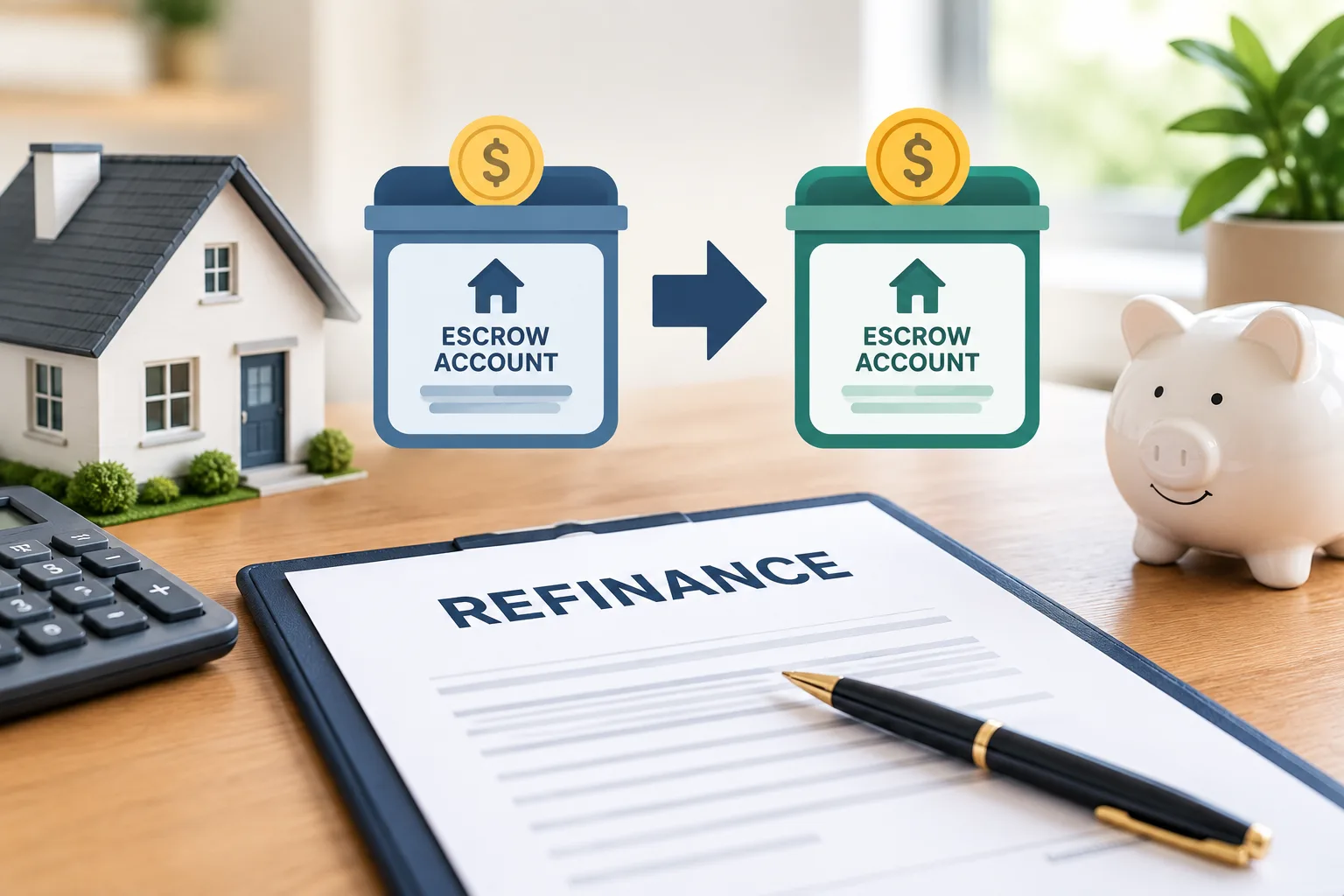
Because the old loan is being paid off completely, its associated escrow account is also closed out. That account doesn’t simply transfer over to the new loan. Instead, two separate things happen:
- Your old escrow balance gets refunded to you (with some important timing caveats, covered below).
- Your new loan requires a brand-new escrow account to be established from scratch, funded at closing.
This is where the “surprise cost” comes in. Homeowners are essentially required to fund a new reserve account before they’ve received the refund from their old one, creating a temporary—and sometimes significant—cash flow gap.
How a New Escrow Account Gets Funded at Closing
When your new lender sets up your escrow account, they don’t start it at zero and simply begin collecting monthly going forward. Instead, they’re required to build in a cushion upfront, so the account has enough funds to cover upcoming tax and insurance bills even if those bills come due before enough monthly payments have accumulated.
This upfront amount is calculated based on:
- Your property tax cycle: When your taxes are due and how much time remains before the next bill.
- Your insurance renewal date: Whether your homeowners insurance premium is due soon after closing.
- A legally permitted cushion: Federal regulations (specifically RESPA, the Real Estate Settlement Procedures Act) allow lenders to collect up to two months’ worth of escrow payments as a cushion, in addition to the amounts needed to cover taxes and insurance due before enough monthly collections have built up.
In practice, this often means borrowers are required to bring several months’ worth of estimated property tax and insurance payments to closing, sometimes totaling thousands of dollars, on top of standard closing costs like origination fees, appraisal costs, and title fees.
For example, if your annual property tax bill is $6,000 and your homeowners insurance premium is $1,800, your new lender might need to collect enough at closing to ensure roughly six to eight months of taxes and two to three months of insurance are already sitting in the account before your first regular monthly payment is even due. Depending on timing, that could mean bringing several thousand dollars to the closing table specifically for escrow funding, separate from any other closing costs.
The Refund Timing Gap: Why This Feels Like Double-Paying
The part that frustrates borrowers most isn’t that a new escrow account needs to be funded—most people intellectually understand that taxes and insurance need to be covered somehow. It’s the timing mismatch between paying into the new account and getting the old one refunded.
Here’s the typical sequence:
- You close on your refinance and, as part of that transaction, fund a new escrow account (often a few thousand dollars, depending on your tax and insurance costs).
- Your old loan is paid off, and your old servicer closes out your prior escrow account.
- Your old servicer is required to refund your remaining escrow balance—but this refund isn’t automatic or instantaneous.
Under RESPA rules, once your old servicer processes the loan payoff, they generally have a limited window (commonly around 20 business days, though this can vary) to return any remaining escrow balance to you, typically via a mailed check.
So for a period that can range from a couple of weeks to over a month, you may have effectively paid into two escrow accounts: funding the new one at closing while waiting for the old servicer to return what was sitting in the previous one. If your old escrow balance was, say, $2,500, and your new escrow funding requirement was $3,000, you’ve temporarily got $5,500 tied up in the process, even though you’ll eventually get the $2,500 back.
This isn’t a fee you’re permanently out—the refund is legally required and does show up eventually. But the cash flow timing can catch homeowners off guard, especially if they didn’t budget for having that much cash unavailable during the transition period.
Why Doesn’t the Old Escrow Balance Just Transfer to the New Loan?
This is one of the most common questions borrowers ask, and it’s a reasonable one. If you’re refinancing with the same lender, it can feel especially strange that the escrow balance doesn’t simply carry over.
The answer comes down to how mortgage payoffs and originations are structured, even when handled by the same institution. A refinance is legally treated as paying off one loan in full and originating an entirely separate loan, even if it’s with the same servicer. Each loan has its own escrow account tied specifically to that loan’s terms, payment schedule, and payoff date. There’s no standard mechanism to simply “carry forward” a balance from a closed account to a newly originated one, even internally.
Some lenders, particularly when refinancing in-house with the same servicer, may offer smoother handling or even apply old escrow funds toward new escrow funding requirements as part of the closing transaction—but this isn’t universal, and borrowers shouldn’t assume it will happen automatically. It’s worth explicitly asking your loan officer whether this is an option if you’re refinancing with your current servicer.
What Determines How Much You’ll Need to Fund the New Escrow Account?
Several factors influence exactly how much cash you’ll need to bring to closing to fund your new escrow account:
Timing relative to your tax bill. If your property tax bill is due shortly after your closing date, your new lender needs to collect enough to cover that bill in full, since not enough time will have passed to build it up through monthly payments alone. Refinancing right before a tax bill is due tends to require larger upfront escrow funding than refinancing right after one has just been paid.
Timing relative to your insurance renewal. Similarly, if your homeowners insurance premium is due for renewal soon, your new escrow account needs enough cushion to cover that cost.
The cushion allowed by RESPA. As mentioned, lenders can build in up to two months of additional cushion beyond the minimum required, and most do take advantage of this to some degree, which increases the upfront funding requirement.
Whether you’re also paying mortgage insurance or flood insurance through escrow. If your loan requires private mortgage insurance (PMI), an FHA mortgage insurance premium, or flood insurance, these also get built into the new escrow calculation, increasing the total upfront amount.
State and local property tax cycles. Some states bill and collect property taxes twice a year, others annually, and the specific due dates vary by county, all of which affect how much cushion is needed at any given point in the year.
A Realistic Example
Let’s walk through a simplified example to make this concrete.
Imagine you’re refinancing in March. Your annual property tax bill of $7,200 is due in two installments, one in April and one in October. Your homeowners insurance premium of $2,400 renews in June.
Because your April tax installment ($3,600) is coming due almost immediately after closing, your new lender needs to have that covered right away—there’s no time to collect it gradually through monthly payments first. They’ll also start collecting toward your October installment and your June insurance renewal, plus a cushion of up to two months.
Your old servicer, meanwhile, may have already been holding several months’ worth of escrow collections toward that same April tax bill—money that’s about to become a refund check heading your way, but not fast enough to help you cover the new account’s funding requirement at closing.
The practical result: you might need several thousand dollars in escrow funding at your refinance closing, on top of your standard closing costs, and you’ll be waiting several weeks for a refund check from your old servicer to help offset that outlay.
How This Affects Your “Cash to Close” Calculations
This is where the surprise really lands for a lot of borrowers. When shopping for a refinance, most people focus on their loan estimate’s summary of closing costs—origination fees, appraisal, title insurance, and so on. Escrow funding requirements are included in the loan estimate (federal disclosure rules require this), but they’re often glossed over or misunderstood because they’re technically a “prepaid” cost rather than a traditional fee, and borrowers assume prepaids are smaller than they often turn out to be.
If you’re refinancing with plans to roll closing costs into the new loan balance (a “no-cost” or low-cash-to-close refinance), it’s worth checking specifically whether your lender allows escrow funding to be rolled in as well, or whether it must be paid out of pocket regardless. Policies vary, and this is a critical detail to nail down before you commit to a closing date, especially if your available cash is tight.
Does Refinancing With the Same Lender Avoid This Problem?
Not necessarily, though it can sometimes reduce friction. As discussed above, even an in-house refinance is typically processed as paying off one loan and originating a new one, meaning a new escrow account technically still needs to be established.
That said, some lenders do offer smoother internal processes for existing customers refinancing with them directly—potentially applying old escrow funds toward the new account’s funding requirement as part of the same transaction, reducing or eliminating the “double funding” gap. This isn’t guaranteed, and it varies significantly by lender, but it’s worth asking directly: “If I refinance with you, can my existing escrow balance be applied toward funding the new escrow account instead of being refunded and re-collected separately?”
Escrow Analysis and Payment Shifts: Why Your New Payment Might Not Match What You Expected
Beyond the funding-at-closing issue, there’s a second, related surprise many borrowers encounter: their new monthly mortgage payment doesn’t match what they mentally calculated based on the new interest rate alone.
This happens because your total monthly mortgage payment isn’t just principal and interest—it’s principal, interest, taxes, and insurance (often abbreviated PITI) when escrow is involved. Even if your principal and interest payment drops significantly due to a lower rate, your escrow portion is recalculated independently, based on current property tax and insurance costs, not the numbers from when your old loan was originated.
If your property’s assessed value has increased since your last loan (triggering higher property taxes), or if your homeowners insurance premium has gone up (which has been common in many markets due to rising replacement costs and, in some regions, insurer pullback), your new escrow portion could be meaningfully higher than what you were paying before—even though nothing about your refinance directly caused those increases.
This means a borrower can refinance into a lower rate, see their principal and interest payment drop by, say, $150 a month, but see their total payment drop by only $40 a month, or in some cases barely change at all, because the escrow portion absorbed the difference. In markets with fast-rising property taxes or insurance costs, some borrowers have even seen their total payment increase slightly despite refinancing into a lower rate, purely due to the escrow recalculation.
This isn’t something your refinance caused directly—your taxes and insurance would have gone up regardless of whether you refinanced—but the refinance is often the moment those increases become visible, since a fresh escrow analysis is being run as part of setting up the new account. It’s worth asking your loan officer for a clear breakdown of new principal-and-interest versus new estimated escrow, rather than just the bottom-line total payment, so you understand exactly where the number is coming from.
What Happens to Your Old Escrow Refund, Step by Step
Understanding the refund process in detail helps set realistic expectations for timing.
Loan payoff is processed. Once your refinance closes and your old loan is paid off in full, your prior servicer processes the payoff and formally closes the loan.
Escrow account reconciliation. The old servicer calculates the final balance in your escrow account—essentially, whatever was sitting there after the last disbursements for taxes and insurance, minus anything that still needed to be paid out before closing.
Refund issuance. Federal servicing rules generally require the refund to be issued within a defined window after the account is closed, commonly cited as around 20 business days, though this can vary by servicer and by state-specific regulations, which sometimes impose shorter or additional requirements.
Check delivery. Most servicers mail a physical check to your address on file, rather than depositing funds electronically, which can add a few more days for postal delivery on top of the processing window.
If you haven’t received your escrow refund within what feels like a reasonable window (generally, if it’s been more than a month), it’s worth contacting your prior servicer directly to check on status, since checks occasionally get sent to outdated addresses or delayed due to processing backlogs.
Common Escrow-Related Surprises Borrowers Report
Beyond the core funding-gap issue, a few related surprises come up repeatedly among borrowers who’ve been through a refinance.
Being asked to fund an escrow account despite having waived escrow on the old loan. If you previously qualified to pay taxes and insurance directly (no escrow) on your old mortgage, that waiver doesn’t automatically carry over to a new loan. Your new lender independently evaluates escrow waiver eligibility, and requirements (like a minimum equity threshold) may mean you’re required to escrow on the new loan even if you weren’t before—especially if your new loan-to-value ratio is different from your old one, or if the new lender has stricter waiver policies.
Escrow shortage notices shortly after refinancing. If your new escrow account was underfunded relative to actual tax or insurance costs (sometimes due to estimates that didn’t perfectly match final bills), you may receive a shortage notice within the first year, requiring either a lump-sum payment or an increased monthly payment to cover the gap. This is a normal part of annual escrow analysis but can feel like an unwelcome surprise so soon after refinancing.
Confusion when two servicers both show activity around the same tax bill. If your refinance closes close to a tax due date, it’s possible for both your old and new servicer to show escrow activity related to the same tax cycle, creating confusion about who actually paid the bill. This is usually resolved through standard payoff and closing procedures, but it can cause a stressful few weeks of uncertainty if you’re checking both accounts closely.
Insurance company confusion during the transition. Because your escrow account (and the servicer paying your insurance premium) changes, it’s not uncommon for insurance companies to send notices to the old servicer or otherwise create administrative confusion during the transition. Proactively notifying your insurance company of the refinance and new servicer/loan information can help prevent a lapse in coverage or payment mix-ups.
How to Prepare Financially for Escrow Changes When Refinancing
Given how commonly this catches borrowers off guard, a bit of proactive preparation goes a long way.
Ask for a detailed breakdown of estimated escrow funding at closing, not just a total closing cost figure. Your loan estimate will include this, but ask your loan officer to walk through it specifically, so you understand how much of your “cash to close” is escrow-related versus traditional fees.
Time your refinance around your tax and insurance cycle when possible. If you have flexibility on timing, closing shortly after a tax installment has been paid (rather than right before one is due) can reduce the upfront escrow funding requirement, since less needs to be collected immediately.
Budget for a temporary cash flow gap, not just the net cost. Even though your old escrow balance will eventually be refunded, plan as though that money is unavailable for several weeks after closing, rather than assuming it offsets your new funding requirement in real time.
Confirm your mailing address is current with your old servicer. Since escrow refunds are typically mailed as physical checks, an outdated address can add unnecessary delay.
Ask whether escrow funding can be rolled into the loan. Some lenders allow this, particularly on refinances where the borrower prefers to minimize cash due at closing, though it does increase your loan balance slightly.
Directly ask if you’re refinancing with your existing servicer whether old escrow funds can offset new funding requirements. As discussed, this isn’t universal, but it’s worth asking rather than assuming it’s not possible.
Review your new escrow analysis carefully within the first year. Since initial escrow accounts are based on estimates, watch for a shortage or surplus notice in the months following your refinance, and understand that a shortage isn’t necessarily an error—it may simply reflect updated tax or insurance costs.
Escrow Waivers: Can You Avoid This Entirely by Not Escrowing on the New Loan?
For borrowers who want to sidestep escrow account complications altogether, waiving escrow (where eligible) is worth considering when refinancing—though it comes with its own trade-offs.
Eligibility for an escrow waiver typically depends on factors like your loan-to-value ratio (often requiring 20% or more equity for conventional loans), loan type (FHA and USDA loans generally don’t allow waivers at all; VA loans sometimes do), and lender-specific policies. Some lenders also charge a small rate premium (often a fraction of a percentage point) in exchange for allowing an escrow waiver, since the lender takes on slightly more risk that a borrower could fail to pay taxes or insurance directly and in full.
If you do successfully waive escrow, you avoid the entire funding-gap issue described in this article, but you take on full personal responsibility for paying property taxes and insurance directly and on time, in potentially large lump sums, without your lender’s built-in payment structure. For some borrowers—particularly those who are disciplined savers and prefer to earn interest on their own tax reserves rather than have that money sit in a non-interest-bearing escrow account—this tradeoff is worth it. For others, the forced structure of escrow is a helpful guardrail against accidentally missing a large annual tax bill.
What If You’re Refinancing More Than Once (Refinancing an Already-Refinanced Loan)?
If this isn’t your first refinance, it’s worth knowing that the same escrow funding and refund cycle repeats every time you refinance, regardless of how many times you’ve been through it before. There’s no cumulative benefit or reduced funding requirement just because you’ve refinanced previously—each transaction is treated independently, with its own new escrow account, its own funding requirement, and its own refund process for whatever loan is being paid off.
Borrowers who refinance frequently to chase rate drops should factor this recurring cash flow gap into their calculations each time, rather than assuming it’s a one-time cost they’ve already accounted for.
Frequently Asked Questions
Will I definitely get my old escrow balance back?
Yes. Any remaining balance in your escrow account after your loan is paid off and all outstanding disbursements are made is legally required to be refunded to you. It’s your money; escrow is just a holding mechanism, not an additional cost paid to the lender.
How long does it typically take to receive an escrow refund after a refinance?
This varies by servicer, but a commonly cited window is around 20 business days after the loan payoff is processed, sometimes longer depending on internal processing times and mailing.
Can I ask my old servicer to speed up the refund process?
You can ask, but servicers are generally following standard procedural timelines and may not be able to expedite significantly. Confirming your correct mailing address in advance is one of the more effective things you can do to avoid unnecessary delay.
Is escrow funding at closing considered a “closing cost”?
Technically, it’s categorized as a “prepaid” item rather than a traditional closing cost/fee, but it still represents real cash you need to bring to the transaction, and it’s included in your total cash-to-close figure on your loan estimate and closing disclosure.
Can I use my old escrow refund to help pay my new escrow funding requirement?
Only if the timing happens to align, which it often doesn’t, since the refund typically arrives weeks after closing, while the new account needs to be funded at closing itself. In rare cases where you’re refinancing with the same servicer, ask whether they can apply old funds directly rather than issuing a refund and requiring fresh funding.
Why did my new escrow payment come out higher than my old one, even though my interest rate went down?
This is almost always due to updated property tax or insurance cost estimates in your new escrow analysis, not anything to do with your interest rate. Your total payment reflects current taxes and insurance costs, which may have risen since your last loan was originated.
Does this apply to all types of refinances, or just certain ones?
It applies broadly to rate-and-term and cash-out refinances alike, and to essentially any transaction where your existing mortgage is paid off and replaced with a new one, provided your new loan requires (or you choose) an escrow account.
Final Thoughts
Escrow account changes are one of the more mechanical, paperwork-driven aspects of refinancing, which is probably why they don’t get much attention compared to interest rates and monthly payments. But the financial impact is real: a temporary cash flow gap while funding a new account and waiting on a refund from the old one, and a total monthly payment that may not drop as much as expected once updated tax and insurance costs are factored in.
None of this should necessarily talk you out of refinancing if the underlying math—rate, term, and long-term savings—still works in your favor. But going in with clear eyes about how escrow will be handled, what cash you’ll need at closing beyond standard fees, and roughly when to expect your old balance back, turns what could be a stressful surprise into a manageable, anticipated part of the process. Asking your loan officer for a specific breakdown of prepaid escrow costs—rather than just a bottom-line closing cost number—is one of the simplest ways to walk into your refinance closing without an unwelcome surprise waiting at the table.