
Introduction
When a small business needs cash fast, a home equity line of credit can look like the easiest door in the building. The rates are usually lower than a business credit card, the application is faster than an SBA loan, and if you’ve owned your home for a while, the money might already be sitting there, untapped, waiting.
That ease is exactly what makes a HELOC dangerous as a business funding tool. It’s not that a HELOC can’t work for a business — plenty of owners have used one successfully. It’s that the risks are structurally different from any other form of business financing, and most homeowners don’t find that out until they’re already several draws deep.
As of mid-July 2026, the average HELOC adjustable rate sits at 7.23%, tied to a prime rate that’s held at 6.75% for months. Compare that to SBA 7(a) loans, which currently run between 9.75% and 14.75%, or online business term loans, which can charge anywhere from 14% to over 99% APR. On paper, the HELOC wins on price every time. But price is only one variable in a decision that puts your home, not your business, on the line if things go wrong.
This article breaks down exactly what changes when you use home equity for business purposes — legally, financially, and practically — and the specific risks that don’t show up in the marketing materials.
How a HELOC for Business Actually Works
A HELOC is a revolving line of credit secured by the equity in your home. Structurally, nothing about it changes when you use the money for a business instead of a kitchen remodel. The lender doesn’t require a different product, and in most cases, doesn’t even ask what the funds are for once the line is open.
That’s part of the problem. HELOCs are underwritten as consumer products. Approval is based on your personal credit score, your home’s loan-to-value ratio, and your personal debt-to-income ratio — not your business’s revenue, profitability, or cash flow. A lender will hand a HELOC to a business owner running at a loss just as readily as one running at a healthy margin, as long as the homeowner’s personal financials check out.
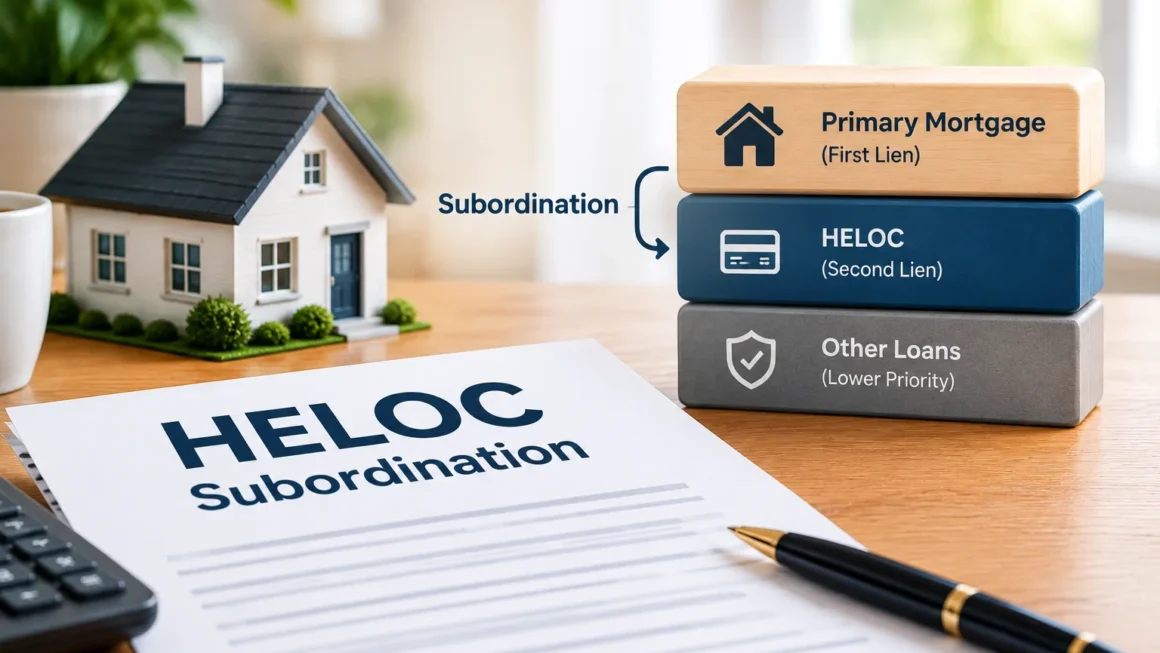
This creates a mismatch: you’re financing a business asset (inventory, equipment, payroll, marketing) with a personal liability secured by your house. Every other form of business financing — SBA loans, business lines of credit, equipment financing — is underwritten against the business itself. A HELOC is underwritten against you and your home. When the business struggles, that difference becomes very real, very fast.
The Basic Mechanics
| Feature | How It Works |
| Collateral | Your home (second lien behind your primary mortgage) |
| Underwriting basis | Personal credit, income, and home equity — not business performance |
| Draw period | Typically 10 years; you borrow and repay as needed |
| Repayment period | Typically 10–20 years after the draw period ends |
| Interest rate | Variable, tied to prime; built from the prime rate plus a lender margin based on credit profile |
| Current average rate | 7.23% adjustable (Curinos, July 2026) |
| Typical use restriction | None — most lenders don’t monitor or restrict fund use |
Why Homeowners Reach for a HELOC Instead of Business Financing
Before getting into the risks, it’s worth understanding why this happens so often. It’s rarely recklessness — it’s usually the path of least resistance.
Speed. A HELOC can close in two to four weeks. An SBA 7(a) loan can take one to three months, sometimes longer, with substantially more documentation.
Rate. A HELOC at roughly 7.23% looks unbeatable next to a business line of credit charging 10% to 99% APR or an online term loan in the same range.
Access. Many small businesses — especially sole proprietorships, newer LLCs, or businesses without two full years of tax returns — simply don’t qualify for conventional business financing yet. A HELOC doesn’t care how old the business is.
Simplicity. There’s no business plan requirement, no collateral audit on business assets, no personal guarantee paperwork beyond what’s already implied by using your home.
Every one of these advantages is real. None of them cancel out what you’re trading away to get them.
Risk #1: You’re Converting Business Risk Into Personal Risk
This is the risk that matters most and gets talked about least.
If a business loan fails — an SBA loan, a business line of credit, even most equipment financing — the consequences generally stay inside the business. The lender may go after business assets, and if you signed a personal guarantee, they can pursue you personally, but there’s a process, and in many structures (particularly with an LLC or corporation properly maintained), your home isn’t the first thing at risk.
A HELOC skips that separation entirely. The moment you draw HELOC funds into your business, you’ve already converted business risk into home risk — no lawsuit, no personal guarantee negotiation required. Miss payments because the business had a bad quarter, and the lender’s path to your home is the same as if you’d missed payments on a kitchen renovation. There’s no legal buffer, no LLC shield, no “the business defaulted, not me” argument. You defaulted, personally, on a loan secured by your house.
This is the single biggest thing homeowners overlook. They think of the HELOC as “business capital,” but the lender only ever sees it as a home-secured personal debt. If the business fails, the debt doesn’t fail with it.
Risk #2: Foreclosure Is a Real, Not Theoretical, Outcome
Because a HELOC is a lien on your home — typically in second position behind your primary mortgage — falling behind on payments can lead to foreclosure just like missing mortgage payments would.
Business cash flow is inherently less predictable than a paycheck. A slow season, a lost client, a late-paying invoice, an inventory bet that didn’t pay off — all normal parts of running a business — can directly translate into missed HELOC payments. Unlike a business credit card or unsecured loan, where a missed payment damages your credit and triggers collections, a missed HELOC payment starts a clock that can end with you losing your home.
A realistic example:
Say you draw $60,000 from a HELOC at 7.23% to buy inventory and cover a marketing push. During the interest-only draw period, your monthly payment is roughly $362 (interest only, on the full $60,000 balance). That feels manageable. But if the business underperforms and you can’t repay principal, you enter the repayment period still owing $60,000 — now amortizing over 15–20 years at a rate that resets periodically with prime. A rate move of even 1–2 percentage points, layered onto a business that’s already struggling to generate the cash to repay it, is how HELOC-funded businesses turn into foreclosure cases.
This isn’t a fringe scenario. It’s the predictable result of financing a volatile-income venture with a fixed monthly obligation secured by the place you live.
Risk #3: HELOC Interest May Not Be Tax-Deductible the Way You Assume
This is one of the most common — and most costly — misunderstandings homeowners bring into this decision.
Since the Tax Cuts and Jobs Act (and its continuation under the One Big Beautiful Bill Act framework through 2026), HELOC interest is only deductible as mortgage interest if the funds were used to buy, build, or substantially improve the home securing the loan. Money used to fund a business does not qualify for the home-mortgage-interest deduction, full stop, regardless of what the money is technically borrowed against.
However — and this is the part that trips people up in the other direction — if you use HELOC funds for legitimate business purposes and can trace and document that use, the interest may be deductible as a business expense instead, under ordinary tracing rules. But this deduction lives on your business’s books (Schedule C, partnership return, or corporate return), not your Schedule A as mortgage interest. That distinction matters for:
- Documentation. You need to prove the funds went to the business, not personal spending, with clean records and ideally a dedicated business account the HELOC funds were transferred into.
- Mixed use. If you draw $50,000 and use $30,000 for business and $20,000 for a personal expense, only the business-use portion is a business deduction — and none of it qualifies as mortgage interest since it wasn’t used to improve the home.
- Entity structure. How the deduction flows depends on whether you’re a sole proprietor, LLC, S-corp, or partnership, and whether the loan is properly documented as a capital contribution or loan to the business.
Homeowners who assume “it’s my house, so it’s mortgage-deductible” and don’t separate or document the business use correctly can lose the deduction entirely — paying full after-tax interest on a loan that could have offset business income if it had been tracked properly from day one. This is a case where working with a CPA before you draw the funds, not after, materially changes the after-tax cost of the loan.
Risk #4: Lenders Can Freeze or Reduce Your Line Without Warning
HELOC agreements typically give lenders the right to freeze, reduce, or suspend your credit line if your home’s value drops, your credit score declines, or broader economic conditions shift. This isn’t rare boilerplate — it happened at scale during the 2008 financial crisis and again during regional banking stress in more recent years.
For a business, this is uniquely dangerous because it can happen at the exact moment you need the line most. If your business is going through a rough patch — the same rough patch that might be dinging your personal credit score because you’ve been juggling payments — that’s precisely when a lender is statistically more likely to review and restrict your line. You could plan your working capital around a $75,000 available line and find out mid-crisis that the lender has cut it to $20,000, with no negotiation and limited recourse.
A dedicated business line of credit or SBA loan doesn’t eliminate this risk, but the terms are typically more transparent and contractually fixed for the term of the loan, especially with SBA products, which come with structured, published rate caps and clearer covenant terms.
Risk #5: Variable Rates Meet Variable Revenue
HELOCs are typically variable-rate products, with rates tied to the prime rate and moving as the Federal Reserve adjusts the federal funds rate. As of mid-2026, the Fed has held the federal funds rate at 3.50%–3.75% for four consecutive meetings, with prime holding at 6.75%, and the median policymaker projection points to rates ending the year near 3.8%, with more officials expecting a hike than a cut.
That means the direction of rates over the life of a multi-year HELOC draw is genuinely uncertain — and business revenue is even less predictable than interest rates. Pairing two volatile, uncorrelated variables (rate cost and business income) is a fundamentally riskier structure than financing that fixes one side of the equation.
Compare this to an SBA 504 loan, which is currently priced between 6.17% and 6.20%, fixed for the life of the loan — a structure built specifically so a business owner’s largest fixed asset purchases aren’t exposed to rate swings. A HELOC offers no equivalent protection unless you specifically seek out one of the less common fixed-rate HELOC products, which typically carry a rate premium and stricter draw limits.
Rate Comparison: HELOC vs. Business Financing Options (July 2026)
| Financing Type | Typical Rate Range | Rate Structure | Secured By |
| HELOC | ~7.43% average ($30K line) | Variable, tied to prime | Your home |
| Home equity loan | ~7.36% average | Fixed | Your home |
| SBA 7(a) loan | ~9–11.5% variable, 9.5–13.5% fixed | Fixed or variable | Business assets + personal guarantee |
| SBA 504 loan | 6.17%–6.20% | Fixed | Business real estate/equipment |
| SBA microloan | 8%–13% | Fixed | Business assets |
| Bank term loan | 6.8%–11% | Fixed or variable | Business assets |
| Business line of credit | 10%–99% | Variable | Business assets/unsecured |
| Online term loan | 14%–99% | Fixed | Varies, often unsecured |
| Equipment financing | 4%–45% | Fixed | The equipment itself |
The takeaway isn’t that HELOCs are always the wrong choice on rate — they’re frequently the cheapest option available. It’s that “cheapest” and “safest” are two different questions, and this table only answers the first one.
Risk 6: You Lose the Legal Separation an LLC Is Supposed to Provide
Many small business owners form an LLC or corporation specifically to separate personal and business liability. Using a HELOC to fund that business quietly undermines the purpose of that structure.
Here’s the mechanism: when you personally borrow against your home and inject that cash into your LLC (as a loan or capital contribution), you’ve created a personal debt that exists independently of the business entity. Even if the business is sued, goes bankrupt, or dissolves, your HELOC obligation to the bank doesn’t dissolve with it. You’re still on the hook, personally, secured by your home — the exact outcome an LLC is designed to prevent.
Some business owners try to address this by properly documenting the HELOC draw as a formal loan from the owner to the LLC, with a promissory note and interest terms, so the business technically owes the money back to the owner. This can help with bookkeeping, tax treatment, and clarity — but it does nothing to change your personal liability to the HELOC lender. The lender’s claim against your home is unaffected by however you’ve structured things internally with your own business.
Risk 7: Underestimating How the Draw Period Ends
HELOCs typically have a 10-year draw period followed by a repayment period, often 10–20 years, during which you can no longer draw new funds and must begin repaying principal and interest.
Business owners frequently plan around the draw period’s low interest-only payments without fully modeling what happens when the draw period ends — sometimes called “HELOC reset shock.” If you’ve been making interest-only payments on a $75,000 balance at roughly 7.23%, that’s about $452/month. Once the repayment period begins and you’re amortizing that same balance over, say, 15 years, the payment can jump to $680–$750/month or more, depending on the rate at that time — a jump that lands regardless of whether the business is thriving or still finding its footing.
Business financing built for business purposes (SBA loans, term loans) is generally structured with amortization from day one, so there’s no repayment cliff waiting at the end of a multi-year runway. That predictability has real value that a lower headline rate doesn’t capture.
Risk 8: It Complicates a Future Home Sale or Refinance
A HELOC used for a home improvement adds value to the same asset securing the debt. A HELOC used for a business does not — you’ve increased debt against your home without increasing your home’s worth. If your business needs multiple draws over several years, that gap between “money owed against the house” and “value of the house” can widen in a way that limits your options later.
This matters concretely if you want to sell your home, refinance your primary mortgage, or take out a future home equity loan for something else (renovation, a child’s education, retirement planning). A large outstanding HELOC balance from business use reduces your available equity for all of those future needs, and it must be paid off (or the lender’s consent obtained) at closing if you sell — sometimes at an inconvenient moment if the business hasn’t yet generated the cash to pay it down.
Risk 9: No Business Credit Building Happens
One underrated cost of using a HELOC instead of business financing: it does nothing to build your business’s credit profile. Every payment on time strengthens your personal credit, not your business’s ability to borrow independently in the future.
This matters more than it seems. A business that never establishes its own credit history stays permanently dependent on the owner’s personal credit and personal collateral for every future financing need — including the day you might actually want to sell the business, bring on a partner, or separate personal and business finances cleanly. Business owners who use SBA loans, business credit cards, or vendor trade lines instead build an asset (business creditworthiness) that a HELOC-funded business never accumulates.
When a HELOC for Business Might Actually Make Sense
None of this means a HELOC is never appropriate for business funding. It can be a reasonable tool when:
- The amount is modest and short-term, with a clear, near-certain repayment source (e.g., bridging a 60-day gap before a contracted payment arrives).
- You have significant home equity and a financial cushion outside the business — meaning a business downturn wouldn’t threaten your ability to make HELOC payments from other income.
- You’ve been declined for business-specific financing due to time in business, but have a well-documented plan for repayment and have run the numbers on worst-case scenarios, not just best-case ones.
- You fully understand and accept that you are personally, and specifically your home, taking on the business’s risk — not hedging it.
Even in these cases, most fee-only financial advisors recommend keeping HELOC-funded business exposure to a small percentage of your total home equity, and having a specific, written plan for repayment that doesn’t depend on the business succeeding.
HELOC vs. SBA Loan vs. Business Line of Credit: A Side-by-Side Look
| Factor | HELOC | SBA 7(a) Loan | Business Line of Credit |
| Collateral | Your home | Business assets + personal guarantee | Business assets, sometimes unsecured |
| Approval basis | Personal credit + home equity | Business financials + credit | Business revenue + credit |
| Typical timeline | 2–4 weeks | 30–90+ days | Days to 2 weeks |
| Current rate range | ~7.43% variable | ~9–13.5% | 10%–99% |
| Foreclosure risk on default | Yes — your home | No — business assets/guarantee pursued first | No — business assets, unless personally guaranteed with collateral |
| Builds business credit | No | Yes | Yes |
| Interest deductibility | Only as business expense if properly traced; not mortgage interest | Business expense deduction | Business expense deduction |
| Best suited for | Homeowners with strong equity and a low-risk, short-term need | Established businesses with 2+ years of financials | Businesses needing flexible, recurring working capital |
Questions to Ask Before You Draw a HELOC for Your Business
- If the business generated zero income for six months, could I still make the HELOC payments from other sources? If the honest answer is no, the risk is likely too concentrated.
- Have I talked to a CPA about how to document the draw so the interest qualifies as a business deduction? Undocumented business use of a HELOC can mean losing a deduction you were entitled to.
- What does my payment look like once the draw period ends and I start amortizing the balance? Model this now, not when it happens.
- Am I comfortable that a business failure could mean losing my home, not just my business? This is the question that gets skipped most often, and it’s the one that matters most.
- Have I actually compared this to SBA or bank financing, or did I default to the HELOC because it was fastest? Speed is a real advantage, but it shouldn’t be the only factor weighed.
Frequently Asked Questions
Can I get in trouble for using a HELOC for business purposes if the lender approved it as a home equity product? Generally, no — most HELOC agreements don’t restrict how you use the funds once drawn, and lenders rarely monitor use closely after closing. The risk isn’t legal trouble with the lender; it’s the financial exposure of having your home as collateral for a business-related debt.
Is HELOC interest ever deductible for business use? It can be deductible as a business expense (not as home mortgage interest) if you can clearly trace the funds to legitimate business use and document it properly. This typically requires separating the funds into a dedicated business account and working with a tax professional to structure the loan correctly on your books.
What happens to my HELOC if my business fails? The HELOC obligation doesn’t fail with the business. You remain personally responsible for repaying the balance, and the lender’s lien on your home remains in place regardless of what happens to the business entity.
Is a HELOC better than a business credit card for funding a business? It depends on the amount and timeline. HELOCs typically offer lower rates and larger available credit, but they put your home at risk. A business credit card carries higher rates but keeps the risk contained to your credit profile rather than your house, and helps build business credit.
Can I use a HELOC as a down payment or bridge for an SBA loan? Some business owners do this, but it stacks two forms of debt — one secured by the home, one against the business — and increases total monthly obligations. It’s worth modeling the combined payment carefully before committing to both.
Should I use a HELOC to cover payroll during a slow season? This is one of the higher-risk uses of a HELOC, since payroll is a recurring obligation, not a one-time investment. If the slow season continues, you’re financing an ongoing operating shortfall with a lien on your home — worth discussing with a financial advisor before proceeding, and worth examining whether the underlying cash flow issue needs a structural fix rather than a financing patch.
Bottom Line
A HELOC can be one of the cheapest sources of capital available to a small business owner, and for the right situation — modest amount, short timeline, strong financial cushion — it can work well. But it’s the only common form of business financing where a downturn in your business can put your home, not just your business, on the line. Before drawing on home equity for business needs, it’s worth running the numbers on business-specific financing first, understanding exactly how the tax treatment works, and being honest about whether your business’s cash flow can support the payment in a bad year, not just a good one.