Introduction
If you already have a home equity line of credit open, you’ve probably noticed your payment doesn’t sit still the way a fixed-rate mortgage payment does. That’s not a mistake or a lender error — it’s the defining feature of a HELOC, and in 2026, it’s become a much bigger deal than in the low-rate years many homeowners opened their lines in.
The Federal Reserve held its benchmark rate steady at 3.50%–3.75% at its June 2026 meeting — the fourth consecutive hold — but the more important story wasn’t the hold itself. It was what came with it. The Fed’s updated projections showed the median policymaker now expects the federal funds rate to end 2026 near 3.8%, up sharply from the 3.4% projected back in March, with nine of eighteen officials penciling in at least one rate hike this year. For homeowners who assumed 2026 would bring relief in the form of rate cuts, that’s a meaningful reversal — and if you have an existing HELOC, it shows up directly in your monthly bill.
This article walks through exactly how rate movements — up, down, or sideways — flow through to an existing HELOC, what’s different about 2026’s rate environment compared to prior years, and what homeowners with open lines should actually be doing about it right now.
Why HELOCs Move With the Fed in the First Place
To understand what’s happening to your HELOC in 2026, it helps to understand the mechanical link between Fed policy and your rate.
HELOCs are built from the prime rate — currently 6.75% — plus a margin set by the lender based on your credit profile, loan-to-value ratio, and risk assessment. The prime rate itself is not set directly by the Fed, but it moves in lockstep with the federal funds rate: when the Fed adjusts its target range, banks almost universally adjust prime by the same amount, typically within a day or two.
So the chain looks like this:
Fed changes federal funds rate → Prime rate moves by the same amount → Your HELOC’s variable rate adjusts at its next reset → Your monthly payment changes
This is fundamentally different from a fixed-rate mortgage, where your rate is locked for the life of the loan regardless of what the Fed does afterward. It’s also different from a fixed-rate home equity loan, where the rate is set once at closing and doesn’t move with prime. A HELOC — which most homeowners hold as a variable-rate product — is designed to track the Fed in near real time, for better or worse.
The Direct Chain of Command
| Step | What Happens |
| 1 | FOMC meets (8 times per year) and sets the federal funds target range |
| 2 | Banks adjust the prime rate to match, usually within 1–3 business days |
| 3 | Your HELOC’s index (tied to prime) resets |
| 4 | Your interest rate adjusts, typically at your next billing cycle |
| 5 | Your monthly payment recalculates based on the new rate and current balance |
There’s no lag of months here the way there sometimes is with, say, adjustable-rate mortgages that reset annually. Most HELOCs reprice essentially in real time with prime, meaning a Fed decision in June can show up on your July statement.
Where Rates Actually Stand in 2026
It’s worth being precise about the current environment, because “rates are high” and “rates are uncertain” are two different problems, and 2026 has delivered both.
The Fed has not cut rates at all in 2026 as of mid-year, holding the target range at 3.50%–3.75% since the fourth quarter of 2025. That’s a sharp change in trajectory from 2025, when the Fed cut rates three times — in September, October, and December — after a run that brought the funds rate down 175 basis points from its 2023 peak of 5.25%–5.5%.
As a direct result, HELOC rates have been essentially flat and elevated all year. As of mid-July 2026:
- The average HELOC adjustable rate sits at 7.23%, with the 2026 low of 7.19% recorded back in mid-May.
- Bankrate’s broader national survey puts the average HELOC rate slightly higher, at 7.43% for a $30,000 line.
- Fixed-rate home equity loans, for comparison, average 7.36%, up from a 2026 low of 7.31% in late June.
- Rates vary considerably by lender and borrower profile — homeowners report seeing anywhere from nearly 6% to as much as 18%, depending on creditworthiness.
What makes 2026 genuinely unusual isn’t just where rates sit — it’s the direction of the forecast. Heading into the year, most homeowners with variable-rate HELOCs were expecting relief. Instead:
- A Fed rate hike in 2026 was considered extremely unlikely as of earlier this year, with futures markets pricing the probability at just 2–5% per meeting.
- That changed by mid-year. Following the June meeting, traders began pricing in the possibility of a hike as early as October, and the removal of the Fed’s prior “bias toward cuts” language signaled a genuine shift in posture.
- The June “dot plot” — the Fed’s internal projection tool — revealed real disagreement among officials, with nine of eighteen members now favoring at least one hike before year-end.
This is a genuinely two-sided risk environment: some forecasters still expect a cut, some now expect a hike, and the Fed itself, under new leadership, has stopped signaling a clear direction. That uncertainty is exactly what makes an existing HELOC harder to plan around in 2026 than in a normal cutting or hiking cycle, where the trend line is at least predictable.
What Rising Rates Do to an Existing HELOC
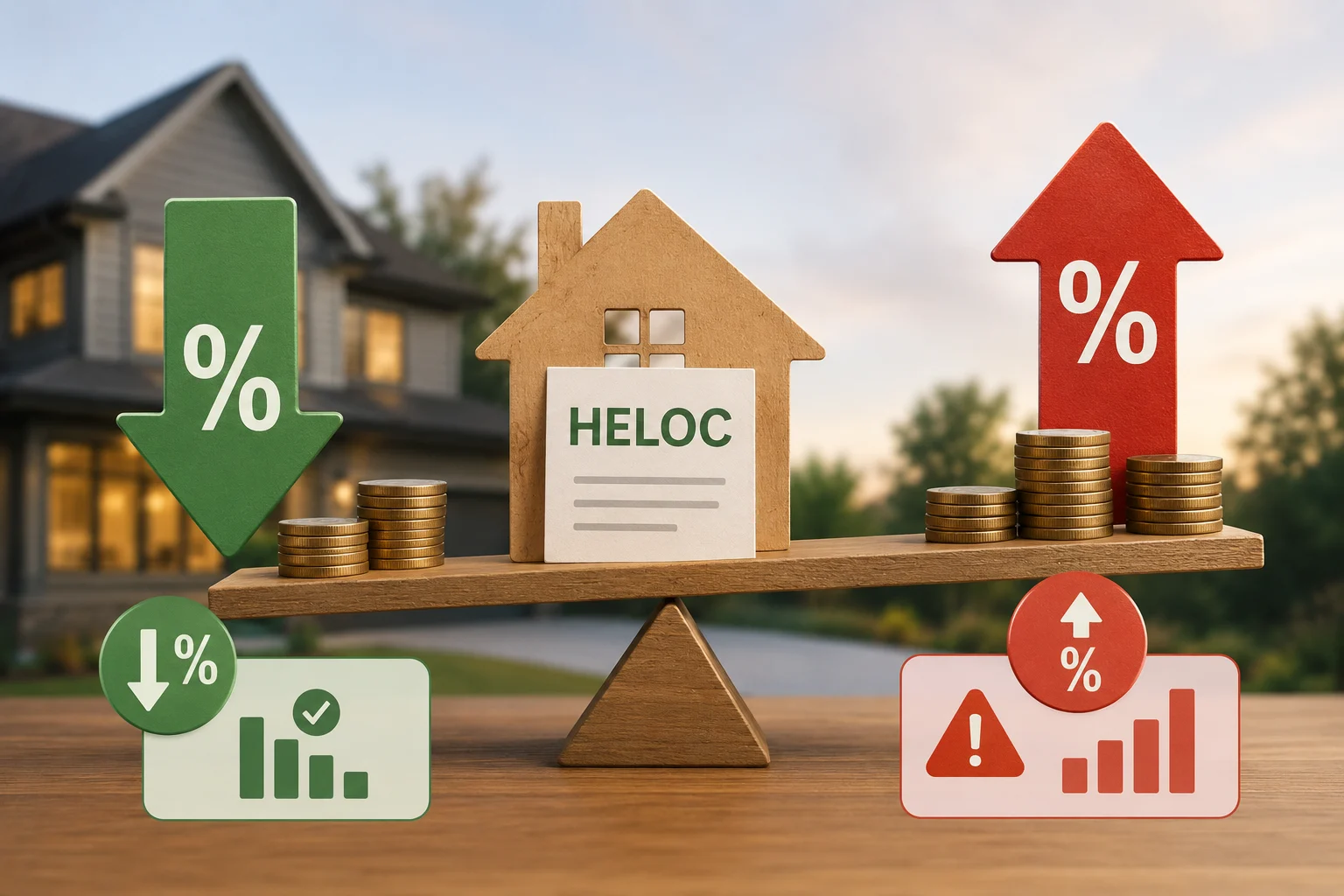
If the Fed does move to a hike later in 2026 — which, per the Fed’s own June projections, roughly half of officials now think is warranted — here’s exactly what happens to a line you already have open.
1. Your Interest Rate Increases at the Next Reset
Most HELOCs adjust monthly or at each billing cycle, tied to prime. A 25 basis point (0.25%) Fed hike translates to a 25 basis point increase in your HELOC rate, typically within one to two billing cycles.
2. Your Payment Increases — Even If Your Balance Doesn’t Change
This is the detail that catches people off guard. You don’t need to draw more money for your payment to go up. If you’re in the draw period making interest-only payments, your payment is a direct function of your outstanding balance times your current rate. Raise the rate, raise the payment, with zero change in how much you’ve borrowed.
Example: You’re carrying a $50,000 HELOC balance during the interest-only draw period.
| Rate | Monthly Interest-Only Payment |
| 7.23% (current average) | $301 |
| 7.48% (+25 bps) | $312 |
| 7.98% (+75 bps) | $333 |
| 8.73% (+150 bps) | $364 |
A relatively modest 150 basis point increase — well within the range some Fed officials are now discussing for 2026 — adds roughly $63/month, or about $756/year, without you borrowing another dollar.
3. If You’re in the Repayment Period, the Effect Compounds
Once your draw period ends and you’re amortizing principal and interest, a rate increase raises both your interest cost and stretches out how much of each payment goes toward principal — meaning you pay down the balance more slowly at a higher total cost, unless your payment is recalculated (as most are) to keep you on the original amortization schedule, in which case the payment itself simply rises further.
Example: $50,000 balance, 15-year repayment period.
| Rate | Monthly P&I Payment |
| 7.23% | $457 |
| 7.98% | $477 |
| 8.73% | $497 |
4. Your Available Credit Isn’t Directly Affected — But Your Approved Limit Might Be
Rate increases don’t automatically reduce your credit line the way a home value drop can trigger a lender freeze. However, rising rates often coincide with tighter underwriting broadly, and if your lender conducts a periodic review of your account (common practice for open lines), a higher-rate environment combined with any softening in your credit profile or home value can increase the odds of a reduction.
What Falling Rates Do to an Existing HELOC
The mechanics work identically in reverse, and it’s worth walking through because the “when” matters as much as the “how much.”
1. Your Rate Decreases at the Next Reset
Same mechanism, opposite direction. If the Fed delivers the one additional cut some forecasters expect — most likely a 25 basis point move bringing the target range to 3.25%–3.50% — that would flow through to prime and, from there, to your HELOC rate within one to two cycles.
2. Your Payment Drops Without You Doing Anything
This is the upside version of the earlier example. On that same $50,000 interest-only balance:
| Rate | Monthly Interest-Only Payment |
| 7.23% (current) | $301 |
| 6.98% (-25 bps) | $291 |
| 6.48% (-75 bps) | $270 |
3. It Doesn’t Retroactively Reduce What You’ve Already Paid
A common misconception: falling rates only affect payments going forward. If you locked in a higher payment during a rate spike and diligently paid it, that money is gone — a rate cut doesn’t refund past interest; it only lowers what you owe from that point forward.
4. Falling Rates Can Be a Good Window to Reassess Your Strategy
If rates head down meaningfully, it can be a reasonable moment to evaluate whether converting some or all of your variable HELOC balance to a fixed-rate option (many lenders offer a fixed-rate conversion feature on a portion of the balance) makes sense — locking in a lower rate before market conditions shift again, rather than riding the variable rate indefinitely.
Why 2026 Is a Genuinely Unusual Year to Be Holding a HELOC
Most rate-and-HELOC content assumes a clear trend: rates are cutting, or rates are hiking, and you plan accordingly. 2026 doesn’t offer that clarity, and that ambiguity is itself the risk worth understanding.
Consider how much the outlook has shifted over just the first half of the year:
- December 2025: Fed officials projected one 25 basis point cut for 2026, alongside forecasts for 2.4% GDP growth and 2.7% year-end inflation.
- April 2026: The Fed held rates again, with market desk surveys still showing an expectation of two 25 basis point cuts over the following year, though pushed later into Q3/Q4 2026 and Q1 2027 than previously modeled.
- June 2026: Under new Fed Chair Kevin Warsh — whose first meeting as chair concluded with a hold and language changes signaling openness to hikes — the committee’s median projection jumped to 3.8% by year-end, implying at least one hike, with the “bias toward cuts” language removed from the official statement entirely.
- Present (July 2026): Forecasters remain split: roughly 55–65% of market participants still expect one final cut this year, bringing the range to 3.25%–3.50%, while 30–40% now think the Fed holds through year-end, and a smaller but real probability sits on a hike materializing.
For a homeowner with an existing HELOC, this means the usual advice — “rates are falling, ride the variable rate” or “rates are rising, lock in fixed now” — doesn’t cleanly apply. The honest answer in 2026 is that the direction is genuinely uncertain, which changes the calculus toward risk management rather than rate prediction.
What’s Driving the Uncertainty
A few factors explain why 2026 has been such a pivot year:
- Leadership change. Former Chair Jerome Powell’s term expired May 15, 2026, and the transition to a new chair has come with a genuinely different policy posture than markets initially priced in.
- Inflation stickiness. Officials have pointed to an inflation spike tied partly to energy and supply pressures connected to geopolitical tension in the Middle East, complicating the case for cuts.
- Growth resilience. GDP growth projections have actually risen through the year (to 2.4% for 2026), which reduces the urgency for the kind of rate cuts that typically accompany a slowing economy.
- A wide range of internal Fed opinion. The June dot plot showed real dispersion among the 18 FOMC participants — not the kind of consensus that makes near-term policy easy to predict.
How This Compares to Fixed-Rate Alternatives
If you’re evaluating whether to keep riding a variable HELOC rate through this uncertainty or convert to something fixed, here’s how the current landscape breaks down.
| Product | Current Rate | Rate Movement Risk | Best Fit |
| Variable-rate HELOC | ~7.23% average | High — moves with Fed decisions | Homeowners comfortable with payment variability, expecting rates to hold or fall |
| Fixed-rate home equity loan | ~7.36% average | None — locked at closing | Homeowners who want payment certainty and have a lump-sum need |
| Fixed-rate HELOC conversion (partial) | Typically a premium over the variable rate, less common option | None on converted portion | Homeowners who want to lock in part of a balance without closing the whole line |
| New HELOC draw during uncertainty | ~7.43% national average | High | Homeowners opening a new line who accept variability for lower initial cost |
The rate premium for locking in certainty (moving from HELOC variable to home equity loan fixed) is currently narrow — roughly 0.65 percentage points as of early July — which is smaller than it’s been in some past cycles. That narrow spread is worth factoring in: in years where fixed options carry a much larger premium over variable, riding the variable rate makes more sense on cost grounds alone. In 2026, with the premium this tight and the rate direction this uncertain, the case for paying a little more for certainty is stronger than usual.
What Homeowners With Existing HELOCs Should Actually Do in 2026
1. Know Your Reset Schedule
Check your HELOC agreement or account portal for exactly how often your rate adjusts — most reset monthly with the billing cycle, but confirm this rather than assuming. Knowing your reset cadence tells you how quickly a Fed decision will show up in your actual payment.
2. Model Your Payment at a Range of Rates, Not Just the Current One
Don’t budget around today’s 7.23% average as if it’s fixed. Given the current environment, it’s worth stress-testing your budget against both a 100 basis point increase and a 50 basis point decrease, so neither scenario catches you unprepared.
3. Understand Where You Are in the Draw vs. Repayment Timeline
If you’re approaching the end of your draw period, rate uncertainty compounds with the separate “reset shock” of shifting from interest-only to full amortization. Model both changes together, not separately — the combined effect is often larger than homeowners expect.
4. Consider a Partial Fixed-Rate Conversion
Many HELOC lenders allow you to lock a portion of your outstanding balance into a fixed rate while leaving the rest variable. With the fixed-vs-variable spread currently narrow, this can be a reasonable middle ground — certainty on the portion you’re least able to absorb rate swings on, flexibility on the rest.
5. Avoid New Large Draws Until the Fed’s Direction Clarifies
If you have discretion over the timing of a planned draw, drawing into a genuinely two-sided rate environment carries more risk than drawing during a clear cutting or hiking cycle. If the draw isn’t urgent, it may be worth waiting for more clarity from upcoming FOMC meetings and inflation data before committing to a large balance at today’s uncertain trajectory.
6. Revisit Your Rate Cap and Floor Terms
Many HELOC agreements include a lifetime rate cap (and sometimes a floor) that limits how high or low your rate can go regardless of Fed movement. If you haven’t reviewed this since opening the line, it’s worth pulling your agreement and confirming what your actual worst-case payment could look like.
7. Watch the Same Data the Fed Is Watching
Upcoming CPI and PCE inflation reports, along with jobless claims data, are the specific inputs the Fed has said will determine whether it holds, cuts, or hikes at its next meetings. Homeowners with meaningful HELOC balances have a direct financial reason to track these releases the same way markets do.
A Broader Historical Note: This Isn’t the First Volatile HELOC Year
It’s worth some context. The federal funds rate peaked at 5.25%–5.5% in July 2023 — the highest since 2006 — after a rapid hiking cycle to combat post-pandemic inflation. The Fed then held steady until September 2024, when it began cutting: 50 basis points that month, then 25 in November, then 25 in December — followed by three more 25-point cuts across September, October, and December of 2025.
Homeowners who opened HELOCs near the 2023 peak have already lived through a full swing from a near-9% average rate down toward today’s 7.23% — proof that these lines genuinely do move meaningfully over a multi-year draw period, in both directions. The current pause-with-hike-risk environment is, in that sense, just the next chapter of a cycle that’s already demonstrated real volatility. What’s different about 2026 specifically is the direction has flipped from broadly predictable (cuts, cuts, cuts) to genuinely contested for the first time in this cycle.
Frequently Asked Questions
How quickly does a Fed rate change show up in my HELOC payment? Most HELOCs reprice at the next billing cycle after prime adjusts, which itself typically moves within a day or two of a Fed decision. In practice, expect a change within one to two billing statements of an FOMC announcement.
Does the Fed holding rates steady mean my HELOC rate stays the same? Generally yes, if your rate is purely tied to prime and prime hasn’t moved. However, some lenders periodically re-underwrite your margin based on your updated credit profile or home value, which can change your effective rate even without a Fed move.
If the Fed cuts rates later in 2026, will my HELOC rate drop automatically? Yes, assuming your HELOC’s index is tied to prime, which nearly all are. You don’t need to request anything — the rate adjusts on its own at your next reset once prime moves.
Should I refinance my HELOC into a fixed-rate home equity loan right now? It depends on your risk tolerance and the current rate spread. With the fixed-vs-variable gap currently around 0.65 percentage points, converting is relatively inexpensive insurance against further uncertainty, but it also means giving up the chance to benefit if the Fed ultimately cuts. This is a decision worth running past a financial advisor given your specific balance and timeline.
Can my HELOC rate rise even if I don’t draw any new funds? Yes. Your rate is tied to the index (prime), not your draw activity. An existing balance repriced at a higher rate produces a higher payment regardless of new borrowing.
What’s the maximum my HELOC rate could go to? Check your original loan agreement for a lifetime cap — most HELOCs include one, though the specific ceiling varies significantly by lender and originating credit profile. If you can’t locate it, your lender or loan servicer can provide the exact terms.
Is now a bad time to open a new HELOC given the uncertainty? Not necessarily — current average rates around 7.23% are close to the 2026 low of 7.19%, so pricing isn’t unusually elevated. The bigger question is your comfort with payment variability over the draw period given a genuinely two-sided rate outlook, not the entry price itself.
Bottom Line
An existing HELOC is one of the few loans where a headline about the Federal Reserve translates directly into a different number on your monthly statement — often within weeks. In 2026, that connection matters more than usual, because the Fed’s own signals have shifted from a fairly confident cutting path into genuine internal disagreement about whether the next move is a cut or a hike. Homeowners carrying a variable-rate balance should model their payment across a real range of outcomes, understand exactly when and how their rate resets, and take a hard look at whether locking in some certainty — through a fixed-rate conversion or otherwise — is worth the modest premium given how unsettled the rate path looks for the rest of the year.